Tuberculosis Study Guide - M.M. Savula 2002
Methods of Tuberculosis Diagnosis
Tuberculin diagnostics
Tuberculin Skin tests are a specific diagnostic tool used for mass screening of children and adolescents for tuberculosis (mass or preventive tuberculin testing), as well as for the Diagnosis, Cytology/practical/136.html">Differential diagnosis OF tuberculosis, and determination of disease activity (individual or diagnostic tuberculin testing).
FAP healthcare workers are primarily involved in mass tuberculin testing. It is administered to BCG-vaccinated children starting from 12 months of age and repeated annually, regardless of previous test results. For children who were not vaccinated with BCG at birth due to medical contraindications, the Mantoux test is performed twice a year starting from 6 months of age, prior to tuberculosis immunization.
The purpose of mass tuberculin testing:
- early detection of tuberculosis;
- identifying children at high risk of developing tuberculosis;
- selecting cohorts for BCG revaccination;
- determining infection rates as an epidemiological indicator.
For mass tuberculin testing, purified protein derivative (PPD) in standard dilution is used, where 0.1 ml of solution contains 2 TU (tuberculin units). Tuberculin is prepared from a mixture of killed human and bovine strains of mycobacteria; this preparation contains neither live nor dead mycobacteria, but only metabolic products and Cell components. The active component of tuberculin consists of Proteins (tuberculoproteins) that act as incomplete Antigens.
Tuberculin is supplied in 3 or 5 ml ampoules as a clear liquid. It is stored for up to a year at temperatures between +2 and +8 °C in a dark place. For mass tuberculin testing, an intradermal Mantoux test with 2 TU is performed. FAP staff order tuberculin from the SES based on the number of children aged 12 months and older in their service area. One ampoule of tuberculin (3 ml) is ordered per 15 children.
Mantoux Test Technique. Before performing the tuberculin test, the healthcare worker must thoroughly read the instructions included in each box of tuberculin. Only personnel who have completed special training at a TB dispensary and obtained an annually renewed permit are authorized to perform the test. Disposable 1-ml tuberculin syringes with 0.1-ml graduations are used. The syringe must not leak solution past the plunger or around the needle hub. A separate syringe and needle must be used for each child. After wiping the ampoule with alcohol and opening it, draw 0.2 ml of tuberculin solution, then expel air and excess liquid down to the 0.1 ml mark. Wipe the skin on the anterior surface of the forearm with 70% alcohol, stabilize it with the left hand, insert the needle bevel up strictly intradermally (just enough to cover the bevel), and inject 0.1 ml of the solution (Fig. 13). Correct technique produces a white wheal ('lemon peel' appearance) 7-8 mm in diameter, which quickly resolves. Opened tuberculin may be stored under aseptic conditions for up to 2 hours. Below is the step-by-step Procedure for a healthcare worker performing the Mantoux test.
Class="center">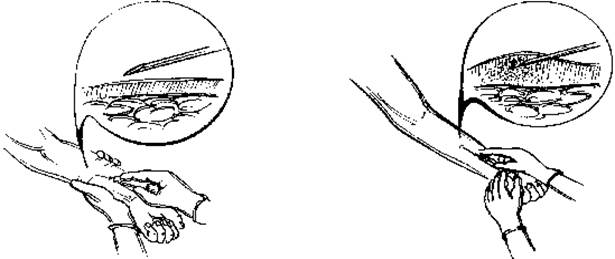
Fig. 13. Mantoux test technique.
Performing the Mantoux Test
|
Required Materials |
Procedure Steps |
|
1. Tuberculin in standard dilution in ampoules 2. Sterilizing drum (bix) with cotton balls 3. Ethyl alcohol 70% 4. Disposable 1-ml tuberculin syringes with 0.1-ml graduations 5. Injection needles No. 0845 for drawing tuberculin 6. Injection needles No. 0415 for intradermal injections 7. Anatomical forceps |
1. Sanitize hands, ask the patient to sit down 2. Inspect the tuberculin ampoule, check the expiration date, and wipe the neck of the ampoule with a cotton ball moistened with 70% alcohol 3. Score the neck of the ampoule with an ampoule file and snap it off 4. Using a sterile disposable syringe with needle No. 0845, draw 0.2 ml (2 doses) of tuberculin solution from the ampoule 5. Replace the needle with the finer No. 0415 needle, expel air and excess solution down to the 0.1 ml mark 6. Wipe the skin on the inner surface of the middle third of the forearm with 70% ethyl alcohol, then dry with a sterile cotton ball 7. Insert the needle bevel up into the Superficial layer of the skin, parallel to its surface, until the needle bevel is completely covered 8. Inject exactly 0.1 ml of tuberculin solution intradermally. This will produce a white wheal ('lemon peel' appearance) 7-8 mm in diameter |
Tuberculin testing may only be performed in healthcare facilities, designated rooms in kindergartens or schools, or at FAPs; performing it at home is strictly prohibited. Tuberculin tests are always administered during the same season—either spring or autumn—prior to other vaccinations, using the right forearm in even-numbered years and the left forearm in odd-numbered years.
Interpretation. Mantoux test results are evaluated after 72 hours. A transparent, colorless ruler is used to measure the transverse diameter of the resulting papule (induration) perpendicular to the long axis of the forearm (Fig. 14 - see Appendix). Erythema (redness) is recorded only in the absence of a papule. It is forbidden to use thermometer scales, graph paper, or homemade rulers for measurement. The possible reactions to the Mantoux test are as follows:
- negative: no papule or erythema, though a needle prick reaction of up to 1 mm may be present;
- doubtful (equivocal): a papule of 2-4 mm or erythema of any size without a papule;
- positive: a papule of 5 mm or larger;
- strongly positive (hyperergic): a papule of 17 mm or larger in children and adolescents, or 21 mm or larger in adults. A reaction is also classified as hyperergic if vesicles (blisters) or lymphangitis develop, regardless of the size of the induration.
Contraindications for the Mantoux test during mass screening include skin diseases, acute infections, and exacerbations of chronic illnesses (until clinical symptoms resolve), allergic conditions (Bronchial Asthma, idiosyncrasies with pronounced cutaneous manifestations), acute and subacute phases of rheumatic fever, and Epilepsy. Children who do not receive the Mantoux test due to contraindications are tested individually at a pediatric clinic or FAP once the contraindications have resolved.
The results of the Mantoux test in children and adolescents attending childcare or educational institutions are recorded in Log Form No. 063/o and the child's medical record (Form No. 026/o); for non-enrolled children, they are recorded in Log Form No. 063/o and the child's developmental history (Form No. 112/o). The entry must include: a) the manufacturer of the tuberculin, batch/series number, control number, and expiration date; b) the date of the tuberculin test; c) whether the right or left arm was used; d) the size of the papule in millimeters, or, in its absence, the size of the erythema.
Interpretation of Mantoux test results is complicated by the fact that positive reactions can occur both in individuals infected with Mycobacterium tuberculosis or suffering from active tuberculosis, and in healthy individuals immunized with the BCG vaccine. Therefore, the primary objective of analyzing tuberculin test results is to differentiate reactions caused by tuberculosis vaccination (post-vaccination allergy) from those resulting from infection with virulent Mycobacterium tuberculosis (infectious allergy).
To correctly interpret Mantoux test results and differentiate post-vaccination reactions from infectious ones, the following factors must be considered:
- whether the child was vaccinated against tuberculosis and when (inspect the post-vaccination scar and measure its size);
- Mantoux test reaction results in previous years;
- the child's health status, contact with tuberculosis patients.
Based on these data, it can be determined whether a positive
tuberculin reaction is caused by BCG Vaccination or by infection with virulent Mycobacterium tuberculosis. The following points should be kept in mind.
♦ About 30 % of children do not react to the standard dose of tuberculin after BCG vaccination (their reaction to the Mantoux test with 2 TU is negative). In other vaccinated children, the reactions are doubtful or positive, but the papule is small (up to 11 mm).
♦ Post-vaccination tuberculin reactions peak 1 -1.5 years after BCG vaccination, subsequently decreasing each year and gradually fading.
♦ A positive tuberculin reaction with a papule of any size in an unvaccinated child is caused by infection with virulent Mycobacterium tuberculosis.
♦ Positive tuberculin reactions in infected children persist throughout their lives.
♦ If a child with a prior positive post-vaccination tuberculin reaction becomes infected, the reaction increases significantly after infection with virulent MBT (the papule size increases compared to the previous year).
♦ Hyperergic tuberculin reactions indicate infection with mycobacteria.
Based on these principles, it should be noted that a child's first-ever infection with virulent MBT may manifest as a positive Mantoux test after a previously negative one in a child who was not vaccinated with BCG the previous year, or as an increase in tuberculin sensitivity (papule size) if the infection occurred against the Background of post-vaccination allergy. Such A change in tuberculin sensitivity resulting from primary infection with Mycobacterium tuberculosis is called a tuberculin reaction "conversion".
Sometimes, active forms of Primary tuberculosis are detected during examination in children with tuberculin reaction "conversion", even if they feel generally well. This is even more likely in children with hyperergic tuberculin reactions. An increase in tuberculin sensitivity in long-infected children may also accompany The Development of active forms of tuberculosis. Therefore, after mass tuberculin screening, the following children must be referred to a TB specialist for examination:
1) those with newly positive Mantoux test reactions who were not vaccinated with BCG last year;
2) with hyperergic tuberculin reactions (papule of 17 mm or more);
3) children whose tuberculin reaction (papule size) has increased by 6 mm or more compared to the previous year.
Children with symptoms suggestive of tuberculosis must be referred to a TB specialist regardless of the Mantoux test results. The referral must specify the dates of BCG vaccination and revaccination, as well as the Mantoux test results for all previous years. Children in contact with tuberculosis patients are routinely examined by a pediatric TB specialist twice a year.
Every year, staff from the feldsher-midwife station (FAP) submit data on tuberculin screening results to the district pediatrician: information on the coverage rate of tuberculin tests among children, the number of individuals tested, and the percentage of those with positive and hyperergic reactions, including those with tuberculin reaction "conversion".
Tuberculosis infection in children is only possible after contact with an infectious patient shedding mycobacteria. Therefore, the childhood infection rate (percentage of infected children) depends on the number of bacterial excretors and can be used as an epidemiological indicator of tuberculosis prevalence. WHO experts have established that tuberculosis can be considered eliminated as a widespread disease in areas where the infection rate among children under 14 years of age does not exceed 1 %. In Ukraine, the infection rate of 7-8-year-old children is 8.5 %, and of 14-year-olds - 19.5 %.
Individual tuberculin testing is performed in healthcare facilities for differential diagnosis in children with symptoms of intoxication of unknown origin, or when there are Changes in the Lungs or other Organs suspicious of tuberculosis, as well as to determine The activity of the tuberculous process.
For individual tuberculin testing, the Mantoux test with 2 TU or higher doses of tuberculin is used. For this purpose, appropriate dilutions are prepared from dry purified tuberculin, which is supplied in ampoules of 50000 TU with a shelf life of up to 5 years. It is used in specialized facilities.
For diagnostic purposes, the Mantoux test with 2 TU is performed out of schedule, but strictly on the opposite forearm to the previous test. The Emergence of a newly positive tuberculin reaction, an increase in papule size compared to previous tests, or strongly positive reactions raise suspicion of tuberculosis in children and adolescents.
Most adults are already infected with tuberculosis (80 % of 40-year-olds), so the diagnostic value of tuberculin testing in adults is lower. Only negative tuberculin reactions rule out tuberculosis, while hyperergic reactions (in adults, a reaction to the Mantoux test with 2 TU is considered hyperergic if a papule of 21 mm or larger forms) raise suspicion of it.
In cases of diagnostic difficulty, higher doses of tuberculin are used for the Mantoux test, or tuberculin is injected subcutaneously into the shoulder at a dose of 20 to 50 TU (Koch's test). After 24, 48, and 72 hours, the local reaction (formation of an infiltrate of 15-20 mm at the injection site is considered positive), general reaction (fever, joint pain, headache, etc.), and focal reaction (symptoms of tuberculosis exacerbation corresponding to its localization—for example, Swelling and tenderness of the affected Lymph Nodes) are evaluated. These reactions are positive only in active tuberculosis.
Questions
1. What is tuberculin?
2. What is the purpose of mass tuberculin skin testing?
3. At what age and how often should children receive the Mantoux test?
4. Describe the technique for performing the Mantoux test.
5. How long after administration is the Mantoux test reaction read? Describe the evaluation method.
6. Which Mantoux test reactions are classified as negative, equivocal, positive, or strongly positive?
7. Which children are likely to have positive tuberculin skin test reactions?
8. What factors must be considered to differentiate between post-vaccination and infectious tuberculin reactions?
9. What is meant by the term "conversion" of tuberculin reactions?
10. Which Mantoux test results require a referral to a TB specialist? What patient information must be included in the referral?
11. List the contraindications for the Mantoux test during mass tuberculin skin testing.
Case Studies
- After performing tuberculin skin testing at a school, 2/3 of an ampoule of standard-dilution tuberculin remains unused. What should be done with the remaining tuberculin (choose the correct option)?
a) wrap it in a sterile wipe and store it in the refrigerator for use the next day;
b) store it under aseptic conditions in the refrigerator for up to 3 days;
c) store it under aseptic conditions at room Temperature for use the next day;
d) discard and do not use.
- In October 2001, a 10-year-old boy presented to a pediatric clinic with a referral for a "Mantoux test with 2 TU". His last Mantoux test was performed on the left forearm in April 2001, resulting in a 6 mm papule.
a) Can the boy receive a Mantoux test at this time?
b) If yes, on which forearm should it be performed?
- During the first year of life, a child's reaction to a Mantoux test with 2 TU was a 10 mm papule, and In the second year, a 5 mm papule. The child is in good general health and was vaccinated with BCG at birth.
a) Determine The Nature of this tuberculin reaction (infectious or post-vaccination).
b) Does the child need to be referred for further evaluation?
A five-year-old child has an 8 mm papule reaction to a Mantoux test with 2 TU. Last year and two years ago, the tuberculin reactions were negative. The child was vaccinated with BCG at birth and has a post-vaccination scar.a) Determine the nature of this tuberculin reaction (infectious or post-vaccination).
b) Does the child need to be referred for further evaluation?
- Following a Mantoux test with 2 TU in first-grade children, 2 had a negative result, 3 showed a newly positive reaction with a papule diameter of 5-7 mm, and 2 showed a newly positive reaction with a papule diameter of 18 mm. In 4 children, tuberculin reactions have long been positive, currently presenting with papules 5-10 mm in diameter. All children were BCG-vaccinated at birth. They are all in good health.
Which of these children should be referred for further evaluation?
Last update: 10/08/2026
Editorial and Educational Adaptation: This material has been compiled based on the primary/original source text. The project team performed an editorial review, corrected technical inaccuracies, structured sections, and adapted the content for an educational format.
What was processed:
- elimination of formatting defects (OCR errors, structural breaks, corrupted characters);
- editorial organization of content;
- standardization of terminology in accordance with academic sources;
- verification of factual statements against the original source text.
All mentions of the author, publication year, and origin of the primary text have been preserved in accordance with the source.