Cytology, General Histology and Embryology - V. K. Naphkanyuk 2002
Tissues
A tissue is an evolutionarily developed, distinct biological system consisting of one or more Cell differons and their derivatives, united by a common origin and Structure, and performing specific Functions through the cooperative activity of all its elements.
Any tissue is a complex system whose elements are Cells and their derivatives. Tissues, in turn, serve as components of morphofunctional units that act as Building Blocks of Organs. Because all elements within any system are structurally organized and function in harmony, the system as a whole exhibits emergent properties that are not inherent to any individual element on its own. Similarly, neither the structure nor the functions of a tissue can be reduced to a simple sum of The properties of its constituent cells and their derivatives.
The primary elements of a tissue system are cells. In addition to cells, tissues contain cellular derivatives (such as symplasts, syncytia, and post-cellular structures) as well as Extracellular matrix (ground substance and fibers).
In Histology, the Classification of studied objects is of paramount importance. This is because classification serves, on the one hand, as a logical synthesis of empirical data and, on the other, as a tool for a deeper understanding of nature. The prominent Russian histologist A. A. Zavarzin hypothesized that tissues evolved as subordinate systems of the Organism. Their phylogenetic development was closely tied to the refinement of four fundamental physiological functions: boundary maintenance, internal Homeostasis, mobility, and reactivity.
This provided the basis for A. A. Zavarzin (1934) to propose a classification of tissues (Fig. 29).
Class="center">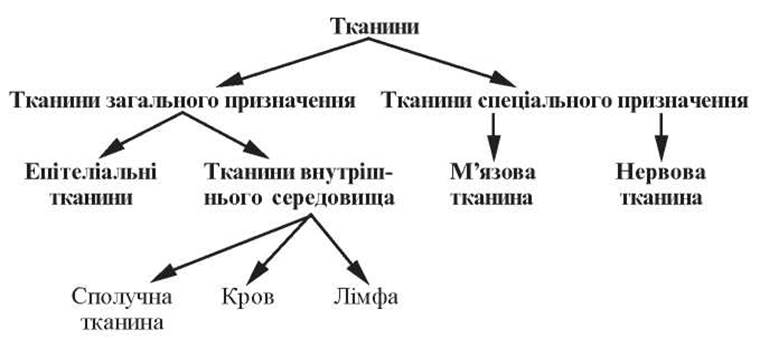
Fig. 29. Classification of tissues (after A. A. Zavarzin)
Tissue development (histogenesis) takes place during the Embryonic period of ontogeny following The formation of germ layers (ectoderm, endoderm, and mesoderm), which subsequently differentiate to form tissues.
Every tissue possesses, or previously possessed during Embryogenesis, stem cells.
Stem cells are poorly differentiated cells that form a population capable of self-renewal and multidirectional differentiation, ultimately giving rise—via progenitor cells—to the mature, functioning cells of a given tissue.
A Lineage of cells sequentially derived from a single type of stem cell down to a mature specialized cell is termed a differon, or histological series. In most cases, tissues comprise multiple differons.
Last update: 10/08/2026
Editorial and Educational Adaptation: This material has been compiled based on the primary/original source text. The project team performed an editorial review, corrected technical inaccuracies, structured sections, and adapted the content for an educational format.
What was processed:
- elimination of formatting defects (OCR errors, structural breaks, corrupted characters);
- editorial organization of content;
- standardization of terminology in accordance with academic sources;
- verification of factual statements against the original source text.
All mentions of the author, publication year, and origin of the primary text have been preserved in accordance with the source.