Human Anatomy - Kotsan I. Y. 2009
Vestibulocochlear organ (organ of hearing and equilibrium)
Auditory pathway
Sound waves reach the Cytology/practical/79.html">Spiral organ of Corti through the following pathway (Fig. 273). Airborne sound waves are captured by the auricle and directed into the external acoustic meatus, reaching the tympanic membrane and causing it to vibrate. The vibrations of the tympanic membrane, the amplitude of which can be regulated by the tensor tympani Muscle, are transmitted along the chain of auditory ossicles (malleus-incus-stapes) and reach the vestibular window (oval window). The force of vibration of the stapes base in the vestibular window is regulated by the stapedius muscle. The movement of the stapes base is transmitted to the perilymph of the vestibule. The vibrations of the vestibular perilymph propagate to the perilymph of the scala vestibuli and reach the cochlear cupula, where they are transmitted via the helicotrema to the perilymph of the scala tympani. Through the perilymph of the scala tympani, the sound waves return to the vestibule and are dampened by the secondary tympanic membrane. From the perilymph of the scala vestibuli and scala tympani, the sound vibrations are transmitted to the endolymph of the cochlear duct and are perceived by the sensory Hair Cells of the spiral organ, which serves as the receptor component of the Auditory Analyzer.
Class="center">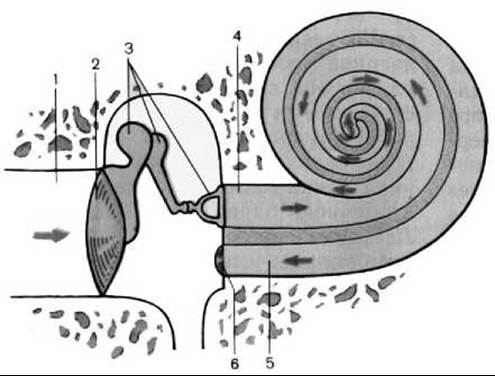
Fig. 273. Diagram of sound propagation (indicated by arrows) in the auditory organ (after M. R. Sapin)
1 — external acoustic meatus; 2 — tympanic membrane; 3 — auditory ossicles; 4 — scala vestibuli; 5 — scala tympani; 6 — secondary tympanic membrane
Last update: 08/08/2026
Editorial and Educational Adaptation: This material has been compiled based on the primary/original source text. The project team performed an editorial review, corrected technical inaccuracies, structured sections, and adapted the content for an educational format.
What was processed:
- elimination of formatting defects (OCR errors, structural breaks, corrupted characters);
- editorial organization of content;
- standardization of terminology in accordance with academic sources;
- verification of factual statements against the original source text.
All mentions of the author, publication year, and origin of the primary text have been preserved in accordance with the source.