Human Anatomy - Kotsan I. Y. 2009
Muscles and Fascia of the Lower Limb
Muscles of the Pelvic Girdle
The human lower limb, serving as an organ of support and locomotion, features the most highly developed musculature, accounting for over 50 percent of the total Muscle mass. The Functional Significance of the lower limb Muscles lies in their role of providing movement in the hip, knee, ankle, and FOOT joints, as well as maintaining posture and the Shock-absorbing Properties of the limb. Based on topographical and Anatomical Features, the Muscles of the Lower Limb are divided into the Muscles of the Pelvic Girdle and the Muscles of the Free Lower Limb.
Due to the fact that the pelvic girdle forms a nearly immobile joint with the sacral spine, there are no muscles that act to move the pelvis itself. The muscles located in the pelvic region primarily move the leg at the hip joint, or, when the lower limb is fixed, they act upon the spine.
The muscles of the pelvic girdle are divided into two groups: the internal (anterior) and external (posterior) groups (Fig. 127, 128).
Class="center">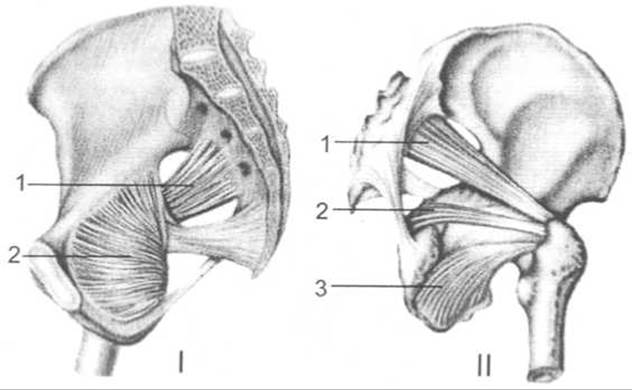
Fig. 127. Muscles of the pelvis
(I — view from the pelvic cavity side, II — external view). 1 — piriformis muscle, 2 — obturator internus muscle, 3 — obturator externus muscle
Last update: 08/08/2026
Editorial and Educational Adaptation: This material has been compiled based on the primary/original source text. The project team performed an editorial review, corrected technical inaccuracies, structured sections, and adapted the content for an educational format.
What was processed:
- elimination of formatting defects (OCR errors, structural breaks, corrupted characters);
- editorial organization of content;
- standardization of terminology in accordance with academic sources;
- verification of factual statements against the original source text.
All mentions of the author, publication year, and origin of the primary text have been preserved in accordance with the source.