Human Anatomy, Part 1 - K. A. Dyubenko, A. K. Kolomiysev, Yu. B. Chaykovsky 2002
Special Part
Myology, myologia [the study of muscles] — Muscles and Fascia of the Trunk
Muscles and Fascia of the Thorax — Thoracic Muscles Attaching to the Upper Limb
1. Pectoralis major Muscle, m. pectoralis major.
2. Pectoralis minor muscle, m. pectoralis minor.
3. Subclavius muscle, m. subclavius.
4. Serratus anterior muscle, m. serratus anterior.
1. Pectoralis major muscle, m. pectoralis major — a broad, thick muscle (Fig. 129) that covers the greater part of the anterior chest and forms the anterior wall of the cavum axillare. According to P. F. Lesgaft, this muscle should be classified as a muscle of the shoulder girdle and shoulder joint.
The external contour of the upper torso's anterior surface largely depends on the shape of the pectoralis major. It originates from the internal surface of the clavicle (clavicular part, pars clavicularis), the anterior surface of the Sternum and the cartilages of Ribs II–VI (sternocostal part, pars sternocostalis), and the anterior wall of the rectus abdominis sheath (abdominal part, pars abdominalis). The muscle bundles of all parts intertwine and attach via a large tendon to the crista tuberculi majoris of the humerus.
Function: adducts and medially rotates the raised arm, bringing it into the sagittal plane when the arm is in a horizontal position. When the upper limb is fixed, it assists in expanding The thoracic cage during inspiration.
Blood supply: aa. thoracoacromialis, thoracica lateralis, thoracica superior, rr. intercostales anteriores.
Innervation: nn. pectoralis medialis et lateralis (C X-Th I).
Class="center">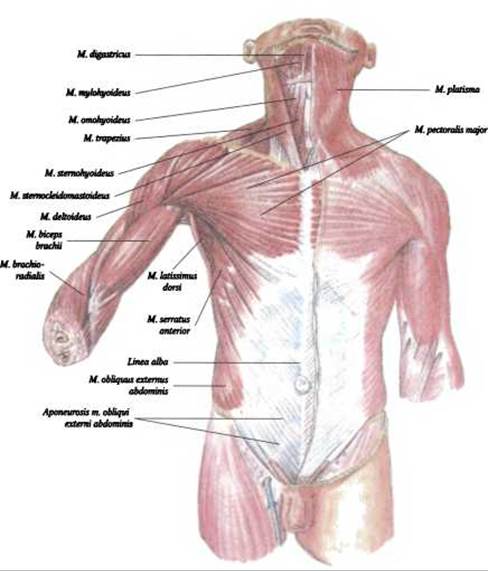
Fig. 129. Muscles AND FASCIAE of the trunk — SUPERFICIAL MUSCLES OF the chest, neck, and abdomen (after R. D. Sinelnikov)
2. Pectoralis minor muscle, m. pectoralis minor — located beneath the m. pectoralis major In the second layer, having a triangular shape (Fig. 130). It originates by three digitations from ribs II–V, courses upward and laterally, and inserts into the processus coracoideus scapulae.
Function: draws the shoulder girdle forward and downward. When the scapula is fixed, it elevates the ribs and contributes to the expansion of the thoracic cavity.
Blood supply: aa. thoracoacromialis, intercostales anteriores, thoracica superior.
Innervation: m. pectoralis medialis et lateralis (С VII—7% I).

Fig. 130. Muscles of the chest — anterolateral surface (after V. P. Vorobyov)
3. Subclavius muscle, m. subclavius — located between the rib and the clavicle (see Fig. 130). It originates from the Cartilage of the 1st rib, courses laterally, and inserts into the inferior aspect of the pars acromialis claviculae.
Function: draws the clavicle closer to the first rib and stabilizes it at the sternoclavicular joint.
Blood supply: a. thoracica superior, a. thoracoacromialis.
Innervation: n. subclavius (С V).
4. Serratus anterior muscle, m. serratus anterior — located in the anterolateral region of the chest (see Figs. 129, 130). It is the primary muscle that moves the scapula forward and laterally. It originates by digitations from the upper VI1-1X ribs and from the tendinous arch between the 1st and 2nd ribs, courses backward and medially, and inserts into the vertebral border of the scapula and its inferior angle.
Function: pulls the scapula toward the spine and secures it against the trunk, displacing its inferior angle forward and laterally.
Blood supply: aa. thoracodorsalis, thoracica lateralis, intercostales.
Innervation: n. thoracicus longus (CV-CVII).
Last update: 08/08/2026
Editorial and Educational Adaptation: This material has been compiled based on the primary/original source text. The project team performed an editorial review, corrected technical inaccuracies, structured sections, and adapted the content for an educational format.
What was processed:
- elimination of formatting defects (OCR errors, structural breaks, corrupted characters);
- editorial organization of content;
- standardization of terminology in accordance with academic sources;
- verification of factual statements against the original source text.
All mentions of the author, publication year, and origin of the primary text have been preserved in accordance with the source.