Human Anatomy Part 1 - K. A. Dyubenko, A. K. Kolomiysev, Yu. B. Chaykovsky 2002
Special Part
Joints of the lower limb bones, juncturae membri inferioris - The pelvis as a whole
The pelvis, pelvis, is formed by the hip bones, sacrum, coccyx, and ligaments (Fig. 97A). It is divided into the greater pelvis, pelvis major, and the lesser pelvis, pelvis minor. The boundary between them is the pelvic brim, linea terminalis, which extends from the sacral promontory to the arcuate line and further to the pubic tubercle. The cavity of the greater pelvis serves as a reservoir for Internal Organs, and its bones serve as attachment sites for the abdominal and thigh Muscles. The pelvis has two apertures: the superior aperture, apertura pelvis superior, bounded by the pelvic brim, and the inferior aperture, apertura pelvis inferior, bounded posteriorly by the coccyx, laterally by the ischial tuberosities, and anteriorly by the rami of the ischium and pubis. In males, the lesser pelvis contains the rectum, Urinary Bladder, Prostate Gland, Seminal Vesicles, and Ductus deferens, while in females it contains the rectum, Uterus, Uterine tube, urinary bladder, Ovaries, and Vagina.
Class="center">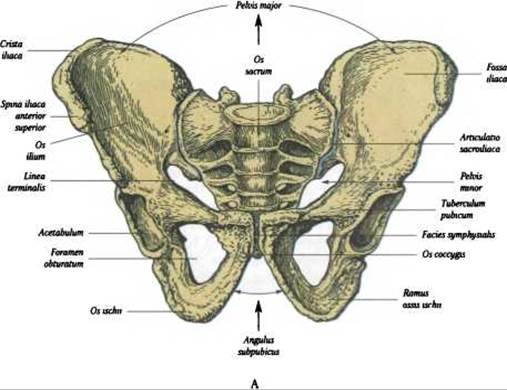
Fig. 97. Pelvis, pelvis: A - male pelvis
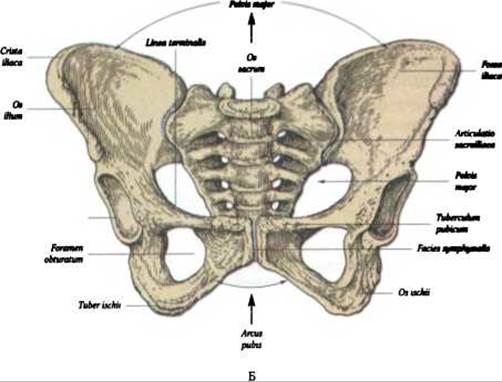
Fig. 97. Pelvis, pelvis (Continued): B - female pelvis
The lesser pelvis also contains Blood and Lymphatic vessels, Lymph Nodes, nerves, and nerve plexuses.
The Structure of the pelvis exhibits pronounced Sexual Dimorphism. In early childhood, the pelvis is nearly identical in both sexes. Sexual characteristics of pelvic structure develop during Puberty. The female pelvis is broader and shallower than the male pelvis, whereas the latter is taller and narrower (see Fig. 97). The iliac wings are more flared in the female pelvis than in the male. The pelvic inlet in females is larger than in males and has an oval shape. The cavity of the lesser pelvis, cavitas pelvis [pelvica], is cylindrical in females and funnel-shaped in males. The sacral promontory, promontorium, projects markedly forward in the male pelvis, whereas it projects less in the female. The sacrum is broad, flat, and short in females, but narrow, tall, and curved in males. The ischial tuberosities are directed more laterally in the female pelvis. The junction of the pubic bones forms an arch, and the inferior rami of the ischium and pubis form an obtuse angle. In the male pelvis, the pubic rami converge to form an acute angle.
Pelvic dimensions and shape are of paramount importance for predicting labor outcomes and preventing complications.
The external dimensions of the pelvis, as well as the dimensions of the pelvic inlet and outlet, are distinguished (Fig. 98):
1) the distance between the two anterior superior iliac spines (spinous distance), distantia spinarum, is 25-27 cm, and the distance between the most remote points of the iliac crests (crest distance), distantia cristarum, is 28-30 cm;
2) the distance between the greater trochanters of the femurs (trochanteric distance), distantia trochanterica, is 30-32 cm;
3) the direct diameter [conjugate] of the pelvic inlet, or conjugate anatomica, represents the distance between the sacral promontory and the upper margin of the Pubic Symphysis and equals 11 cm;
4) the transverse diameter, diameter transversa (the distance between the most remote points of the pelvic brim in the frontal plane), equals 13 cm;
5) the oblique diameter, diameter obliqua (the distance between the sacroiliac articulation on one side and the iliopubic eminence on the other), equals 12 cm;
6) the direct size, diameter recta, of the female pelvic outlet (the distance between the tip of the coccyx and the lower margin of the pubic symphysis, which depends on the degree of mobility of the coccyx) is 9-12 cm;
7) the transverse size, diameter transversa, of the pelvic outlet (the distance between the inner margins of the ischial tuberosities) is 11 cm.
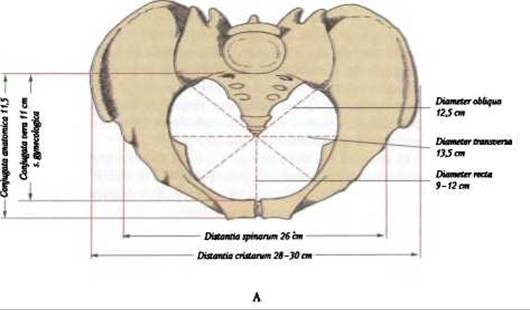
Fig. 98. Dimensions of the female pelvis:
A - external dimensions, inlet, and outlet of the pelvis
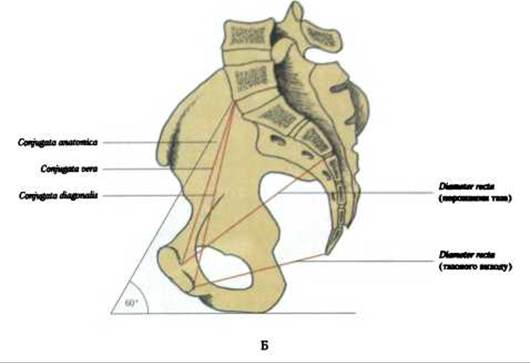
Fig. 98. Dimensions of the female pelvis (Continued): B - sagittal section of the female pelvis
In obstetrical practice, it is essential to know the shortest anteroposterior diameter in the pelvic inlet region. This dimension is the true conjugate, conjugate vera — the distance between the sacral promontory and the most projecting surface of the pubic symphysis into the pelvic cavity. It is also referred to as the obstetric conjugate, conjugate gynaecologica, highlighting its practical significance. The true conjugate of the female pelvis averages 10.5-11 cm.
The male pelvis is 1.5-2 cm smaller than the female pelvis. Variations in pelvic dimensions depend on age, body posture type, and individual body proportions. Individual variations in the external appearance of the pelvis may involve the shape and size of the sacrum, the hip bones, and the prominence of the sacral promontory.
Various diseases exert a negative impact on pelvic shape, including Rickets, spinal deformities, and Congenital Malformations.
X-ray anatomy. Radiography of the pelvic bones is performed in three projections: posterior, anteroposterior (direct), and lateral. Radiographs in the posterior projection clearly display all PARTS OF THE hip bone, the triangular sacrum, the pelvic inlet, the obturator foramen, and the hip joint space. A radiolucent area corresponding to the discus interpubicus is visible in the midline between the pubic bones, representing the joint space of the pubic symphysis.
Last update: 08/08/2026
Editorial and Educational Adaptation: This material has been compiled based on the primary/original source text. The project team performed an editorial review, corrected technical inaccuracies, structured sections, and adapted the content for an educational format.
What was processed:
- elimination of formatting defects (OCR errors, structural breaks, corrupted characters);
- editorial organization of content;
- standardization of terminology in accordance with academic sources;
- verification of factual statements against the original source text.
All mentions of the author, publication year, and origin of the primary text have been preserved in accordance with the source.