HUMAN MEDICAL BIOLOGY, ANATOMY, PHYSIOLOGY AND PATHOLOGY - Y.I. Fedonyuk 2010
ANATOMY, PHYSIOLOGY, PATHOLOGY
CHAPTER 3. ANATOMICAL AND PHYSIOLOGICAL ASPECTS OF BODY FUNCTION SELF-REGULATION
GENERAL ISSUES OF THE ANATOMY AND PHYSIOLOGY OF SENSORY SYSTEMS
THE ORGAN OF VISION
2. PHYSIOLOGY OF THE VISUAL SENSORY SYSTEM
2.1. The Optical System OF THE EYE
On their way to the light-sensitive membrane—the retina—light rays pass through the Optical System of the eye, which is a complex lens system that forms a real, inverted, and diminished image of the external world on the retina. The dioptric apparatus consists of the transparent cornea, the anterior and posterior chambers filled with aqueous humor, the crystalline lens, and the vitreous body.
The nodal point in the reduced eye—the optical system's point through which rays pass without refraction—is located at a distance of 7.5 mm from the apex of the cornea and 15 mm from the retina (the length of a normal eye is 22.5 mm).
To construct an image in the reduced eye, two rays must be drawn from the two extreme points of an object through the nodal point. These rays pass through the nodal point without refraction and are called principal rays, while the angle formed by them is termed the visual angle. The image formed on the retina is real, inverted, and diminished. However, since The activity of these Organs is cross-checked by others, and for a human being "down" is wherever the force of gravity is directed, we perceive objects in their upright orientation. In a normal (emmetropic) eye, a parallel beam from a very distant source (such as a star) converges on the retina (i.e., the focus is located there). If the observed object is not situated very far away and the rays coming from it are not parallel, the accommodation apparatus comes into play.
Accommodation is the ability of the eye to clearly focus on objects at varying distances. The Essence of accommodation lies in changing the curvature of the crystalline lens and, consequently, its refractive power. The lens is enclosed in a capsule, which is attached to the ciliary Muscle by means of the suspensory ligament. When viewing close objects, the ciliary muscle contracts, the ligament relaxes, the elastic lens becomes more convex, and its refractive power increases. When viewing distant objects, the ciliary muscle relaxes, the ligament is pulled taut, the elastic lens flattens, and its refractive power decreases.
In both cases, the image of the object is focused on the retina thanks to accommodation.
Accommodation is regulated by the parasympathetic fibers of the Oculomotor nerve. The administration of atropine into the eye disrupts the transmission of nerve impulses to the ciliary Muscles and impairs accommodation when viewing close objects.
For the emmetropic eye of a young person, the far point of distinct Vision (where two points are distinguished as separate rather than merging into one) lies at infinity. Such a person views distant objects without any accommodative effort. The near point of distinct vision is located at a distance of 7 cm from the eye.
With age, the elasticity of the lens decreases, and consequently, the eye's accommodative capacity also declines, hindering clear near vision. The nearest point of distinct vision recedes from the eye. Age-related farsightedness (presbyopia) develops after the age of 40.
Eye refraction refers to the Optical Properties of the eye in the absence of accommodative changes. It is known that in a normal, emmetropic eye, the principal focus lies precisely on the retina, allowing a person to see objects clearly. Refractive anomalies include farsightedness (hyperopia) and nearsightedness (myopia). Refractive errors are most frequently the result of abnormal eye development, particularly concerning its axial length (Fig. 3.61).
Class="center">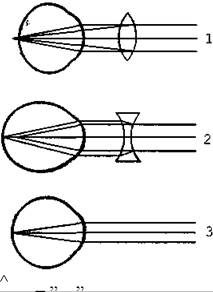
Fig. 3.61. Optical imperfections of the eyes and their correction using lenses
In myopia, the anteroposterior axis of the eye is elongated, causing the principal focus to lie in front of the retina rather than on it. Instead of a sharp point, a circle of scattered light is formed on the retina. The far point of distinct vision is not at infinity, but at a very close distance (25 cm). Distant objects appear blurred. Bconcave lenses are required to correct nearsightedness. Hyperopia occurs when the Eyeball is shortened. The principal focus lies behind the retina, making the retinal image blurred. In farsighted individuals, the near point of distinct vision is pushed further away from the eye compared to emmetropes. Therefore, for reading, hyperopes use glasses with biconvex lenses that enhance the refraction of light rays.
Optical "physiological" imperfections of the eye include spherical aberration, chromatic aberration, diffuse light scattering, and astigmatism. Spherical aberration arises because the focal length of the cornea and lens is not uniform across all areas—it is greater in the central part than in the periphery. Chromatic aberration is explained by the fact that the optical apparatus of the eye refracts light with shorter wavelengths (e.g., blue color) more strongly than light with longer wavelengths (red color). This is precisely why blue objects appear more distant to us than red ones. Diffuse light scattering occurs as light passes through the vitreous body, which contains structured Proteins. Astigmatism results from the fact that the curvature of the cornea in the vertical plane is greater than in the horizontal plane. This causes variations in refractive power. If this difference does not exceed 0.5 D, such astigmatism is termed "physiological."
Last update: 08/08/2026
Editorial and Educational Adaptation: This material has been compiled based on the primary/original source text. The project team performed an editorial review, corrected technical inaccuracies, structured sections, and adapted the content for an educational format.
What was processed:
- elimination of formatting defects (OCR errors, structural breaks, corrupted characters);
- editorial organization of content;
- standardization of terminology in accordance with academic sources;
- verification of factual statements against the original source text.
All mentions of the author, publication year, and origin of the primary text have been preserved in accordance with the source.