MEDICAL BIOLOGY, HUMAN ANATOMY, PHYSIOLOGY AND PATHOLOGY - Y.I. Fedoniuk 2010
BIOLOGY
SECTION 1. BIOLOGICAL BASIS OF HUMAN VITAL ACTIVITY
1.2. CELL. TISSUES. CONCEPT OF AN ORGAN, ORGAN SYSTEM, AND ORGANISM
EPITHELIAL TISSUE
1. Surface epithelium
The morphological Classification of surface epithelium is based on the number of Cell layers and cell shape. Therefore, epithelium is primarily subdivided into simple and stratified types.
In Simple Epithelium, all Cells rest upon the basement membrane. In Stratified Epithelium, only the deepest basal layer of epithelial cells contacts the basement membrane, whereas the overlying cells lose this contact. Simple epithelium is further subdivided into single-layer (monolayered) and pseudostratified. Single-layer epithelium, in turn, is classified by cell shape into squamous, cuboidal, and columnar. In single-layer epithelium, all cells are uniform in shape and size, with their nuclei located at the same level. In pseudostratified epithelium, due to the varied types, sizes, and shapes of the cells, their nuclei lie at different levels, yet all epithelial cells remain in contact with the basement membrane (Fig. 1.4).
Stratified epithelium is subdivided into non-keratinized stratified squamous, keratinized stratified squamous, and transitional epithelium. This classification depends on the Structural Features of the Superficial layer of epithelial cells.
Class="center">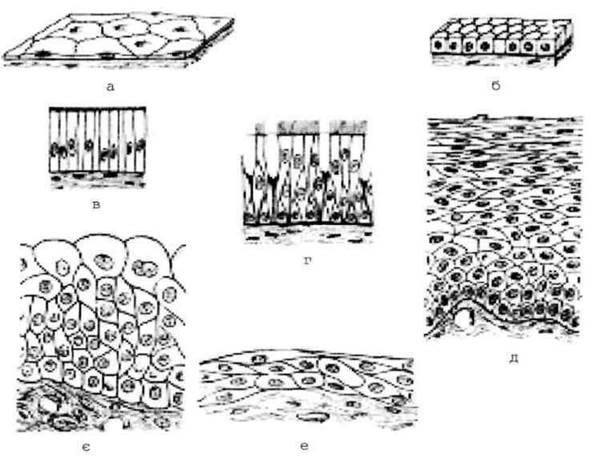
Fig. 1.4. Schematic diagram of various types of surface epithelium: a - simple squamous; b - simple cuboidal; c - simple columnar brush border epithelium; d - pseudostratified ciliated; e - stratified non-keratinized squamous; f - stratified transitional in a stretched state; g - stratified transitional in a relaxed state.
Last update: 08/08/2026
Editorial and Educational Adaptation: This material has been compiled based on the primary/original source text. The project team performed an editorial review, corrected technical inaccuracies, structured sections, and adapted the content for an educational format.
What was processed:
- elimination of formatting defects (OCR errors, structural breaks, corrupted characters);
- editorial organization of content;
- standardization of terminology in accordance with academic sources;
- verification of factual statements against the original source text.
All mentions of the author, publication year, and origin of the primary text have been preserved in accordance with the source.