FISHES OF THE FAMILY CYPRINIDAE IN THE WATER BODIES OF UKRAINE - V. V. Zamorov - 2015
GENUS VIMBA - VIMBA FITZINGER
Identification key to the species of the genus Vimba
1 (2). Anal fin with 17-21, on average 18-21 branched rays. Lateral line with 50-62, on average 55-58 scales. Vimba bream - V. vimba
2 (1). Anal fin with 15-18, on average 16-17 branched rays. Lateral line with 48-58, on average 54 scales. Water bodies of Crimea. Small vimba - V. tenella
Vimba bream - Vimba vimba (Linnaeus)
Morphological features: D III 8 (9); A III (17) 18-20 (21); P I (14) 15-17 (18); VII 9 (10); l. l. (49-53) 54-59 (60-61); Squ1 (8,5) 9-10,5 (11), Squ2 5-6; sp. br. (14-15) 16-18 (19), d. f. 5-5 (93.3%), 5-4 (4.0%), 45 (2.7%). Maximum body length 40 cm, usually 20-30 cm, weight 800-900 g, lifespan up to 10-12 years (Fig. 27).
Class="center">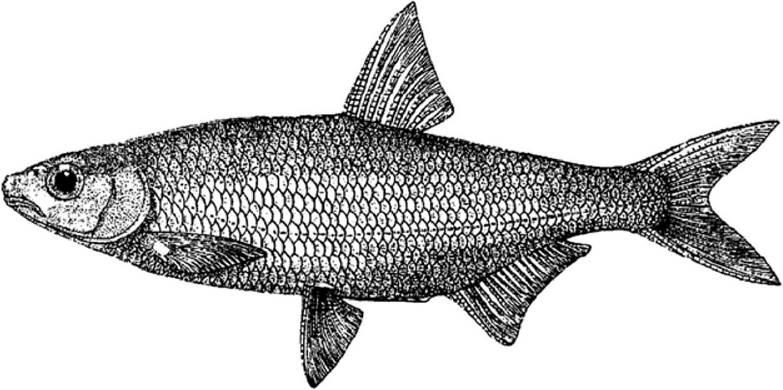
Fig. 27. Vimba bream Vimba vimba
Body moderately elongated, laterally compressed, relatively high. Its maximum depth in adult fish averages 27-29% of body length. The dorsal profile is smoothly slightly convex, sometimes almost straight; the ventral profile from the lower part of the HEAD to the anal fin is slightly convex. The back in front of the dorsal fin is laterally compressed, with a prominent median ridge running along it, which begins on the head behind the nostrils (naked on the head) and reaches the dorsal fin. Sometimes a scale-free groove runs along its middle from the occiput to the Base of the dorsal fin. Immediately behind the dorsal fin, a rather sharp keel begins, formed by scales bent in the middle, extending to the base of the caudal fin. In front of the pelvic fins, the belly is rounded, behind them - laterally compressed. A prominent, scale-free keel is present on it from the pelvic to the anal fin. The caudal peduncle is short, averaging 13-16% of body length.
Dorsal fin small, truncated, with a slight notch, pointed at the apex. Anal fin low, long, with a noticeable notch in the anterior part, rounded at the apex. Paired fins slightly rounded, pointed at the tips. Caudal fin with a well-defined deep notch, usually its lower lobe is slightly longer than the upper, sometimes both lobes are pointed at the tips and equal in length. The dorsal fin originates behind the vertical of the posterior margin of the pelvic fin base. Pectoral fins are relatively long, reaching half or more of the pectoventral distance. At the base of the pelvic fins externally, There is a rather large, elongated, acutely tipped scale.
Scales of medium size, densely covering the body. Lateral line complete, curving in a gentle arc toward the belly, extending onto the head anteriorly. Head relatively small, its length almost equal to the pectoventral distance. Snout long, almost conical, fleshy anteriorly, somewhat rounded at the tip, noticeably projecting over the Mouth. Mouth small, inferior, semilunar, with medium-thickness Lips, its tip located noticeably below the lower margin of the eye. Eyes of medium size. Forehead wide, convex, its width in sexually mature fish usually equal to the snout length. Upper jaw is always shorter than the lower and falls well short of the anterior margin of the eye. The lower jaw articulates with the cranium at the vertical of the anterior eye margin. Gill rakers relatively short, spaced not densely. Pharyngeal Teeth fairly robust, laterally compressed, with a crescent-shaped short grinding surface at the tip, arranged in a single row. Abdominal cavity usually light, reddish.
In Ukraine, it occurs in the basins of all major rivers and in the brackish estuaries of the northwestern part of the Black Sea and the northern part of the Azov Sea (most abundant in the lower reaches of the Danube, Dniester, Southern Bug, and Dnieper). Resident forms are known in the upper Dniester basin, in some tributaries of the Dnieper (Sluch, Ros), in its reservoirs, and in the Siversky Donets.
Small vimba - Vimba tenella (Nordmann)
Morphological features: D III 8 (7-8); A III 15-16; l. l. 48-58; sp. br. 12-17.
Maximum body length up to 17.7 cm, lifespan 7-8 years (Fig. 28).
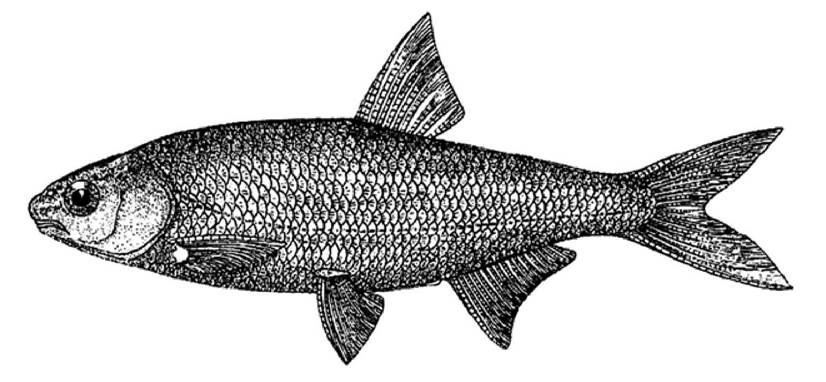
Fig. 28. Small vimba Vimba tenella
Body relatively elongated, moderately high, laterally compressed. A sharp keel, covered with centrally bent scales, extends behind the dorsal fin all the way to the base of the caudal fin. A keel begins on the head behind the nostrils and reaches the Origin of the dorsal fin. This keel is bare and scale-free in approximately its first half. On the belly, between the pelvic and anal fins, there is also a scale-free keel. The upper part of the anal fin has a significant notch.
Snout conical, fleshy, noticeably projecting over the mouth, but less so than in V. vimba. Mouth inferior, its corners do not reach the vertical of the anterior eye margin. Gill rakers short, sparsely set. Pharyngeal teeth arranged in a single row, hooked at the tips, not adjoining each other (unlike in V. vimba); there is always a free space between them. The grinding surface of the first four teeth is obliquely cut. The fifth tooth (and sometimes the fourth) always has a pointed, upward-hooked, uncut grinding surface.
In Ukraine, it was known from the rivers of Crimea (Salgir, Chorna, and Biyuk-Karasu). A rather rare, low-number fish. Listed in the Red Book of Ukraine.
Last update: 07/08/2026
Editorial and Educational Adaptation: This material has been compiled based on the primary/original source text. The project team performed an editorial review, corrected technical inaccuracies, structured sections, and adapted the content for an educational format.
What was processed:
- elimination of formatting defects (OCR errors, structural breaks, corrupted characters);
- editorial organization of content;
- standardization of terminology in accordance with academic sources;
- verification of factual statements against the original source text.
All mentions of the author, publication year, and origin of the primary text have been preserved in accordance with the source.