FISHES OF THE FAMILY CYPRINIDAE IN UKRAINIAN WATERBODIES - V. V. Zamorov - 2015
THE GENUS BLICCA - BLICCA HECKEL
Body deep, moderately compressed laterally. Scales of medium size (l. l. 40-51), thick, closely set; scale Nucleus centrally located. A more or less distinct groove behind the occiput (as scales from one side do not cross the dorsal ridge to the other). A scaly keel absent behind the pelvic fins. D III (7) 8 (9), unspined, A III 17-25, originating beneath the posterior end of the dorsal fin. Mouth small, subterminal, oblique. Gill rakers moderately long, fairly densely set, numbering 14-21. Pharyngeal Teeth biserial, 2.5-5.2 (also 3.5-5.2, 2.5-5.3, etc.), strongly compressed laterally, smooth, slightly obliquely truncated on the chewing surface, with a weak hook. Peritoneum light-colored. Closely related to the genera Abramis and Alburnoides.
White bream - Blicca bjoerkna (Linnaeus)
Morphological features: D III 8 (9); A III 19-23 (predominantly 21-22); l. l. 43-51 (typically 45-48); Squ1 9-10; Squ2 4-6; vert. 40-42 (mostly 41); sp. br. 12-21; d. f. 2.5-2.5. The largest specimen had a body length of 30 cm, a weight of 400 g, and a lifespan of 8-10 years (Fig. 29).
Class="center">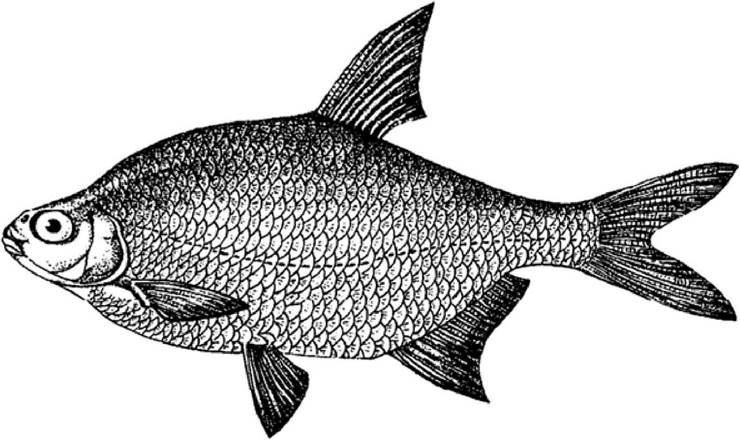
Fig. 29. White bream Blicca bjoerkna
Body slightly elongate, deep, strongly compressed laterally. Based on average indices across various waterbodies, the following morphological features are observed. Maximum body depth ranges from 36.7 to 41.2% of standard body length (l), exceeding body thickness by 2.6-2.7 times. The caudal peduncle is somewhat elongated, low, and compressed laterally, with a length of 11.9-14.7% l and a height of 10.3-11.7% l. The dorsal fin begins noticeably posterior to the vertical line through the midpoint of l; the predorsal distance is 54.2-57.6% l and is 1.5-1.6 times greater than the postdorsal distance. The base of V is located noticeably anterior to the vertical through the midpoint of l; the preventral distance is 45.4-47.8% l. The preanal distance slightly exceeds 1/3 of l. The base of D
constitutes 12.4-13.8% l, and the base of A is twice as long. The length of P (18.2-20.8% l) is 1.2-1.3 times smaller than the P-V distance, while the length of V (16.8-19.2% l) is 1.2-1.4 times smaller than the V-A distance. The length of the upper lobe of C is 23.1-28.2% l, and the lower lobe is 26.3-30.8% l. HEAD is short, making up 21.4-23.5% l.
Head height is quite significant, accounting for 76.4-88.7% of head length (c). Eyes are very large (eye diameter is 27.0-32.8% c), positioned somewhat closer to the anterior tip of the head (snout length is 22.6-26.7% c) than to its posterior margin (postorbital distance is 42.3-47.9% c), and widely spaced (interorbital width is 35.7-39.3% c). Jaws are small: upper jaw length is 22.3-29.7% c, lower jaw length is 28.5-34.1% c.
In Ukraine, it occurs in almost all rivers, their tributary systems, reservoirs, floodplain lakes, and lowland stretches of mountain rivers. It is absent in Crimea, though it may occasionally appear there via Dnieper Water transfers.
Last update: 07/08/2026
Editorial and Educational Adaptation: This material has been compiled based on the primary/original source text. The project team performed an editorial review, corrected technical inaccuracies, structured sections, and adapted the content for an educational format.
What was processed:
- elimination of formatting defects (OCR errors, structural breaks, corrupted characters);
- editorial organization of content;
- standardization of terminology in accordance with academic sources;
- verification of factual statements against the original source text.
All mentions of the author, publication year, and origin of the primary text have been preserved in accordance with the source.