FISHES OF THE FAMILY CYPRINIDAE IN THE WATER BODIES OF UKRAINE - V. V. Zamorov - 2015
GENUS ABRAMIS - ABRAMIS CUVIER
Body strongly compressed laterally. Scales firmly attached. The lateral line runs in a gentle curve without sharp bends. There is a scaly-free groove behind the occiput. There is no keel behind the dorsal fin. The belly behind the pelvic fins features a naked (scaleless) keel. The dorsal fin is located behind the vertical line of the Base of the pelvic fins, without a spine, D III 8-10. Anal fin with a long base, III 1544, beginning anterior to the vertical of the dorsal fin origin. Pharyngeal Teeth uniserial, 5-5, occasionally 6-5, more rarely 5-6, their crown compressed, obliquely truncated, with a groove on the chewing surface.
Includes a single species represented in Ukraine.
Common bream - Abramis brama (Linnaeus)
Morphological features: D III 8-10; A III 22-28; P I 15-18; VII 8-10; C I 17 I; l. l. 50-57; Squ1 (12) 13-14 (16), Squ2 6-7 (8); vert. 38-48; sp. br. 16-26; d. f. 5-5. Maximum body length 60 cm, weight over
1000 g, lifespan up to 15-16 years (Fig. 30).
Class="center">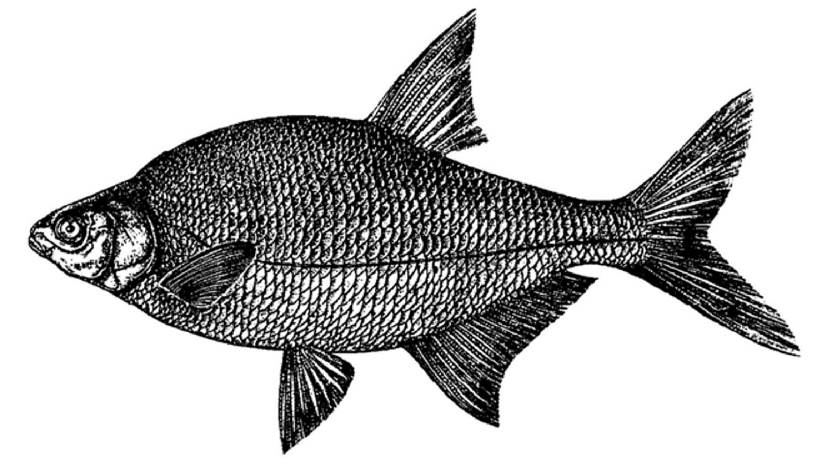
Fig. 30. Common bream - Abramis brama
Body moderately elongate, high, and rather laterally compressed. In the lateral profile, particularly in adult specimens, a marked hump immediately behind the occiput is clearly visible. Average plastic CHARACTERISTICS OF THE bream across Water bodies of various river basins in Ukraine exhibit the following features. Expressed as a percentage of standard body length l, the maximum body depth (corresponding to the vertical through the midpoint of l) exceeds 1/3 l, reaching 39% l, and is three times the body width. The caudal peduncle is short, low, laterally flattened; its length constitutes 13-14% l, height 1/10 l, and thickness is half the height of the caudal peduncle. The base of the dorsal fin begins slightly posterior to the vertical through the midpoint of l, the antedorsal distance reaches 58% l, the postdorsal distance is only slightly greater than 1/3 l, and the anteanal distance is just under /3 l. The base of the pelvic fin originates slightly anterior to the vertical through the midpoint of l, with the anteventral distance reaching only 45% l. The length of the D base is almost equal to the length of the caudal peduncle, while the A base length is twice as large. The height of the unpaired fins is quite substantial—the height of D reaches a quarter of l, and the height of A is 16-18% l. The length of P equals 1/5 l and is 1.2 times greater than the length of V. P nearly spans the P–V distance, which accounts for 22-24% l, whereas the length of V is noticeably smaller than the V–A distance, which slightly exceeds 1/5 l. The length of the upper lobe of C makes up 21-26% l, and the length of the lower lobe of C is 24-30% l. HEAD length is generally equal to the length of the upper lobe of C. As a percentage of head length, head height is 80-88%. Eyes are relatively small. The eye diameter, 18-21% c, is located significantly closer to the anterior margin of the head (snout length 29-31% c) than to the posterior margin (postorbital distance 49-50% c). The length of the upper jaw is slightly less, and that of the lower jaw slightly greater, than 1/3 c. The forehead is moderately broad (37-33% c).
In Ukraine, it occurs in the basins of almost all rivers, main-channel and floodplain lakes, estuaries, and desalinated areas of the northwestern Black Sea and the northern Sea of Azov. Acclimatized in Crimean reservoirs.
Last update: 07/08/2026
Editorial and Educational Adaptation: This material has been compiled based on the primary/original source text. The project team performed an editorial review, corrected technical inaccuracies, structured sections, and adapted the content for an educational format.
What was processed:
- elimination of formatting defects (OCR errors, structural breaks, corrupted characters);
- editorial organization of content;
- standardization of terminology in accordance with academic sources;
- verification of factual statements against the original source text.
All mentions of the author, publication year, and origin of the primary text have been preserved in accordance with the source.