CYPRINID FISHES (CYPRINIDAE) OF UKRAINIAN WATER BODIES - V. V. Zamorov - 2015
GENUS PELECULUS (SABREFIN) - PELECUS AGASSK
The body is elongate, strongly compressed laterally. The pectoral fins are very long; the dorsal fin is short, of moderate height, unspined, and originates slightly behind the vertical line passing through the Water/144.html">Origin of the anal fin, which has an elongated base and considerable height; the caudal fin is deeply emarginate. The scales are small and easily shed. The lateral line follows a zigzag course (l. l. about 100). In the cephalic mechanosensory system, the parietal branch and the posterior section of the supraorbital canal are greatly elongated. On the upper part of the HEAD, body musculature reaches the vertical of the anterior margin of the eye. The Brain is rather well differentiated; the lobi optici and Cerebellum are significantly developed, the latter extending far backward, while the corpora striata and Medulla Oblongata are weakly differentiated. A sharp, scale-less keel extends along the entire ventral midline from the throat to the anus. The Mouth is superior, with a prominence on the lower jaw that fits into a notch on the upper jaw. The gill openings are very wide, as the gill membranes are attached very close to the lower jaw, reaching the vertical of the eye. The gill rakers are elongated and densely set, numbering 18-23 on the first gill arch. Pharyngeal Teeth are biserial, 2.5-5.2, with hooked and slightly serrated crowns. There are 46-52 vertebrae, with the second and third firmly fused together. A single species is known.
Sabre carp (sabre-fish) - Pelecus cultratus (Linnaeus)
Morphological features: D III 7; A III 23-31; P I 14-16; V II 6-7; l. l. 94-115; Squ1 12-16, Squ2 3-6; vert. 46-52; sp. br. 18-26; d. f. 2.5-5.2 (2.5-4.2; 2.4-5.2; 2.5-5.3). Maximum body length of the largest specimen is 50.0 cm, weight 800 g, lifespan up to 10-12 years (Fig. 24).
Class="center">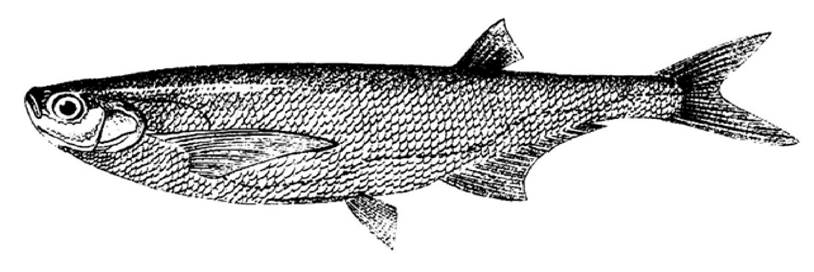
Fig. 24. Sabre carp Pelecus cultratus
The body is slender, sabre-shaped, and strongly compressed laterally. The maximum body depth (H) almost coincides with the vertical line passing through the mid-point of standard body length (l), averaging 20.53-23.41% (18.6-25.8) of l and exceeding the maximum body thickness by 2.5-3 times. The dorsal profile of the body runs almost in a straight line from the head to the caudal peduncle, while the ventral profile is arched, particularly steep in the section from the lower jaw to the lower corner of the operculum, and less steep along the abdomen. In some individuals, the head and anterior trunk are curved upward, though most commonly only the snout is upturned. The back and belly are compressed along the margins, especially the belly, which bears a keel extending from the throat to the anus. The caudal peduncle is moderately elongated, low, and laterally compressed. The minimum body depth is 6.6-7.8 (5.8-12)% of l and is 1.7-2 times less than the length of the caudal peduncle. The bases of all fins, except the anal fin, are short. The dorsal fin originates slightly posterior to the vertical of the anal fin origin; the pectoral fin originates almost immediately behind the posterior margin of the gill cover, its tip reaching the posterior margin of the pelvic fin base. The point of attachment of the pelvic fins to the abdomen nearly coincides with the lower limit of body depth H. The tips of all fins are pointed; the anal fin has a slight notch, while the caudal fin has a deep emargination. The pectoral fins are very long, somewhat widened at the base, and in length nearly equal the pectoventral distance. The scaly cover consists of thin, relatively small, easily shed scales of varying size, arranged in somewhat irregular rows. The zigzag lateral line runs from the upper point of the gill slit slightly backward, then curves downward beneath the pectoral fin almost to the ventral margin, subsequently rises above the bases of the pelvic and anal fins, reaching the longitudinal axis of the body only near the end of the caudal peduncle; occasionally it is interrupted before the pelvic fin. The anterior section of the lateral line extends onto the head.
A characteristic feature is that its parietal branch and the posterior section of the supraorbital canal are greatly elongated. The head is small, its length equal to nearly 1/5 of l and close to the maximum body depth. The snout is of medium size, sometimes slightly upturned, its length being 2.5 times less than the head height. The mouth is relatively large and superior, its apex reaching or sometimes exceeding the upper margin of the head profile. The eyes are large, with a diameter close to the snout length and up to 1/4 of the head length. The forehead is moderately narrowed, its width fitting between 1/5 and 1/4 of the head length.
In Ukraine, it is distributed in the basins of all major rivers; formerly, it was also found in the estuarine and adjacent freshened areas and limans of the northwestern Black Sea and the northern Sea of Azov, but is absent in Crimea.
Last update: 07/08/2026
Editorial and Educational Adaptation: This material has been compiled based on the primary/original source text. The project team performed an editorial review, corrected technical inaccuracies, structured sections, and adapted the content for an educational format.
What was processed:
- elimination of formatting defects (OCR errors, structural breaks, corrupted characters);
- editorial organization of content;
- standardization of terminology in accordance with academic sources;
- verification of factual statements against the original source text.
All mentions of the author, publication year, and origin of the primary text have been preserved in accordance with the source.