FISHES OF THE FAMILY CYPRINIDAE IN UKRAINIAN WATER BODIES - V. V. Zamorov - 2015
THE GENUS BARBEL (MARENA) - BARBUS CUVIER, 1816
Identification key for species of the genus Barbus
1 (4). The last unbranched ray of the dorsal fin is noticeably thickened, rigid, strong, and largely covered with densely arranged sharp denticles (strongly serrated); the flexible jointed part of this ray makes up no more than 30% of its length. The lower lip is bilobed, and the space between the lateral lobes is thickened to form a ridge, but never forms a separate lobe.
2 (3). When folded against the back, the tip of the dorsal fin clearly does not reach the vertical line of the anal fin origin. The minimum body depth is 45–55%, averaging 50% of the caudal peduncle length. The posterior barbels are long, usually reaching the vertical line of the posterior edge of the eye or extending beyond it. Basins of the Vistula, Danube, and Dniester. Common barbel - B. barbus
3 (2). When folded against the back, the tip of the dorsal fin usually reaches the vertical line of the anal fin origin or extends beyond it. The minimum body depth is 53–77%, averaging 59% of the caudal peduncle length. The posterior barbels are short, usually reaching only the vertical line of the anterior edge or the middle of the eye. Dnieper barbel - B. borysthenicus
4 (1). The last unbranched ray of the dorsal fin is thin, flexible, entirely jointed, without denticles on the posterior edge (smooth) or partially slightly thickened and weakly serrated in certain areas. The lower lip is distinctly trilobed.
5 (6). The last unbranched ray of the dorsal fin is thin,
flexible, entirely jointed, without denticles on the posterior edge (smooth). The upper margin of the dorsal fin is straight or slightly rounded. Danube-Dniester barbel - B. petenyi
6 (5). The last unbranched ray of the dorsal fin is slightly thickened and partially covered with small denticles along its posterior edge (weakly serrated). The upper margin of the dorsal fin is rounded.
7 (8). The snout is relatively long, narrow, and pointed. The middle lobe
of the lower lip is well developed, relatively small, with a noticeable free posterior margin. The height of the dorsal fin is 15–19 (17.9–21.8)% of the body length excluding the caudal fin. Walecki's barbel - B. waleckii
8 (7). The snout is relatively short and blunt. All three lobes of the lower lip are equally well developed, but the middle one lacks a free posterior margin. The height of the dorsal fin is 20.5–24.1% of the body length excluding the caudal fin. Crimean barbel - B. tauricus
Common barbel - Barbus barbus (Linnaeus)
Morphological features: D IV 6-9; A III 5-6; P I 15-18; VII 8; l. l. 53-63; Squ1 12-14, Squ2 7-9; sp. br. 8-13; d. f 2.3.5-5.3.2. Maximum body length is about 100 cm, weight up to 10 kg, lifespan up to 15 years (Fig. 19).
Class="center">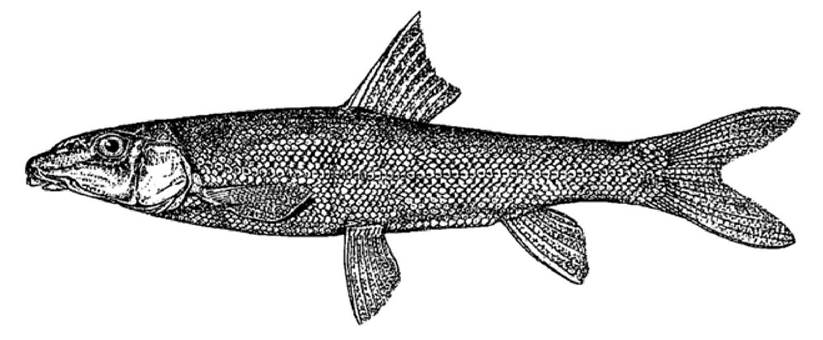
Fig. 19. Common barbel (Barbus barbus)
The body is elongated, fusiform, slender, slightly laterally compressed, and densely covered with small scales. The minimum body depth fits 2.0 (1.8–2.2) times into the length of the caudal peduncle. The posterior barbels are long, typically reaching the posterior edge of the eye or extending past it. When folded against the back, the tip of the dorsal fin visibly falls short of the vertical line of the anal fin. The back is dark gray, the sides are greenish-olive or greenish-yellow, and the belly is yellowish or milky-white. The dorsal and caudal fins are gray, often reddish; all other fins are pink, orange, or red, with grayish tips. The iris is silvery or golden.
Distribution: Western, Central, and partly Eastern Europe from Great Britain to the Dniester basin inclusive, and north of the Pyrenees and Alps to the basins of the North and Baltic Seas. The Taxonomy of the species is insufficiently studied and requires clarification.
In Ukraine, it occurs in the Danube basin (lower Danube, Tisza, Prut, and Siret basins), as well as in the Dniester and Vistula basins.
A rather rare, low-number fish species. Listed in the Red Book of Ukraine.
Dnieper barbel - Barbus borysthenicus Dybowski
Morphological features: D IV-V (6) 7-8 (9); A III 5-6; Р І (13) 14-16 (18); VII (7) 8; І. І. (53, 54) 55-61 (67, 63); Squ1 12-15 (16), Squ2 79 (10); sp. br. (8) 9-14 (15), d. f. 2.3.5-5.3.2. Maximum body length up to 80-90 cm, weight up to 10-12 kg (exceptionally up to 16 kg, usually up to 4-5 kg), lifespan up to 12-13 years (Fig. 20).

Fig. 20. Dnieper barbel Barbus borysthenicus
Lifespan is up to 12–13 years. Externally, it resembles the common barbel, but its body is less slender, thicker, and features a characteristic hump in the dorsal fin region. The caudal peduncle is wider and shorter (the minimum body depth fits into the length of the caudal peduncle 1.3–1.9 times, on average 1.7 times). The dorsal fin is taller, and when folded back, its tip reaches the vertical of the anal fin origin or extends beyond it. The posterior barbels are shorter, reaching only the anterior margin or sometimes the middle of the eye. Yellowish-golden tones predominate in coloration, and the fins are
colored more intensely: carrot-red dominates the paired, anal, and caudal fins, while pinkish-red is dominant in the dorsal fin.
In Ukraine, it is currently distributed only in the additional basin System of the Dnieper and in the Southern Bug. Formerly common, it was locally a commercial fish species. Today, isolated specimens are found in the upper Dnieper, sporadically in Dnieper tributaries such as the Teteriv, Psel, and Sluch, and locally in the rapids sections of the middle Southern Bug. It is a rather rare, low-abundant fish species, and is listed in the Red Data Book of Ukraine.
Danube-Dniester barbel - Barbus petenyi Heckel
Morphological features: D IV 8; A III 5; P I 15-17; V II 8 (9); l. l. 52-57; Squ1 11-12, Squ2 7-8, sp. br. 8-11, d. f 2.3.5-5.3.2. Maximum body length 30 cm, weight up to 300 g, lifespan up to 10 years (Fig. 21).
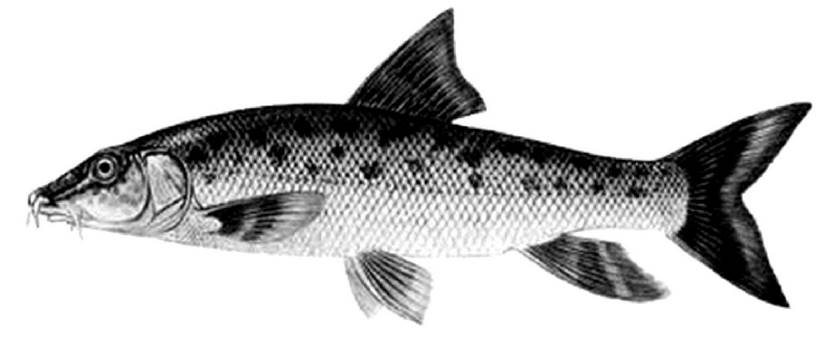
Fig. 21. Danube-Dniester barbel Barbus petenyi
The body is elongated, fusiform, slender, and slightly compressed laterally. It differs from other barbels in our Water bodies by having a flexible, non-thickened, fully segmented last unbranched ray of the dorsal fin, which is smooth along the entire posterior edge (not serrated), as well as smaller body length and mass. The coloration is dominated by a grayish-brown tone, transitioning from an olive-greenish upper half of the body to yellowish on the belly. The dorsal fin edges are reddish-orange. On the back, sides, dorsal and caudal fins there are dark gray spots, all other fins are light gray, and the pelvic and anal fins can be brownish.
It has no commercial value and is an object of amateur and sport fishing. Its population size is low and steadily declining. It is listed in the Bern Convention, IUCN lists, and the European Red List.
In Ukraine, it occurs in the Tisza basin, the upper reaches of the Prut and Siret, and the upper Dniester basin. It is a fairly rare, low-abundant fish, and is listed in the Red Data Book of Ukraine.
Walecki's barbel - Barbus waleckii Rolik
Morphological features: D III-IV (7) 8(9); A III 5; P I 15-17 (18); V II 8 (9); l. l. 55-70; Squ1(11) 12-13, Squ27-8; sp. br. 9-13; d. f 2.3.5-5.3.2, maximum body length about 35 cm (Fig. 22).
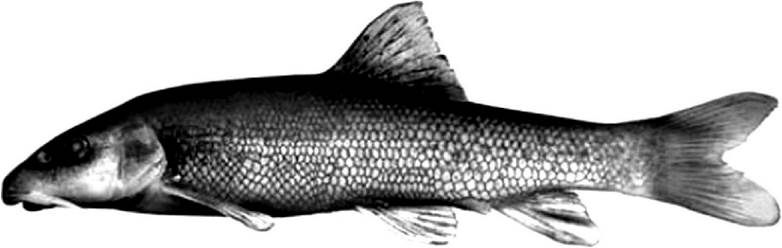
Fig. 22. Walecki's barbel Barbus waleckii
The body is elongated, slender, nearly fusiform, and slightly compressed laterally. The snout is relatively long, narrow, and pointed. The middle lobe of the lower lip is quite well developed, relatively small, with a noticeable free posterior margin.
The height of the dorsal fin is 15–19% (17.9–21.8) of the body length excluding the caudal fin. The back and upper part of the HEAD are dark, brownish-grayish. The sides are greenish-yellowish or yellowish-golden with faint dark speckling, which is also present on the head, back, and caudal fin. The pectoral, pelvic, and lower lobe of the caudal fins are brownish- or yellowish-orange, while all others are grayish.
It has no commercial value. Its population size is low and requires special study.
Species distribution: Vistula and Upper Dniester basins.
In Ukraine, this fish was first officially recorded in 2003, although it was encountered earlier (specimens in the museum collections of the National Museum of Natural METABOLISM/13.html">History of the National Academy of Sciences of Ukraine date back to 1974 and 1976). It is found exclusively in the upper Dniester basin within Lviv Region and in some of its tributaries, notably the Strviazh River. It is a rather rare, low-abundant fish and is listed in the Red Data Book of Ukraine.
Crimean barbel - Barbus tauricus
Morphological features: D IV 8; A III 5-6; P I 14-18; V II 6-8; l. l. (51) 52-57 (58); Squ1 10-14, Squ2 7-8; sp. br. 10-14; d. f 2.3.5-5.3.2. Maximum body length about 70 cm, weight up to 5-7 kg, lifespan over 9 years (in rivers up to 35 cm, 1.2 kg, and 7 years, respectively) (Fig. 23).
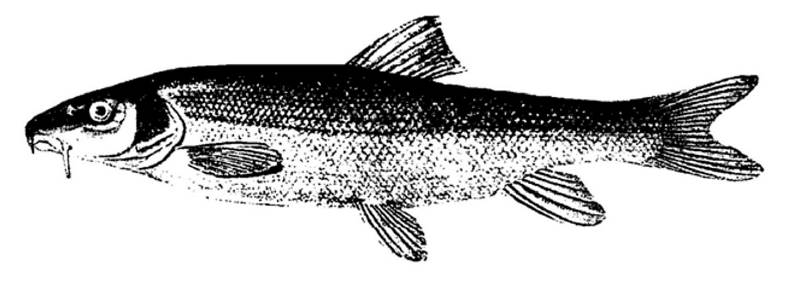
Fig. 23. Crimean barbel Barbus tauricus
The body is elongated, fairly deep, and slightly compressed laterally. The snout is relatively short and blunt. All three lobes of the lower lip are well developed, but the middle one lacks a free posterior margin. The height of the dorsal fin is 20.5–24.1% of the body length excluding the caudal fin. The coloration is more or less uniform, greenish-olive, lighter and silvery-gray on the sides, and whitish or yellowish on the belly. The dorsal and caudal fins are dark gray, while all others are light gray and yellowish at the tips. Young specimens feature scattered dark spots across the body.
Biology has not been sufficiently studied.
An endemic species of Crimean water bodies, the population of which has sharply declined, especially in rivers.
In Crimea, it is distributed in the middle reaches of the Alma, Kacha, Ayan, Belbek, Chernaya, Salpir, and Uchansu rivers, and has been acclimatized in the Bakhchisaray, Alma, Simferopol, and Ayan reservoirs, among others. It is a rather rare, low-number fish species. Listed in the Red Book of Ukraine.
Last update: 07/08/2026
Editorial and Educational Adaptation: This material has been compiled based on the primary/original source text. The project team performed an editorial review, corrected technical inaccuracies, structured sections, and adapted the content for an educational format.
What was processed:
- elimination of formatting defects (OCR errors, structural breaks, corrupted characters);
- editorial organization of content;
- standardization of terminology in accordance with academic sources;
- verification of factual statements against the original source text.
All mentions of the author, publication year, and origin of the primary text have been preserved in accordance with the source.