Basics of Evolution - Korzh O.P. - 2006
Part III. PATHS OF LIFE DEVELOPMENT
Chapter 21. Anthropogenesis
21.1. The Historical Record of the Development of Homo sapiens
According to one hypothesis, the ramapithecus was considered the earliest ancestral human form, with the overall history of anthropogenesis spanning about 15 million years. This assumption was primarily based on dental Morphology, which remains the only thoroughly studied anatomical feature common to almost all hominids (reduced canines, thickened tooth enamel, and enlarged premolars and molars in ramapithecus). Given these characteristics, scientists constructed a classical model of hominid development, suggesting a rather early divergence of the Lineage leading to modern anthropoid apes.
Later it turned out that this same dental Structure is also characteristic of other forms, including modern great apes (such as the orangutan) and certain extinct forms (gigantopithecus, sivapithecus). As a result, ramapithecus began to be viewed solely as a product of divergent evolution, and the overall timeframe of anthropogenesis was shortened to 7–8 million years. The accumulation of fossil remains of putative human ancestors, whose traits proved to be convergent, forced researchers to abandon the notion of a strictly unilineal character of anthropogenesis progressing from simpler to more advanced forms.
It is this relatively small-sized form that could have been the direct ancestor of all subsequent forms.
Between 4 and 3 million years ago, the common hominid lineage split into several species, giving rise to two main directions in Human Development. The first includes the australopithecines, which exhibited significant differences between early and late forms. In addition to the Afar hominid, scientists classify the southern ape Australopithecus africanus among the early species, sometimes combining it with the former into a single species. They possessed a slender, gracile body build, a globular cranium, strongly reduced canines; The structure of the hand, FOOT, and pelvis resembled that of modern humans, and they practiced upright walking. Subsequently, representatives of late australopithecines emerged in Africa (at least two species are distinguished—A. boisei and A. robustus), characterized by a robust body build.
Overall, the australopithecine group (translated as "southern ape") was closer to humans compared to modern great apes. The greatest similarity lay in the STRUCTURE OF THE Teeth and dental system (in most species, even the premolars were bicuspid, just like in humans). Brain volume ranged
Currently, Australopithecus afarensis is considered the earliest representative of ancient hominids; it appeared in the Pliocene (about 4–5 million years ago) and already possessed all the traits inherent to true hominids, notably the capacity for bipedalism.
within 450–550 cm3, and height ranged from 100 to 150 cm. These inhabitants of open spaces were predominantly omnivorous, although later forms leaned more toward herbivory, and cannibalism was also practiced. It is believed that australopithecines already utilized some primitive tools, and certain species may have even used fire.
Another branch of anthropogenesis is marked by The Emergence of the genus Homo, the earliest representative of which was Homo habilis. Unlike australopithecines, its jaws and teeth were significantly smaller, and its cranial capacity already exceeded 650 cm3. The structure of the foot (the big toe was no longer opposable to the others) indicates the completion of morphophysiological adaptations associated with bipedalism. The very name "handy man" is associated with its ability to manufacture genuine pebble tools (the transition to the pebble-tool culture is recognized as the main dividing line between humans and their ancestral forms).
Regarding the relationship between these two groups, scientists have not yet reached a consensus (Fig. 21.1). Australopithecus afarensis is the earliest known form among all hominids and may have given rise to later forms. According to one hypothesis, Australopithecus africanus descended from A. afarensis and is the ancestor of both robust australopithecines and Representatives of the genus Homo. However, another view suggests that australopithecines and humans diverged even before the appearance of Australopithecus afarensis.
Class="center">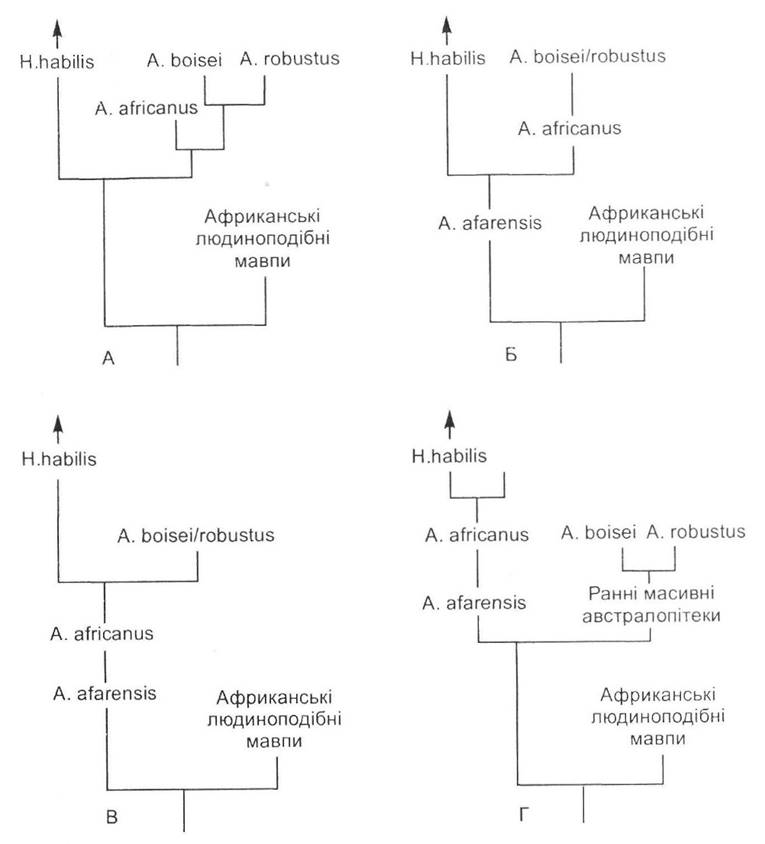
Fig. 21.1. Alternative phylogenetic schemes for the evolution of early hominids (based on various authors cited in R. Foley, 1990)
At the beginning of the Pleistocene, robust australopithecines and Homo habilis coexisted. However, by about 1.6 million years ago, H. habilis was replaced by archanthropines (Homo erectus), and more than a million years ago, australopithecines finally disappeared (some specialists believe they vanished even later).
Archanthropines are of particular interest because they began to disperse beyond their origins in modern South-East Africa. They were characterized by larger body sizes, relatively large faces and teeth (compared to modern humans and H. habilis), and well-developed supraorbital ridges. Brain volume reached 800–1000 cm3, indicating their capacity for articulate speech (a modern child begins to speak once brain volume exceeds 800 cm3). They lived primarily in caves or constructed primitive stone shelters. This species persisted for a very long time (from 1.6 million to 400,000 BC) with little change across its entire geographic range, with many regional forms recognized (such as Telanthropus, Sinanthropus, and Java Man).
The transition to Homo sapiens began with the Neanderthals (Homo sapiens neanderthalensis). They inhabited mainly Europe and Asia from approximately 350,000 to 50,000 years ago. As for the taxonomic position of Neanderthals, there is no universal agreement among scientists: some consider this form a subspecies of Homo sapiens, while others view it as an entirely independent species complex.
In their Anatomical and morphological features, these forms still differed significantly from anatomically modern humans. The brain volume of this species already averaged 1500 cm3, with an extraordinary Development of the brain regions associated with logical thinking.
Neanderthals made extensive use of fire, significantly improved their stone tools, but had not yet abandoned cannibalism.
Today, scientists have concluded that Neanderthals represent a heterogeneous group; specifically, their early and late forms exhibited marked morphological differences. The earlier forms were physically less robust than the later ones, but showed a strong tendency toward social Organization, which allowed early Neanderthals to survive intense evolutionary competition and ultimately give rise to modern humans.
Both Neanderthals and Cro-Magnons (Homo sapiens sapiens) coexisted for a certain period, though the exact timeline of the transition to the latter remains uncertain. With a fair degree of probability, it can be stated that about 40,000 years ago, anatomically modern humans remained the sole surviving hominid representative and spread across the globe, although they may have coexisted with other paleanthropic groups for quite some time.
Last update: 07/08/2026
Editorial and Educational Adaptation: This material has been compiled based on the primary/original source text. The project team performed an editorial review, corrected technical inaccuracies, structured sections, and adapted the content for an educational format.
What was processed:
- elimination of formatting defects (OCR errors, structural breaks, corrupted characters);
- editorial organization of content;
- standardization of terminology in accordance with academic sources;
- verification of factual statements against the original source text.
All mentions of the author, publication year, and origin of the primary text have been preserved in accordance with the source.