BOTANY WITH BASICS OF HYDROBOTANY (AQUATIC PLANTS OF UKRAINE) - B.Ye. Yakubenko - 2011
VI. PLANT KINGDOM SYSTEM
LOWER SPORE PLANTS
GENERAL CHARACTERISTICS AND FEATURES
Order Zygnematales - Zygnematales
Includes coccoid and unbranched filamentous Algae (about 1,600 species, of which about 200 are part of the flora of Ukraine). Cells are coccoid-fusiform, cylindrical, non-constricted, with a wall lacking pores and covered with a layer of mucus. METABOLISM/14.html">Chloroplasts are axial, laminate, ribbon-like, and stellate, with one or several pyrenoids. Vegetative Reproduction occurs through transverse Cell Division in half (coccoid forms) and filament fragmentation (filamentous forms), while sexual reproduction takes place via anisogamous conjugation (lateral and scalariform). During the conjugation of coccoid forms, their cell walls become mucilaginous, forming a common mucous layer in which each cell produces a short copulation process directed toward the neighboring partner. After the copulation processes meet, their walls dissolve, and The Cell protoplasts fuse to form a zygote. During the conjugation of filamentous forms, The formation of a conjugation tube is observed between two Cells of the same filament (lateral conjugation) or between cells of adjacent filaments (scalariform conjugation). The latter type of conjugation occurs when both filaments become mucilaginous within a shared mucous layer, with each or an individual cell forming a copulation process directed toward the partner's cell (resulting in a membranous ladder-like Structure). After they meet and their walls dissolve, a conjugation tube is formed, through which the protoplasts of both cells or only one of them move toward each other, fusing to form a zygote either within the tube itself or in one of the cells. The zygote forms a thick three-layered wall, the upper layer of which is ornamentally patterned and transforms into a zygospore. Following a resting period, the zygospore nucleus undergoes reduction division, producing one (in filamentous forms) or four (in coccoid forms) seedlings of new vegetative cells.
Genus Spirogyra - Spirogyra (Fig. 42). Features a filamentous thallus, most commonly free-floating, occasionally attached to the substrate by rhizoids. Cells are short-cylindrical or elongated, with a large central vacuole containing cell sap, an outer cellulosic wall, and a mucous layer. The Cytoplasm occupies a peripheral, parietal position, while a small region in the center of the vacuole contains a prominent nucleus and connects to the peripheral part via several cytoplasmic strands. Chloroplasts are ribbon-like and spiral (ranging from one to four) with dissected margins and numerous pyrenoids. The Nucleus is located in the center, with a distinct nucleolus (Fig. 43).
Class="center">Water/water.files/image043.jpg" width="497"/>
Fig. 42. Life Cycle of species of the genus Spirogyra
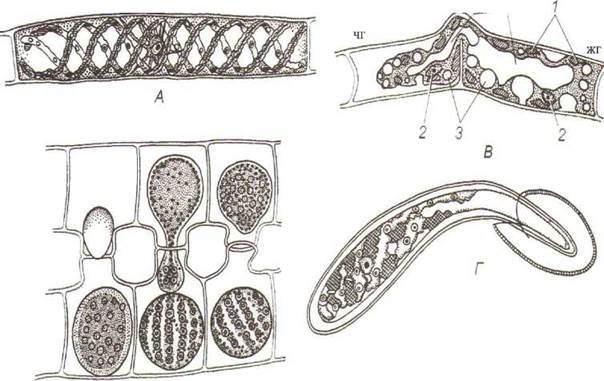
Fig. 43. Structural features and Sexual process in species of the genus Spirogyra:
A - Cell Structure; B - scalariform conjugation; C - lateral conjugation; D - zygote germination; жг - female gamete; чг - male gamete; 1 - chloroplasts; 2 - nucleus; 3 - contractile vacuoles; 4 - central vacuole
Genus Zygnema - Zygnema. Closely related in appearance to the previous genus of filamentous zygnematalean algae. Characterized by elongated-cylindrical cells with 2 stellate chloroplasts connected by cytoplasmic strands, with pyrenoids in the center of each, and the presence of a thin outer mucous layer (Fig. 44). The formation of basal rhizoids is occasionally observed. This is a typical representative of wetland water bodies.
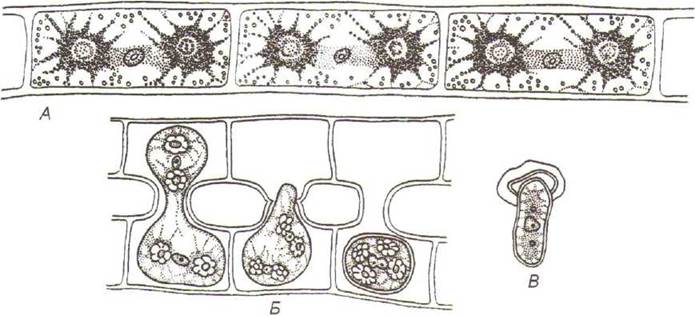
Fig. 44. Schematic view of a filament of a representative of the genus Zygnema and the sexual process:
A - cell structure; B - scalariform conjugation; C - zygote germination.
Last update: 07/08/2026
Editorial and Educational Adaptation: This material has been compiled based on the primary/original source text. The project team performed an editorial review, corrected technical inaccuracies, structured sections, and adapted the content for an educational format.
What was processed:
- elimination of formatting defects (OCR errors, structural breaks, corrupted characters);
- editorial organization of content;
- standardization of terminology in accordance with academic sources;
- verification of factual statements against the original source text.
All mentions of the author, publication year, and origin of the primary text have been preserved in accordance with the source.