BOTANY WITH BASICS OF HYDROBOTANY (AQUATIC PLANTS OF UKRAINE) - B.Ye. Yakubenko - 2011
V. CYTOLOGY. CONCEPT OF THE CELL
Structure of the Plant Cell
Inclusions
Substances produced by The plant Cell can accumulate in large quantities within the Cytoplasm matrix, Organelles, vacuoles, and The Cell wall in an amorphous or crystalline state. These solid substances or structured liquids are called inclusions. Inclusions are ergastic substances, which include reserve nutrients and the End products of METABOLISM.
Nutritive inclusions include starch grains, lipid droplets, and aleurone grains or protein globules. The end products of metabolism are represented by crystals formed by certain substances.
Starch grains are inclusions representing reserve starch. Starch grains are formed exclusively in Plastids. During Photosynthesis in the presence of light, osmotically active sugars are produced in the Chloroplasts of leaves. They are subsequently converted into insoluble assimilatory (primary) starch. At night, this starch is hydrolyzed into soluble and transportable carbohydrate forms, which are translocated to storage Organs where amyloplasts convert them into reserve (secondary) starch. Initially, a nucleation center forms within the amyloplast stroma, upon which new layers of starch are subsequently deposited.
According to their shape, starch grains are classified (Fig. 6) as concentric (spherical) and eccentric (irregular). Based on the number of nucleation centers, starch grains are divided into simple, compound, and semi-compound. Simple grains have a single nucleation center, resulting in The formation of one starch grain within the amyloplast. Compound and semi-compound grains possess multiple nucleation centers. A compound starch grain is formed within a single amyloplast from several simple grains closely pressed against one another. A semi-compound grain is formed through the deposition of common starch layers over a group of simple starch grains within the amyloplast.
Class="center">Water/water.files/image006.jpg" width="374"/>
Fig. 6. Starch grains:
1 — wheat, 2 — rye, 3 — barley, 4 — corn, 5 — buckwheat, 6 — oat,
7 — in germinated wheat grains, 8 — pea, 9 — bean, 10 — simple potato,
11 — compound potato, 12 — semi-compound potato.
Lipid droplets occur in the cytoplasm matrix of Seed and Fruit Cells, as well as in the wood parenchyma of conifers, linden, birch, and oak. Here, they are most frequently housed within spherosomes.
Reserve Proteins form storage deposits or crystalline structures known as aleurone grains. Reserve proteins are synthesized in Ribosomes and deposited in the vacuoles of storage cells in seeds and fruits. As the seeds mature, the vacuoles dehydrate, and their reserve proteins crystallize into aleurone grains.
Calcium oxalate crystals are deposited within vacuoles. They can be simple (solitary) or compound, such as druses and raphides (Fig. 7). Spherical clusters of crystals are called druses, whereas elongated bundles of needle-like crystals are termed raphides. Crystals may also consist of carbonates and silica.
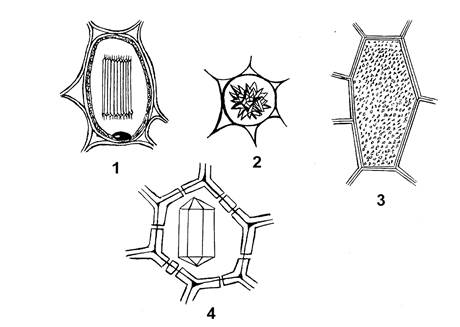
Fig. 7. Shapes of calcium oxalate crystals in cells:
1 - raphide (Touch-me-not), 2 - druse (prickly pear), 3 - crystal sand (potato), 4 - solitary crystal (vanilla).
Last update: 07/08/2026
Editorial and Educational Adaptation: This material has been compiled based on the primary/original source text. The project team performed an editorial review, corrected technical inaccuracies, structured sections, and adapted the content for an educational format.
What was processed:
- elimination of formatting defects (OCR errors, structural breaks, corrupted characters);
- editorial organization of content;
- standardization of terminology in accordance with academic sources;
- verification of factual statements against the original source text.
All mentions of the author, publication year, and origin of the primary text have been preserved in accordance with the source.