BOTANY WITH BASICS OF HYDROBOTANY (AQUATIC PLANTS OF UKRAINE) - B.Ye. Yakubenko - 2011
X. SEED PLANTS
Pondweed Family (Potamogetonaceae)
Perennial aquatic herbs, fully or partially submerged in Water. Leaves alternate, with sheaths or axillary stipules. Flowers inconspicuous, bisexual or unisexual, arranged in spike-like inflorescences or solitary; perianth simple, four-merous, sometimes absent; stamens and pistils four each, rarely a single pistil, gynoecium apocarpous. Flower formula: * P2+2 A2+2G4(1). Fruit drupaceous or nut-like.
The family comprises two genera and about 100 species distributed worldwide; one genus and 18 species occur in Ukraine.
Fennel-leaved pondweed (Potamogeton pectinatus L.). A plant with a thread-like, highly branched stem, 15-150 (200) cm long; rhizome horizontal, branched, with tuberous thickenings 10-30 cm long; roots thin (Fig. 180). Leaves narrow-linear, filiform, 2-15 cm long and up to 2 mm wide, with three Veins. Stipules fuse with the lower part of the blade, forming tubular sheaths up to 2.5 cm long. Inflorescence spike-like; peduncles long, thread-like; rings of flowers float on the water surface during flowering. Flowers bisexual, four-merous. Blooms in June–August. The fruit consists of one to four drupaceous single-seeded fruitlets.
A polymorphic species forming numerous ecological forms. It grows in freshwater bodies throughout Ukraine and tolerates wastewater-polluted habitats.
A forage, ornamental, and industrial plant with potential for cultivation. Its thickets serve as concentration sites for waterfowl and spawning grounds for fish; its leaves are consumed by common carp, barbel, crucian carp, roach, grass carp, Caspian roach, bream, tench, and ide, though mass proliferation can occasionally harm fish fry. The plant is suitable for composting and fertilizer production. It enriches water bodies with oxygen, enhances their aesthetic appeal, and is widely used in aquascaping.
Flat-stemmed pondweed (P. compressus L.). A plant with a strongly flattened stem up to 2 m long, featuring elongated internodes (3-20 cm long). Leaves elongated, alternate, entire, sessile, 5-20 cm long, 2-4 mm wide, with 5 main veins (Fig. 181).
Stipules long, up to 3 cm, whitish, apex acute. Inflorescence a dense cylindrical spike; flowers bisexual, perianth absent, stamens four, pistils four. Blooms in May–July. Fruit a drupe, up to 2 mm long, Kidney-shaped.
Class="center">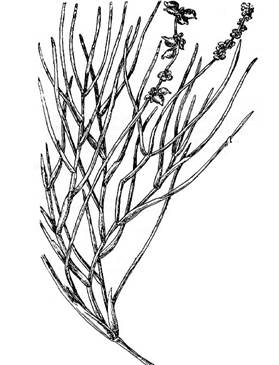
Fig. 180. Fennel-leaved pondweed (Potamogeton pectinatus)
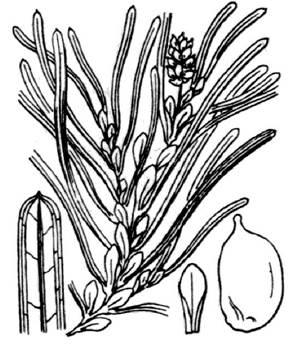
Fig. 181. Flat-stemmed pondweed (Potamogeton compressus)
A forage, ornamental, and water-protection plant. Its vegetative parts contain Proteins, CARBOHYDRATES, nitrogen-free extractives, and various macro- and microelements. It serves as high-quality forage for most aquatic fauna and is suitable for water body decoration.
Found in meso-eutrophic flowing and standing water bodies with a depth of 20-150 cm, oxbow lakes, lakes, reservoirs, along the coastal zones of riverbeds, and on peat bogs. Distributed in Polissia, and sporadically in the Forest-Steppe, Steppe, Carpathians, and Pre-Carpathian region.
Small pondweed (P. obtusifolius Mert. et Koch). Distinguished by peduncles equal in length to the inflorescences, rarely shorter. Inflorescence dense, short, cylindrical, 6-8-flowered. Flowers bisexual, blooming in June–August; fruit nut-like, 2-3 mm long, tuberculate, beaked.
Occurs in Polissia, sporadically in the Forest-Steppe, Steppe (lower reaches of major rivers), and in the Carpathians from lowland to foothill belts. Grows in lakes, floodplains, canals, and shallow areas of artificial reservoirs. Intolerant of bottom freezing; fails to flower in polluted, turbid waters.
A forage and water-protection plant, acting as a pioneer species in the overgrowth of alluvial sites in water bodies. Listed in the Green Book of Ukraine.
Fries' pondweed (P. friesii Rupr.). Peduncles two to six times longer than the inflorescences, which contain 3-4 (10) flowers; leaves linear, stipules twice-forked at the apex. Blooms in June–August. Fruit nut-like, obliquely elliptic, up to 3 mm long, with a short, straight, or recurved beak.
Distributed sporadically in Polissia and the Forest-Steppe in lakes, river oxbows, canals, ponds, and shallow reservoir areas.
Hair-like pondweed (P. trichoides Cham. et Schlecht.). A plant with narrow, setaceous leaves and a prominent midrib. Stem thread-like, branched. Peduncles two to three times longer than the inflorescence. Blooms in June–August. Fruitlets 2-3 mm long, with a short straight or curved beak.
Rarely found in small stagnant water bodies in Transcarpathia, Polissia, and the Forest-Steppe.
Reddish pondweed (P. rutilus Wolfg.). Plants with slender stems 0.5-2 mm thick; leaves with a reddish tint, narrow-linear, with a long acute apex, up to 7.7 cm long. Stipules fused at the margins, forming an ocrea. Peduncles four to six times longer than the sparse inflorescences. Blooms in June–August. Fruitlets up to 2 mm long, hemispherical, with a curved beak.
Occasionally found in northern Polissia and the Forest-Steppe. Listed in the Green Book of Ukraine.
Sharp-leaved pondweed (P. acutifolius Link). A plant with a flattened stem and closely set branches. Stems and leaves are nearly equal in width (up to 4 mm). Leaves are linear, acutely pointed, with reddish tubercles at the base. Peduncles equal or slightly shorter than the inflorescence, which consists of four to eight flowers. Blooms in June–August. Fruitlets are up to 3 mm long, with a tubercle at the base and a curved beak.
Grows in standing and slow-flowing waters throughout Ukraine; rare in Transcarpathia, and sporadic in Polissia, the Forest-Steppe, and the Steppe zones.
Small pondweed (P. pusillus L.). The stem is cylindrical or slightly flattened, branched, 15–70 cm long; the rhizome is thin, branched, up to 30 cm long. Leaves are linear, thread-like, without a sheath; There is a single membranous stipule with three veins. Peduncles are 1–3 cm long, two to four times longer than the spike-like inflorescence, which features three to six closely set three-flowered whorls. Flowers are bisexual with a four-part simple perianth. Blooms in June–August. The fruit is drupe-like, up to 2.5 mm long, elliptic, with a short beak.
Characterized by a diversity of ecological forms. Widespread in Transcarpathia, Polissia, and the Forest-Steppe (frequent); sporadic in the Steppe; rare in Crimea.
Grows in meso-eutrophic water bodies with moderate current and a water depth of up to 2.5 meters.
A forage and technical plant, showing promise as an organic fertilizer.
Berchtold's pondweed (P. berchtoldii Fieb.). Differs from the previous species by having free stipules and a flattened stem 15–70 cm long. Blooms in June–August. Fruitlets are convex on the ventral side. Found in lakes, ponds, river floodplains, and marshes across almost all of Ukraine, with the exception of the Carpathians and Crimea.
Sarmatian pondweed (P. sarmaticus Maemetas). A plant with a cylindrical, branched stem 15–60 cm long; internodes in the middle part of the stem are 3–4 cm long, and up to 10 cm long in the upper part. Leaves are opaque, dull, nearly sessile, up to 10 cm long and up to 3 cm wide. The midrib and lateral VEINS OF THE submerged leaves feature a light-colored stripe, a characteristic that distinguishes this species from others. Floating leaves are nearly sessile, arranged in rosette-like clusters. Peduncles are thicker than the stem, thickened at the apex. Flowers are bisexual. Blooms in June–August. The fruit is nut-like, up to 3 mm long.
Occurs occasionally in freshwater or slightly brackish water bodies in the Forest-Steppe and Steppe zones.
An ornamental, forage, and water-protection plant.
Node-flowered pondweed (P. nodosus Poir.). A plant with a thick, cylindrical, highly branched stem. Submerged leaves are 10–30 cm long, lanceolate, blunt at the apex, seven-veined, petiolate, and wither during flowering. Floating leaves are leathery, elliptic, 2–12 cm long, pointed. Stipules are up to 10 cm long, brownish, and shed early. Peduncles are longer than the inflorescence, 2–6 cm long, dense, and many-flowered. Blooms in June–August. The fruit is nut-like, 2–3.5 mm long, with a short beak.
Common in flowing, less frequently enclosed fresh or slightly saline water bodies with a muddy bottom, at a depth of 100–150 cm in the Forest-Steppe and Steppe zones. The above-ground biomass contains carbohydrates, proteins (21.55%), fiber (27.45%), carotenoids, and micro- and macroelements. An ornamental, forage, and water-protection plant. Accumulates radionuclides.
Grass-leaved pondweed (P. gramineus L.). A plant with a branched stem ranging from 30 to 150 (300) cm in length. Leaves are of two types: submersed and emersed. Submersed leaves are sessile, pointed, lanceolate, flat or folded twice, and sickle-shaped. Emersed leaves are elliptic, rarely lanceolate, rounded at the base, with small petiolate stipules; petioles are three times longer than the blades. The inflorescence is spike-like, 2–3 cm long and up to 0.4 mm wide. Flowers are bisexual. Blooms in May–August. The fruit is aggregate, drupe-like, consisting of one to four fruitlets. A polymorphic species distinguished by a significant number of forms and ecotypes. Grows in lakes, ponds, and canals across almost all of Ukraine, except for Crimea, and also acts as a weed in rice paddies. Subject to anthropization, water pollution, and eutrophication, it gradually disappears.
The biomass contains proteins (21.5%), fiber (26.3%), and micro- and macroelements. A forage, phytoremediation, ornamental, and water-protection plant. The biomass serves as excellent fish feed and helps reinforce shoreline banks.
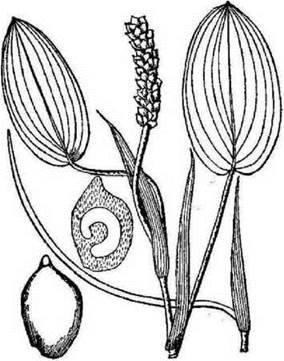
Fig. 182. Floating pondweed
Floating pondweed (P. natans L.). A plant with a weakly branched cylindrical stem, 100–200 cm long (Fig. 182). Leaves are alternate; emersed leaves have long petioles up to 12 cm, are ovate-cordate or broadly lanceolate, and leathery; submersed leaves are narrow-linear, semi-cylindrical, up to 50 cm long, with a vegetation period lasting 25–30 days. The inflorescence is spike-like, 4–5 cm long, on long peduncles. Flowers are yellowish, bisexual. Blooms in June–August. Fruits are aggregate drupes composed of one to four fruitlets.
Widespread across almost all of Ukraine; rare in Crimea and the Steppe zone. Exhibits polymorphism, forming hybrids with grass-leaved and shining pondweeds. Grows in shallow, sluggishly flowing and flowing water bodies, lakes, ponds, riverbeds, backwaters, flooded quarries, ditches, canals, and streams. Forms dense thickets in small water bodies.
The leaves and stems contain organic and Inorganic Compounds, ascorbic acid (50 mg/100 g), and are particularly rich in manganese. Rhizomes contain protein (up to 14%) and fats (up to 2.4%).
A water-protection, valuable forage, food, medicinal, fishery-related, ornamental plant. Medicinally, the leaves are used: an infusion is taken for Skin rashes and itching, as an anti-inflammatory and soothing agent, and for washing wounds and ulcers.
Alpine pondweed (P. alpinus Balb.). Stem is cylindrical, simple, reddish at the top. Emersed leaves are leathery, obovate, sessile or short-petiolate. Submersed leaves are sessile, lanceolate, blunt at the apex, entire-margined. Blooms in June–August. Fruits are up to 3 mm long, with a straight or slightly curved beak. Grows in mountain lakes, ponds, and ditches; tolerates the drying up of water bodies. Found in Transcarpathia, the Carpathians, and Polissia. An indicator of clean water bodies, requiring conservation.
Shining pondweed (P. lucens L.). Plants with a cylindrical, branched stem 20–200 (250) cm long; leaves are alternate. All leaves are submersed, membranous, translucent, short-petiolate, oblong-lanceolate or elliptic, bright green, and glossy. Sometimes the blade is underdeveloped and represented only by the midrib. Peduncles are 10–15 cm long, and the inflorescence is dense, up to 6 cm long. Flowers are bisexual. Blooms in June–August. The fruit consists of one to four drupe-like fruitlets that are nearly spherical, about 4 mm in diameter.
Temporary above-ground forms with short, poorly developed leaves are occasionally encountered. A polymorphic species. Widespread throughout Ukraine; sporadic in the Steppe and the Carpathians, and rare in the foothill zone of Crimea. Grows in lakes, slow-flowing rivers, oxbows, ponds, and as a weed in rice paddies. Frequently found in irrigation canal systems; forms dense underwater meadows covering several hectares in certain lakes. Biomass contains up to 17.4% proteins, 1.1% sugars, and up to 30% fiber, alongside micro- and macroelements.
A valuable forage, technical (as fertilizer), water-protection, and ornamental plant. Thickets serve as spawning grounds for valuable fish species.
Perfoliate pondweed (P. perfoliatus L.). A plant with a branched stem up to 150 cm long. Features exclusively submersed leaves that are broadly ovate or oblong-ovate, with a stem-clasping base and a finely toothed margin. Stipules shed early. Peduncles are two to two-and-a-half times longer than the dense spike-like inflorescence. Flowers are bisexual. Blooms in July–August. The fruit consists of one to four drupe-like fruitlets.
A polymorphic species encompassing numerous intraspecific taxa, both ecological and ontogenetic. Under flowing water conditions, it occasionally forms fringe-like stands.
Widespread throughout Ukraine, though rare in Crimea. It inhabits rivers, lakes, ponds, oxbow lakes, canals, and shallow reservoir areas.
The plant accumulates micro- and Macronutrients, proteins (16.6%), Lipids (up to 1%), and crude fiber (33.6%).
A forage, ornamental, fishery, and technical plant (used as fertilizer), as well as a water-protection species. It serves as an indicator of eutrophic and enclosed mesotrophic water bodies, as well as heavy metal salt pollution. A pioneer in shallow-water overgrowth and a weed in rice paddies. The species shows promise for cultivation in fish and game farms. Its dense stands provide habitats for mass concentrations of waterfowl, fish, and other aquatic fauna. It is a promising biofilter and an active accumulator of biogenic elements.
Long-leaf pondweed (P. praelongus Wulf.). Stem cylindrical, up to 300 cm long, with tortuous internodes. Leaves sessile, 10-15 cm long, oblong-lanceolate, entire-margined. Stipules 1.5-6 cm long, yellowish. Peduncles 15-20 cm long; inflorescences 3-6 cm long, dense, many-flowered. Flowers bisexual. Blooms from June to August. Fruits nut-like, 4-5 mm long.
It grows in eutrophic freshwaters: ponds, lakes, oxbow lakes, and more rarely in riverbeds across the Carpathians, Polissia, and the Forest-Steppe zone. A forage, technical, and water-protection plant.
Curly pondweed (P. crispus L.). Stem compressed, quadrangular, 30-50 (200) cm long. Leaves exclusively submerged, lanceolate or broad-linear, 4-9 cm long, serrate along the margin. Peduncles 2-3 cm long, reddish-brown; inflorescences spicate, 1.5-2 cm long. Flowers bisexual, blooming from June to August; fruitlets up to 2.0 mm long, featuring a long sickle-shaped beak.
It grows in lakes, rivers, quarry water bodies, ponds, and ditches throughout Ukraine, though rare in Crimea. Even under significant wastewater pollution and heightened anthropization, plant vitality does not decline; at times, an expansion of its growth areas is observed. Water level fluctuations induce changes in leaf morphological traits.
A forage, water-protection, and fishery plant. It acts as an indicator of eutrophic, calcium-rich water bodies. It tends to proliferate in ponds utilized for intensive fish farming.
Last update: 07/08/2026
Editorial and Educational Adaptation: This material has been compiled based on the primary/original source text. The project team performed an editorial review, corrected technical inaccuracies, structured sections, and adapted the content for an educational format.
What was processed:
- elimination of formatting defects (OCR errors, structural breaks, corrupted characters);
- editorial organization of content;
- standardization of terminology in accordance with academic sources;
- verification of factual statements against the original source text.
All mentions of the author, publication year, and origin of the primary text have been preserved in accordance with the source.