Plant Physiology - Lecture Notes - O. M. Tarnopilska 2019
4. Photosynthesis
4.5 Non-cyclic and Cyclic Photophosphorylation
Photophosphorylation, namely the synthesis of ATP in METABOLISM/14.html">Chloroplasts via light-driven reactions, can proceed through either cyclic or non-cyclic pathways.
Cyclic photophosphorylation is simpler and evolutionary more primitive. In cyclic photophosphorylation, only PSI Functions, and ATP is its sole product.
Cyclic photophosphorylation was discovered in 1954 by Daniel Arnon, J. M. Allen, and Albert Frenkel in isolated spinach chloroplasts.
In Photosystem II, the reaction center—consisting of a chlorophyll a dimer with an absorption maximum at 680 nm (P680)—sequentially absorbs energy equivalent to two quanta of short-wavelength red light. Upon transitioning to a singlet excited state, it transfers two electrons to pheophytin. From pheophytin, the electrons are successively transferred to the plastoquinones QA and QB, located on the opposite side of the thylakoid membrane, and then to two lipid-soluble plastoquinone PQ molecules. PQ acts as a shuttle carrier for protons and electrons within the membrane. Accepting two electrons and taking up 2 H + from the stroma, two PQH2 molecules diffuse through the lipid phase of the membrane. Electrons from 2 PQH2 enter the chain:
- iron-sulfur protein FeSr → cytochrome f → Cu-containing protein plastocyanin → P700, while protons are released into the thylakoid lumen.
The electron vacancies in P+680 are filled by two electrons from a Mn-containing electron carrier, which is reduced via the protein complex S. The oxidized complex S binds Water and is reduced by electrons derived from water. During the photooxidation of water by complex S, a second pair of protons is released into the thylakoid lumen, and the oxygen atom diffuses out of the chloroplast.
Following the excitation of Photosystem I reaction center—chlorophyll a molecules with an absorption maximum at 700 nm (P700)—by two quanta of long-wavelength red light, two electrons are transferred to the monomeric form of chlorophyll a (A1), and subsequently to the electron carriers: iron-sulfur Proteins A2 and AB, ferredoxin on the outer side of the thylakoid membrane, and NADP reductase. This enzyme reduces NADP to NADPH. The electron vacancies in P+700 are filled by electrons from plastocyanin, thereby completing the non-Cyclic electron transport chain.
A cyclic electron transport can function in chloroplast membranes when only photosystem I is active. Excited P700 molecules transfer electrons to A1, iron-sulfur proteins A2 and AB, which carry electrons across the membrane to ferredoxin, plastoquinone, cytochrome b6, the FeSr iron-sulfur protein, cytochrome f, plastocyanin, and P700 (Fig. 4.4). The energy released during Electron transport is utilized for ADP phosphorylation.
ATP Synthesis. Electron transfer along the Electron Transport Chain proceeds down a redox potential gradient and is accompanied by energy release, which is utilized for ATP synthesis. ATP synthesis is driven by the electrochemical proton gradient built up in the lumen of the granal thylakoid.
Several theories explain The Mechanism of ADP phosphorylation coupled with electron transport. The most widely accepted is the chemiosmotic theory proposed by the English biochemist P. Mitchell (1961). According to this theory, plastoquinone accepts two electrons from P680, picks up two additional protons from the chloroplast stroma, and transports them across the membrane into the thylakoid lumen. Protons accumulate inside the thylakoid, leading to the photooxidation of water.
Class="center">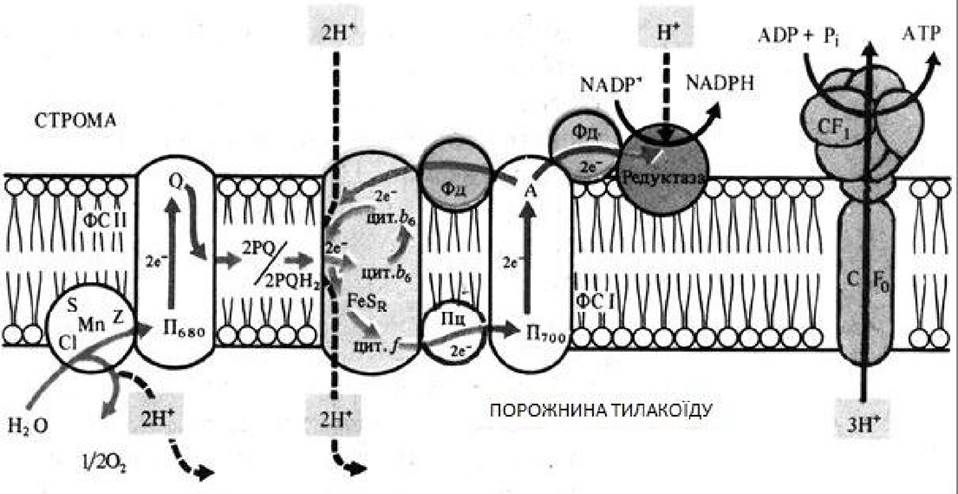
Figure 4.4 - Localization of electron and proton transport reactions in the chloroplast thylakoid membrane (after V. V. Polevoy)
Due to the uneven distribution of protons across both sides of the membrane, a difference in chemical potentials of protons is established, generating a hydrogen ion electrochemical Membrane Potential (ΔμН+). ΔμН' comprises two components: the concentration component (ΔμН), resulting from the asymmetric distribution of protons across the membrane, and the electrical component (Δψ), caused by The Development of opposite charges on the membrane surfaces, i.e., The formation of a membrane potential. The energy of ΔрН and Δψ is harnessed for the back-transport of protons from the thylakoid lumen into the chloroplast stroma through specialized channels. This reverse proton transport is coupled with ADP phosphorylation.
The coupling of reverse proton transport and ADP phosphorylation is mediated by H+-ATP synthase, which is embedded in the thylakoid membranes and consists of two domains: a water-soluble catalytic domain (F1) facing the chloroplast stroma, and a hydrophobic membrane domain (F0) spanning Cell/29.html">The Lipid Bilayer. The latter forms a proton channel through which protons can flow back into the stroma. ADP and phosphate bind to the enzyme at its catalytic F1 domain. Two protons travel down the Electrochemical Potential gradient through the proton channel (F0) and combine with oxygen from the phosphate to form water. The loss of oxygen activates the phosphate group, enabling its attachment to ADP to yield ATP.
The H+-ATP synthase enzyme remains active as long as protons are being transported. Proton translocation occurs when their concentration in the thylakoid lumen is higher than in the stroma. For every two electrons transferred along The electron transport chain, 4H+ accumulate inside the thylakoid. The return of two protons to the chloroplast stroma results in the synthesis of one ATP molecule.
Last update: 07/08/2026
Editorial and Educational Adaptation: This material has been compiled based on the primary/original source text. The project team performed an editorial review, corrected technical inaccuracies, structured sections, and adapted the content for an educational format.
What was processed:
- elimination of formatting defects (OCR errors, structural breaks, corrupted characters);
- editorial organization of content;
- standardization of terminology in accordance with academic sources;
- verification of factual statements against the original source text.
All mentions of the author, publication year, and origin of the primary text have been preserved in accordance with the source.