Plant Anatomy: Practical Course - Paniuta O.O. 2019
Topic 1. The Cell
Laboratory Work No. 3. Cytoplasmic Streaming
Theoretical Background. Cytoplasmic streaming (cyclosis) is one of the most vital Properties of the Cell, closely linked to all its metabolic processes. The rate of cytoplasmic streaming depends on Temperature. At temperatures below 10°C, cytoplasmic streaming nearly ceases, reaching its maximum speed at 27°C, but stops entirely at 42°C.
Cytoplasmic streaming can be observed in various plant specimens, provided they are living material. Streamline (reticulate) movement is easily observed in the staminal Hair Cells of Tradescantia, the ROOT hairs of frogbit (Hydrocharis), and the stinging hairs of nettles; rotational movement is seen in the leaf cells of Vallisneria, Elodea, and others.
Cytoplasmic streaming can be halted by treating the slide with alcohol or iodine, which causes The Cell to die. Consequently, cytoplasmic streaming is a characteristic exclusive to living cells.
Objective: to examine various types of cytoplasmic streaming in plant cells.
Materials and equipment: light microscopes, Glass slides and coverslips, dissecting needles, forceps, razor blades, glass stirring rods, filter paper, distilled Water, ethyl alcohol, plant material.
Slide. Streamline cytoplasmic streaming in the staminal hair cells of Tradescantia virginiana L.
For observation, a stamen is gently removed from a Tradescantia flower or bud using forceps, placed in a drop of water on a glass slide, and a few hairs are then teased off using a needle. In the studied hairs, the Cytoplasm moves very rapidly in various directions along cytoplasmic strands. This movement is indicated by the displacement of small granules suspended in the cytoplasm. This specimen is particularly well-suited for observing cytoplasmic streaming, which occurs in the presence of oxygen; when oxygen is scarce, streaming slows down and eventually stops.
Note. Streamline cytoplasmic streaming can also be observed in the hair cells of young pumpkin shoots. To prepare the slide, they should be carefully sectioned with a razor blade and immediately placed in a drop of water on a glass slide. Subsequent observations are carried out in the same manner as with the Tradescantia staminal hairs.
Streamline cytoplasmic streaming can also be observed in the stinging hairs covering the body of the nettle plant, especially in the first half of summer. Nettle hairs appear as elongated cells. The lower part of the hair is enlarged, housing The Nucleus and the bulk of the cytoplasm. A large number of vacuoles are visible within the cytoplasm. Cytoplasmic streaming here occurs in much the same way as in Tradescantia hairs.
Slide. Rotational cytoplasmic streaming in the leaf cells of Canadian pondweed (Elodea canadensis Michx.)
An Elodea leaf consists of only two cell layers, making it well-suited for direct microscopic examination in its natural state.
To prepare a slide for observing cytoplasmic streaming, use forceps to pluck a young leaf from the tip of an Elodea stem, place it in a drop of water on a glass slide, and cover it with a coverslip. The slide is first examined under low magnification and then positioned so that the cells flanking the midrib or located near the edge of the leaf are in the center of the field of view. These cells contain fewer METABOLISM/14.html">Chloroplasts, making cytoplasmic streaming easier to observe. The cells in an Elodea leaf are elongated, with thin walls; a thin layer of cytoplasm adheres tightly to the inner surface of The Cell wall.
Green Plastids—chloroplasts—are present in the cytoplasm. Upon careful examination of the slide, one can notice that after a few minutes, the chloroplasts begin to move. By focusing the Microscope to clearly view the protoplasm and adjusting the fine-adjustment screw, it becomes apparent that the chloroplasts are not moving under their own power, but are instead being passively carried along by the moving cytoplasm. Continued observation reveals that the cytoplasm circulates in a circular path, and the direction of streaming may vary from one cell to another (Fig. 8).
Class="center">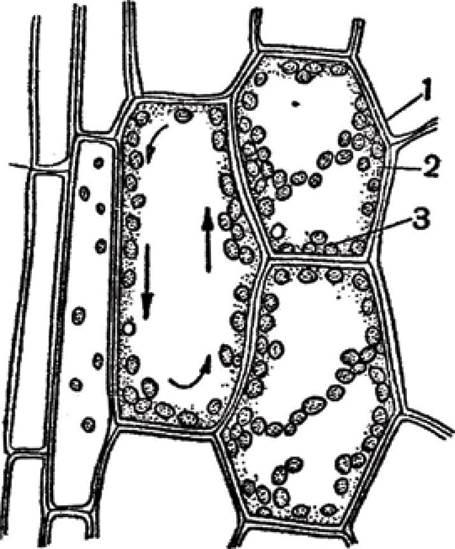
Fig. 8. Rotational cytoplasmic streaming in Elodea leaf cells:
1 - cell wall, 2 - cytoplasm,
3 - chloroplasts (arrows indicate the direction of cytoplasmic streaming)
Note. In Elodea specimens overwintering in an aquarium, cytoplasmic streaming is quite slow; to accelerate it, it is recommended to place the Elodea in warm water (25°C) prior to slide preparation. This speeds up the streaming process.
The leaf may be cut into several pieces, as mechanical irritation prompts the cytoplasm to stream much faster, particularly in cells located close to the cut edge.
Ordinary alcohol can serve as such a stimulus; adding a few drops of it to the water containing the Elodea can likewise accelerate cytoplasmic streaming.
Another aquatic plant frequently used to study cytoplasmic streaming is Vallisneria. Its young leaves can be examined whole without sectioning. Its mature leaves are relatively thick, so for research purposes, it is better to use a razor blade to cut thin sections parallel to the leaf surface before examining them under low and high magnification.
Rotational cytoplasmic streaming can also be observed in other specimens.
Last update: 07/08/2026
Editorial and Educational Adaptation: This material has been compiled based on the primary/original source text. The project team performed an editorial review, corrected technical inaccuracies, structured sections, and adapted the content for an educational format.
What was processed:
- elimination of formatting defects (OCR errors, structural breaks, corrupted characters);
- editorial organization of content;
- standardization of terminology in accordance with academic sources;
- verification of factual statements against the original source text.
All mentions of the author, publication year, and origin of the primary text have been preserved in accordance with the source.