MEDICAL BOTANY - A.G. Serbin - 2003
SECTION 3. SYSTEMATICS
SUPERKINGDOM EUCARYOTA — EUCARYOTA. KINGDOM PLANTAE
CLASS DICOTYLEDONES — Dicotyledones
SYSTEM OF FLOWERING PLANTS PROPOSED BY A.L. TAKHTAJJAN (1987)
Subclass Caryophyllidae — Caryophyllidae
Family Polygonaceae — Polygonaceae
About 800 species, mostly annual, less frequently biennial herbs, shrubs, and lianas, growing predominantly in the temperate zone (diagnostic features of Polygonaceae are shown in Fig. 3.18; References to designations are given in the text). Leaves alternate, simple, petiolate or sessile. Membranous stipules fuse into an ocreate sheath (1) enclosing the stem. Flowers small, occasionally unisexual, in cymose spiciform, racemose, paniculate inflorescences, or gathered in axillary clusters (2). Perianth simple, consisting of 5–6 free or variously fused tepals, which are persistent, enlarging, or non-enlarging in fruit. Stamens 3–9, connate (diadelphous) or free.
Class="center">Fig. 3.18. Diagnostic features of Polygonaceae

Gynoecium pseudomonocarpous, formed by 2–4 carpels. Ovary superior, unilocular, with a single ovule.
Floral formula: 
Fruit an achene (3), often three-sided, small in size, commonly referred to as a nutlet. Seeds with abundant, starchy endosperm. Stomata anisocytic (4); secretory glands (5) and secretory schizogenous receptacles (6) are characteristic; the parenchyma contains star-shaped calcium oxalate crystals—druses (7); epidermis with pubescence of hairs fused in bundles (8).
Genus Knotweed — Polygonum. Includes about 300 species. Flowers are mostly gathered into spiciform racemes. Perianth corolla-like, 4–6-merous, persistent in fruit but not enlarging. Nutlets slightly protruding from the perianth or enclosed within it.
Species of the genus differ in leaf shape, Structure OF THE ochrea, pubescence of the pedicel and perianth, fruit shape, size, etc.
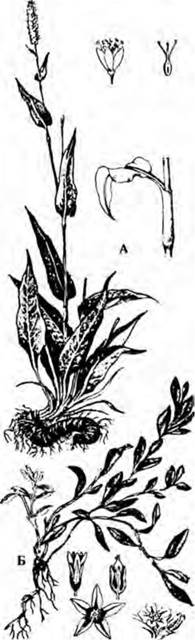
Redleg / Pale persicaria (bitchweed) — Polygonum persicaria (Fig. 3.19, A). Annual. Found in flood meadows, along banks of Water bodies, as a weed in crops, kitchen gardens, arable land, and damp places. Stem ascending, dichotomously branched, 20 to 80 cm tall, with strongly swollen nodes, anthocyanin-pigmented. Leaves mostly short-petiolate, lanceolate, long-acuminate, with a cuneate base, sparsely pubescent with bristly hairs. A brown crescent-shaped spot is present in the middle of the upper surface. Unlike water pepper, the leaves do not have a pungent taste. Ochreae reddish, tightly enclosing the stem, short-appressed-pubescent, with long cilia along the margin. Inflorescences terminal, erect, dense, short spiciform racemes, 5–8 mm thick. Perianth pinkish, greenish at the base, deeply 5-lobed, without glands, as is the pedicel. Styles 2–3, connate at the base.
Floral formula: 
Achenes about 2.5 mm long, shorter than the perianth, compressed-Heart-shaped or three-sided, asymmetrical, light brown or black, glossy.
The herb is used as an astringent, hemostatic, and vitamin remedy.
Water pepper (marshpepper knotweed) — Polygonum hydropiper (Fig. 3.19, B). Annual, growing along water banks, on damp soils (frog's-grass), and as a weed in crops. The entire plant is poisonous! Rhizome thin. Stem erect, 30–90 cm tall, branched, reddish, with swollen nodes. Leaves short-petiolate, with a narrowly cuneate base, rigidly scabrous along the margin. Translucent punctate glands are clearly visible; a dark spot is sometimes present on the upper surface. Leaves and stems have an acrid, peppery taste. Ochreae cylindrical, membranous, reddish, without noticeable pubescence, with short cilia along the margin or without them. Racemes terminal, leafy, lax, long (up to 6 cm), thin, interrupted, with a nodding apex. Perianth 4–5-partite, greenish-pink, dotted with golden glands.
Fig. 3.19: A — Polygonum persicaria, B — P. hydropiper

Floral formula: 
Achenes ovoid, 2–3 mm long, slightly shorter than the perianth, brown or dull black, pitted. They are either three-sided, with one more convex side, or flattened, with flat sides.
Leaves are used as a seasoning; the herb and its preparations exhibit astringent and hemostatic effects, and are used for gastric ulcers and Cancer, to stimulate uterine musculature, and as a vitamin source.
Common bistort (snakeroot, dragonwort) — Polygonum bistorta (Fig. 3.20, A). It grows in forests, mountainous regions, flood meadows, along water bodies, and as a weed in crops. A perennial plant featuring a thick, slightly flattened, snake-like curved rhizome of a deep red color. Stems are erect, reaching up to 100 cm in height. Basal leaves are large, with long winged petioles, oblong-ovate, with an acute apex and a decurrent base. Stem leaves are alternate, sessile, oblong-lanceolate, wavy-margined, with a cuneate or slightly emarginate base, grayish and short-pubescent beneath, and glabrous or slightly pubescent above. Ochreae are oblique and open. Spike-like inflorescences are terminal, dense, compact, cylindrical or oval, with scarious, pointed bracts. The perianth is 5-parted and persists in fruit.
Floral formula: 
Achenes are 3.5 mm long, ovoid, trigonous, glossy, and dark brown.
The rhizome is used as an astringent and hemostatic agent.
Prostrate knotweed (knotgrass) — Polygonum aviculare (Fig. 3.20, B). Widely distributed everywhere, commonly found along roadsides, ditches, in courtyards, waste areas, pastures, and crop fields (known colloquially as knotgrass). An annual plant with a taproot system that is sparsely branched. Stems are 10 — 60 cm long, weak, prostrate or ascending, and branched from the base. Leaves range from elliptic to linear-lanceolate, obtuse or acute, narrowed at the base into a short petiole, grayish- or glaucous-green; ochreae are long-pointed, transparently silvery almost to the base. Flowers occur in clusters of 2 — 5 in the leaf axils. The perianth is deeply 5-parted, green in the lower part, and white or pink in the upper part.
Fig. 3.20: A — Polygonum bistorta, B — P. aviculare
Floral formula: 
Achenes are 2 — 3 mm long, not protruding or only slightly protruding from the perianth, trigonous with narrow, depressed, punctate-tuberculate faces, nearly black, and matte.
The herb is used as a diuretic and hemostatic agent.
Genus Dock — Rumex. Encompasses over 200 species. Characterized by entire leaves, paniculate inflorescences, unisexual or bisexual flowers, a sepaloid 6-membered perianth arranged in two whorls, and brush-like pistil stigmas. Achenes are wingless, small, and protected by enlarged inner perianth segments.
Water dock / Patience dock (Konny sorrel) — Rumex confertus (Fig. 3.21, A). Grows in meadows and forest edges. A perennial with a robust, short rhizome; stem 60 — 120 cm tall, erect, sulcate, and branched in the upper part. Leaves are alternate; upper leaves are smaller, ovate-lanceolate, and sessile; lower leaves are petiolate, oblong-triangular-ovate, obtuse, 15 — 25 cm long, 6 — 12 cm wide, cordate at the base, and slightly wavy-margined. Petioles are grooved on the upper side. Flowers are arranged in whorls forming a dense, narrow paniculate thyrse. Pedicels are jointed in the middle or slightly below; perianth is greenish. The ovary is unilocular; one of the three filiform styles usually features a prominent, pale, swollen thickening; stigmas are brush-like. The achene is trigonous and light brown.
Fig. 3.21: A — Rumex confertus; B — Rumex acetosa

Floral formula: 
The underground Organs are used as a hemostatic and anthelmintic agent.
Common sorrel / Garden sorrel — Rumex acetosa (Fig. 3.21, B). A perennial, dioecious plant. Widely distributed almost everywhere and commonly cultivated. Grows in meadows, forest edges, and crop fields. Stem reaches up to 1 m in height. Leaves are sour in taste; basal leaves are long-petiolate with a hastate base, while stem leaves are nearly sessile. Flowers are unisexual, pink or reddish, gathered in cylindrical polygamous panicles. The inner perianth segments enlarge as the fruit matures.
Floral formula: 
Achenes are trigonous, up to 1.7 mm long, pointed, blackish-brown, smooth, and glossy. Faces are slightly convex, edges sharp, lighter in color, with a narrow margin.
The leaves are recommended as a vitamin-rich, hemostatic, anti-inflammatory, and anti-allergic remedy. The fruits are used as poultry feed.
Genus Rhubarb — Rheum. Stems are hollow, leaves long-petiolate, palmatipartite or entire. Inflorescences are paniculate. The perianth is simple, consisting of two three-parted whorls; the inner perianth segments enlarge during fruiting. Stigmas are capitate. Achenes are winged. Several species are cultivated for food and medicinal purposes: Tatar rhubarb, Pontic (or garden) rhubarb, and palmately lobed (Tangut) rhubarb — Rheum palmatum var. tanguticum (Fig. 3.22, A). This is a perennial plant growing up to 2 m tall. Rhizomes and roots are massive, fusiform, brown, and bright yellow on a cross-section. Stems are erect. Basal leaves are petiolate, very large, 5 — 7-palmatipartite, and setose-scabrous. Stem leaves are smaller than the basal ones, nearly sessile, and lobed. Flowers are yellowish-white, gathered in massive panicles. Achenes are red, broadly winged along the edges. Cultivated as a medicinal, food, and ornamental plant. Young petioles are used for culinary purposes. In small doses, preparations act as an astringent; in large doses, they serve as a laxative, choleretic, and carminative agent.
Fig. 3.22: A — Rheum palmatum var. tanguticum; B — Fagopyrum sagittatum
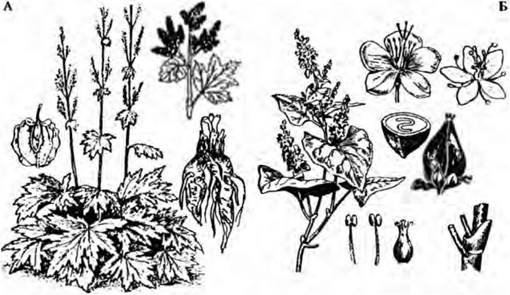
Genus Buckwheat — Fagopyrum. Common buckwheat (common cultivated buckwheat) — Fagopyrum sagittatum (F. esculentum) is cultivated (Fig. 3.22, B). This is an annual plant standing 30 — 70 cm tall. The stem is reddish, and the leaves are triangular-cordate or sagittate, and slightly fleshy. Inflorescences are paniculate. Flowers are pink and dimorphic: some have short styles and long stamens, while others have long styles and short stamens. Stamens and pistils mature at different times, which prevents self-pollination.
Floral formula: 
Achenes sharply triquetrous, protruding about 1/2 beyond the perianth.
Last update: 07/08/2026
Editorial and Educational Adaptation: This material has been compiled based on the primary/original source text. The project team performed an editorial review, corrected technical inaccuracies, structured sections, and adapted the content for an educational format.
What was processed:
- elimination of formatting defects (OCR errors, structural breaks, corrupted characters);
- editorial organization of content;
- standardization of terminology in accordance with academic sources;
- verification of factual statements against the original source text.
All mentions of the author, publication year, and origin of the primary text have been preserved in accordance with the source.