PLANT BIOPHYSICS - Y. I. Posudin - 2004
II. TRANSPORT PROCESSES IN THE SOIL-PLANT-ATMOSPHERE SYSTEM
12. EFFECT OF ENVIRONMENTAL FACTORS ON PLANTS
12.5. EFFECT OF WIND ON PLANTS
Wind parameters. Air motion relative to the Earth's surface is referred to as wind. The Main parameters of wind are its speed, direction, and gustiness. Wind speed is measured in m/s, although units such as knots or km/h are also applied (Table 12.1).
Class="center">Table 12.1. Relationship between wind speed units
м·с-1 |
knot |
км·г-1 |
1,000 |
1,943 |
3.600 |
0,515 |
1,000 |
1,853 |
0,278 |
0,540 |
1,000 |
Wind speed is evaluated using the Beaufort scale (Table 12.2).
Table 12.2. Beaufort scale
Force |
Description |
м·с-1 |
вузол |
км·г-1 |
0 |
Calm |
0,0-0,2 |
<1 |
<1 |
1 |
Light air |
0,3-1,5 |
1-3 |
1-5 |
2 |
Light breeze |
1,6-3,3 |
4-6 |
6-11 |
3 |
Gentle breeze |
3,4-5,4 |
7-10 |
12-19 |
4 |
Moderate breeze |
5,5-7,9 |
11-16 |
20-28 |
5 |
Fresh breeze |
8,0-10,7 |
17-21 |
29-38 |
6 |
Strong breeze |
10,8-13,8 |
22-27 |
39-49 |
7 |
Near gale |
13,9-17,1 |
28-33 |
50-61 |
8 |
Gale |
17,2-20,7 |
34-40 |
62-74 |
9 |
Strong gale |
20,8-24,4 |
41-47 |
75-88 |
10 |
Storm |
24,5-28,4 |
48-55 |
89-102 |
11 |
Violent storm |
28,5-32,6 |
56-63 |
103-117 |
12 |
Hurricane |
>32,7 |
>64 |
>118 |
Wind direction is determined relative to the cardinal points and is designated either in rhumbs (16 in total): north, northeast, east, etc., or in degrees: one division corresponds to 5° or 10° depending on the required measurement accuracy.
Wind gustiness refers to abrupt increases and decreases in wind speed ΔV; ΔV = ± 3 m/s at V = 5-10 m/s; ΔV = ± 5-7 m/s at V = 11-15 m/s.
Effect of wind on Transpiration. An increase in wind speed causes a decrease in boundary layer resistance (see equation (10.3)), which leads to an accelerated evaporation rate. However, if the leaf Temperature significantly exceeds the ambient air temperature (for instance, due to intense radiation under moderately closed Stomata), increased wind speed may cause a reduction in evaporation because the enhanced heat loss lowers the leaf temperature and the Water vapor pressure within the leaf. Consequently, the resulting decrease in the driving force for transpiration may outweigh the reduction in boundary layer resistance. Stomatal resistance can influence transpiration when the boundary layer resistance is low; at high values of the latter, The Effect of stomata on transpiration is negligible.
Effect of wind on Photosynthesis. In terms of electrical analogies, The rate of photosynthesis can be described by the equation [Gaastra, 1959]:

where  are the resistances of the boundary layer, stomata, and mesophyll, respectively, and [CO2]1 and [CO2]2 are the carbon dioxide concentrations in the ambient air and inside the leaf, respectively.
The Use of ventilation flows, which minimize boundary layer resistance to virtually zero, makes it possible to estimate the sum of resistances 
The calculation graphs presented in Fig. 12.9 indicate that the rate of photosynthesis depends on wind speed, stomatal and mesophyll resistances, and leaf surface area.
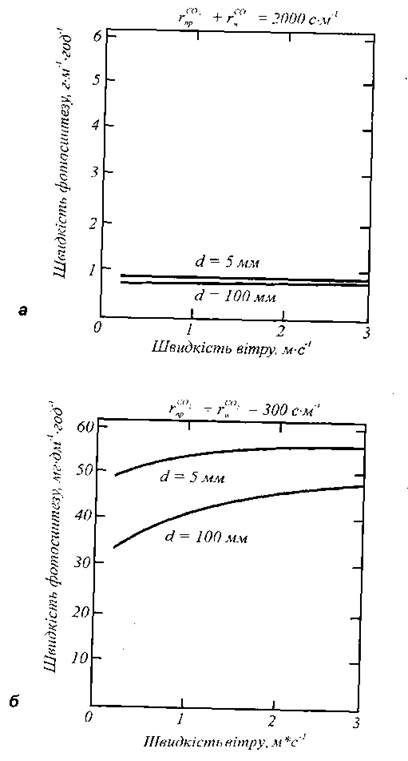
Fig. 12.9. Dependence of photosynthesis rate under high illumination on wind speed: a - for high values of stomatal and mesophyll resistances; b - for low values of stomatal and mesophyll resistances. Here, d denotes the leaf size.
Growth rate. When analyzing plant growth, indices such as relative growth rate (RGR), defined as The ratio of plant weight increase rate to unit weight  , unit leaf rate or net assimilation rate (NAR), defined as the ratio of plant weight increase rate to unit leaf area
  , and specific leaf area
  are employed. Wind tunnel experiments have made it possible to measure all these indices under various wind speeds. The results demonstrate the existence of an optimal wind speed (0.7 m·с-1) for plant growth (using Brassica napus grown in sandy soil); at a wind speed of about 4.0 m·с-1, a decrease in all indices is observed. At the same time, the effect of wind on the growth of plants (Brassica napus, Hordeum vulgare, Pisum sativum) grown in nutrient solutions was negligible. Such a discrepancy in the observed results can be attributed to different transpiration rates in plants cultivated in sand versus solution. Plants grown in sand experience significant hydraulic resistance in the soil, whereas in solution culture, resistance arises solely within the plant itself. Plant growth is affected by both wind speed and soil moisture (Table 12.3).
Table 12.3. Effect of wind speed and soil moisture on the growth of Robinia pseudoacacia (Satoo, 1948, cited in [Grace, 1977])
Parameter |
Wind 3.5 м·с-1 |
No wind |
Wind 3.5 м·с-1 |
No wind |
Soil moisture, % |
80 |
80 |
40 |
40 |
Stem weight, g |
368 |
688 |
118 |
358 |
ROOT weight, g |
69 |
111 |
23 |
67 |
Height, mm |
144 |
258 |
43 |
156 |
Stem diameter, mm |
2,02 |
2,27 |
1,41 |
1,85 |
Root length, mm |
231 |
296 |
124 |
244 |
Other effects induced by wind include plant stuntedness, mechanical deformation and damage, crop lodging, and the spatial dispersal of pollen, seeds, pesticides, and pollutants.
Soil erosion. The destructive impact of external factors such as wind and water on the fertile soil cover and underlying rocks, leading to the displacement and redeposition of weathering products, is referred to as soil erosion (from the Latin erosio meaning to corrode or gnaw away). Erosion accompanied by the destruction of the land surface and The formation of river valleys, slopes, and watersheds is termed natural (geological) erosion. This type of erosion is driven by factors such as wind, water, temperature fluctuations, and biological processes. Wind erosion involves The transport of minute soil particles containing vital fertility components such as humus and chemical substances. Furthermore, this process is accompanied by the exposure of roots in some plants and the burial of others. The Development of erosion is also related to local topography, soil resistance to wash-off and erosion, and the degree of slope coverage by forest or grass vegetation.
Accelerated (anthropogenic) erosion is caused by the combined impact of deforestation, intensive livestock farming, and improper agricultural land use. Plowing, haymaking, harvesting, agricultural machinery operations, land reclamation, deforestation, excessive land tilling, and uncontrolled livestock grazing all contribute to accelerated erosion. The soil layer destroyed over centuries under normal erosion is depleted within a very short timeframe due to human activity (the rate of anthropogenic erosion can be up to 100 times higher than that of natural erosion). Erosion inflicts severe damage on agriculture, as rainwater runoff and melting snow wash away and transport the uppermost, most fertile layer of soil down slopes. As a result, valuable agricultural land is destroyed over vast areas; humus resources and the content of nitrogen, phosphorus, and potassium in the soil sharply decline, severely impairing its fertility; rivers, canals, and water sources silt up; the terrain becomes increasingly dissected by gullies; and its hydrological regime deteriorates. An analysis of soil surveys conducted by Ukrzemproekt indicates that over the past 20 years, the proportion of eroded soils in various regions of Ukraine has increased by 3–26%, while the area of eroded ordinary chernozems has grown by 15–26%.
Last update: 07/08/2026
Editorial and Educational Adaptation: This material has been compiled based on the primary/original source text. The project team performed an editorial review, corrected technical inaccuracies, structured sections, and adapted the content for an educational format.
What was processed:
- elimination of formatting defects (OCR errors, structural breaks, corrupted characters);
- editorial organization of content;
- standardization of terminology in accordance with academic sources;
- verification of factual statements against the original source text.
All mentions of the author, publication year, and origin of the primary text have been preserved in accordance with the source.