PLANT ADAPTATION TO ANTHROPOGENIC FACTORS - 2017
3. ENVIRONMENTAL POLLUTION BY INDUSTRIAL CHEMICAL WASTE
Environmental chemical pollution refers to the presence of substances in the atmosphere, soil, and Water bodies that are not naturally characteristic of these environments in significant concentrations. As a rule, these substances exert a negative Environmental Impact on living organisms.
3.1. General Characteristics of Atmospheric Pollution
The atmosphere is polluted by various gases, particulate matter, and liquid substances that adversely affect living organisms and deteriorate their living conditions. Sources of atmospheric pollution can be both natural and artificial (anthropogenic, Fig. 4).
Class="center">
Fig. 4 - Sources of atmospheric pollution
Natural atmospheric pollution. Under normal conditions, natural pollution sources do not cause substantial changes in air composition. However, the intensive spread of pollutants originating from natural sources in a particular area (such as volcanic ash and gas emissions, forest and steppe fires, etc.) can become a major cause of atmospheric pollution. For instance, during the 1883 eruption of the Krakatoa volcano, the mass of ash and dust reached 150 billion tons, spreading across almost the entire globe. The 1912 volcanic eruption in Alaska released over 20 billion tons of dust into the atmosphere, which remained suspended in the air for a long time. Such catastrophic events occasionally lead to The formation of an opaque screen around the Earth and alter its thermal balance. Nevertheless, natural atmospheric pollution generally does not cause severe damage to living organisms, as it occurs in accordance with specific geological laws and with a certain periodicity.
Artificial (anthropogenic) atmospheric pollution occurs As a result of Changes in the COMPOSITION AND PROPERTIES of the air under METABOLISM/18.html">The Influence of human activity. Based on their physical state, chemical composition, and nature of impact on the atmosphere, artificial pollution sources are conventionally divided into technical (dust from cement plants, smoke and soot from coal combustion) and chemical (dust- or gas-like substances capable of entering into Chemical Reactions, Fig. 5).
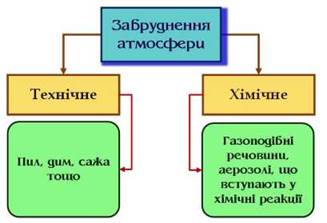
Fig. 5 - Types of artificial atmospheric pollution
3.1.1. Types of Atmospheric Pollutants
In countries with highly developed industries, two MAIN TYPES OF atmospheric pollution, or "smog," are typically distinguished: photochemical (Los Angeles type) and London type (Thomas, 1962). The active agents in both cases are gaseous substances and aerosols of various compositions.
The photochemical type of atmospheric pollution (smog) is characterized by a high content of peroxide-type Hydrocarbons in the surface air layer. Their primary atmospheric sources are products of incomplete gasoline and oil combustion in internal combustion engines and volatile petroleum fractions. According to the Stanford Research Institute, about 1,080 tons of hydrocarbons and 1,380 tons of other organic pollutants were emitted into the air daily in the Los Angeles area in 1953.
In recent years, literature sources have increasingly discussed the ecological crisis looming over humanity. Unconsidered human actions undermine the self-regulating capacity of natural complexes, disrupt the dynamic equilibrium in natural and artificial ecosystems, and create conditions unsuitable for the normal functioning of all ecosystem components. This is driven primarily by the release of substances into the biosphere generated during various technological processes. Annually, the Earth's atmosphere receives 200 million tons of carbon monoxide, 50 million tons of hydrocarbons, 146 million tons of sulfur dioxide, 53 million tons of nitrogen oxides, as well as large amounts of fluorine, chlorine, hydrogen sulfide compounds, and organic matter. According to experts' calculations, carbon dioxide levels continue to rise. A significant portion of pollutants consists of heavy metals. In recent years, emission volumes have multiplied several-fold.
Industrial enterprises annually emit millions of tons of pollutants into the atmosphere, with the metallurgical industry accounting for nearly a quarter of them. In Ukraine, carbon monoxide makes up over half of all toxicants, dust particles account for about 20%, sulfur dioxide and hydrocarbons represent 10% each, and the remainder consists of nitrogen oxides and other impurities. The level of toxic substances in the atmosphere doubles every 10 years.
It is generally believed that pollutants do not cause significant harm to living organisms at the moment of their release into the atmosphere or during nighttime hours. However, the toxicity of pollutants increases sharply after a certain period of exposure to sunlight. According to the Haagen-Smit theory, smog formation results from the photochemical interaction of its components with atomic oxygen. Nitrogen dioxide, sulfur dioxide, and aldehydes are capable of absorbing ultraviolet rays and entering an active state. The atomic oxygen released in the process reacts with molecular oxygen in the air. Part of the atomic oxygen can also be formed from sulfur dioxide or aldehydes. Nitrogen dioxide plays the most crucial role in ozone formation: under the action of ultraviolet rays, its molecules break down into nitric oxide and atomic oxygen. These reactions are believed to proceed in the following sequence:
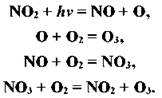
This process repeats multiple times while maintaining The amount of nitrogen oxides involved in it. Therefore, even a negligible content of nitrogen oxides in the air causes the accumulation of ozone, reaching concentrations of 3–4 · 10-5 % or more by air volume.
Ozone and nitrogen oxides react with organic air impurities, resulting in the Formation of Unsaturated hydrocarbons, aldehydes, ketones, acids, and other substances with strongly pronounced phytotoxic effects. Peroxyacetyl nitrate (PAN), formed under these conditions, is considered the specific active agent of Los Angeles-type smog.
When excess ozone is generated in the air, further oxidation of nitrogen and sulfur dioxides occurs, producing nitric and sulfurous acids, respectively:
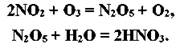
The resulting acids remain suspended in the air as liquid aerosols. Upon contact with foliage, they cause spot-like damage.
The chemical composition of Los Angeles smog is characterized by a high content of C2 to C10 saturated and unsaturated hydrocarbons.
Photochemical smog is widespread in many cities across the US, Italy, France, and other countries with intensive vehicular traffic, restricted air exchange, and abundant sunlight.
The London type of atmospheric pollution (smog) is characterized by the accumulation of predominantly incomplete coal combustion products in the ground-level air layer.
Sulfur dioxide and sulfur trioxide easily dissolve in fog droplets, forming sulfurous and sulfuric acid aerosols. Dust-like particles of coal, ash, and various salts also exhibit phytotoxic effects. Most often, the substances present in London smog possess reducing properties. Its high toxicity becomes especially pronounced during periods of calm weather and Temperature inversions, although the presence of fog is not strictly mandatory.
London-type atmospheric pollution is characteristic not only of Great Britain but also of industrial regions in other Northern European countries, driven by the emission of identical substances into the atmosphere combined with high air humidity, frequent persistent cloud cover, temperature inversions, and poor air exchange in the surface layer.
Ukraine's industry is highly developed and diversified. The extraction and Processing of coal, iron and other ores, oil, and natural gas are conducted with particular intensity across the country. Ukraine is home to A large number of diverse chemical plants and agricultural processing facilities. For instance, in 1961, ferrous metallurgy output per unit area in Ukraine was 2 to 4 times higher than the corresponding figures in the United States. In subsequent years, this gap widened even further.
Acidic and alkaline gases react with each other as well as with active atmospheric components (such as water vapor and oxygen), forming new compounds. In either gaseous or water-dissolved form, all of them penetrate plants, disrupting their vital metabolic processes. Sometimes, the harmful impact of toxic gases and aerosols can be observed up to 50 km away from industrial sources.
In Ukraine, calm weather conditions rarely coincide with prolonged temperature inversions and overcast skies, fogs, or precipitation. Consequently, during the growing season, the accumulation of the bulk of phytotoxicants in the surface air layer occurs less frequently here than in northern regions. This is mitigated by the flat terrain and steady winds. However, when stagnant air masses combine with fog or precipitation, a pungent, irritating haze generated by industrial and transport emissions lingers near the ground, exerting a severe toxic effect on vegetation. Furthermore, the Donetsk-Pridneprovsk industrial region concentrates the bulk of Ukraine's heavy industry enterprises. This results in a wide spectrum of pollutants and their high concentrations. It was precisely these circumstances that led H. M. Ilkun to identify a distinct Ukrainian type of atmospheric pollution.
Last update: 07/08/2026
Editorial and Educational Adaptation: This material has been compiled based on the primary/original source text. The project team performed an editorial review, corrected technical inaccuracies, structured sections, and adapted the content for an educational format.
What was processed:
- elimination of formatting defects (OCR errors, structural breaks, corrupted characters);
- editorial organization of content;
- standardization of terminology in accordance with academic sources;
- verification of factual statements against the original source text.
All mentions of the author, publication year, and origin of the primary text have been preserved in accordance with the source.