BIOLOGY Volume 3 - A Guide to General Biology - 2004
24. VARIATION AND GENETICS
24.2. Chromosomal Theory of Inheritance
Mendel published the results of his research and hypotheses in 1866 in the journal Proceedings of the Natural History Society of Brünn, which was distributed to scientific societies in many countries. However, scientists failed to appreciate The Significance of his discoveries; this was perhaps because at the time it was impossible to link Mendel's data to any specific structures in Gametes through which hereditary factors could be passed from parents to offspring.
By the end of the 19th century, thanks to significant improvements in the optical performance of microscopes and the refinement of cytological techniques, it became possible to observe The behavior of Chromosomes in gametes and zygotes. In 1875, Hertwig noted that Fertilization in sea urchin eggs involves the fusion of two nuclei—the sperm Nucleus and the egg nucleus. In 1902, Boveri demonstrated the crucial role of The Nucleus in regulating The Development of organismal traits, and in 1882, Flemming described the behavior of chromosomes during mitosis.
In 1900, Mendel's Laws were rediscovered almost simultaneously by three scientists—de Vries, Correns, and Tschermak—who fully recognized their importance. Correns formulated Mendel's Conclusions in the familiar form of two laws and introduced the term "factor" instead of "element," which Mendel had used to describe the unit of heredity. Meanwhile, the American researcher Walter Sutton noted a striking similarity between the behavior of chromosomes during gamete formation and fertilization and the transmission of Mendelian hereditary factors (Table 24.3).
Class="center">Table 24.3. Correspondence between events occurring during Meiosis and fertilization and Mendel's hypothesis
Meiosis and fertilization |
Mendel's hypothesis |
Diploid Cells contain pairs of homologous chromosomes |
Traits are controlled by pairs of factors |
Homologous chromosomes separate during meiosis |
Paired factors segregate during gamete formation |
Each gamete receives one of the homologous chromosomes |
Each gamete receives a single factor |
Only the Nucleus of the male gamete fuses with the egg nucleus |
Factors are transmitted from generation to generation as discrete units |
During fertilization, pairs of homologous chromosomes are restored; each gamete |
Each Organism inherits one factor from each parent |
 contributes one of the homologous chromosomes
Based on all the evidence outlined above, Sutton and Boveri suggested that chromosomes serve as the carriers of Mendelian factors and formulated a theory known as the chromosomal theory of inheritance. According to this theory, each pair of factors is located in a pair of homologous chromosomes, with each chromosome carrying one of these factors. Since the number of traits in any organism is vastly greater than the number of its chromosomes visible under a Microscope, each chromosome must contain numerous factors.
In 1909, Johannsen replaced the term factor, which denoted the basic unit of heredity, with the term Gene. Alternative forms of a gene that determine its phenotypic expression were named alleles. Alleles are specific variants in which a gene can exist; they occupy the same positions (loci) on homologous chromosomes (Fig. 24.5).
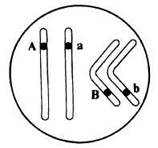
Fig. 24.5. A Cell with two pairs of homologous chromosomes. The locations of two different gene loci are indicated by black circles. In this case, the two loci are located on different pairs of homologous chromosomes, and each gene is represented by two alleles.
Mendel's law of segregation of factors can now be explained by the Separation of homologous chromosomes occurring in anaphase I of meiosis, and the random distribution of alleles among gametes. These events are diagrammed in Fig. 24.6.

Fig. 24.6. Explanation of Mendel's law of segregation of factors (alleles) A and a As a result of the disjunction of homologous chromosomes in meiosis.
24.2.1. Chromosome Behavior as the Basis for Independent Assortment
Mendel's law of independent assortment can also be explained by the movement of chromosomes during meiosis. During gamete formation, the distribution of alleles from a given pair of homologous chromosomes occurs completely independently of the distribution of alleles from other pairs (Fig. 24.7). It is precisely the random arrangement of homologous chromosomes at the spindle equator in metaphase I of meiosis and their subsequent segregation in anaphase I that lead to a diversity of allele recombinations in gametes. The number of possible allele combinations in male or female gametes can be determined by the general formula 2n, where n is the haploid chromosome number. For humans, n = 23, and the possible number of different combinations is 223 = 8,388,608.

Fig. 24.7. Explanation of Mendel's law of independent assortment of factors (alleles) A, a, B, b as a result of the independent segregation of different pairs of homologous chromosomes in meiosis (cf. Fig. 23.16).
24.5. Starch deposition in maize pollen grains is controlled by the presence of one allele of a specific gene. In the presence of the other allele, starch deposition does not occur. Explain why half of the pollen grains produced by a given maize plant contain starch, while the other half do not.
24.6. Calculate the number of possible chromosome combinations in the pollen grains of the crocus (Crocus balansae), which has a diploid chromosome number of six (2n = 6).
Last update: 06/08/2026
Editorial and Educational Adaptation: This material has been compiled based on the primary/original source text. The project team performed an editorial review, corrected technical inaccuracies, structured sections, and adapted the content for an educational format.
What was processed:
- elimination of formatting defects (OCR errors, structural breaks, corrupted characters);
- editorial organization of content;
- standardization of terminology in accordance with academic sources;
- verification of factual statements against the original source text.
All mentions of the author, publication year, and origin of the primary text have been preserved in accordance with the source.