BIOLOGY Volume 3 - A Guide to General Biology - 2004
26. EVOLUTION, OR THE HISTORY OF LIFE ON EARTH
26.7. Evidence for the Theory of Evolution
26.7.2. Geographical Distribution
All organisms are, to a greater or lesser extent, adapted to their environment. If the abiotic and biotic factors available in a particular habitat can sustain a certain species, one might expect that species to be found in a similar habitat in another comparable geographic region—for example, lions inhabiting the African savannas could theoretically live in the South American pampas. However, this is not the case. The distribution of plants and animals across the globe is discontinuous. While this is often driven by ecological factors, evidence that plants and animals successfully colonize new habitats when introduced by humans suggests that other factors operate alongside ecological adaptation. Rabbits were not native to Australia, but their rapid population growth after being introduced by humans indicates that Australian habitats suited them well. Similar Examples include the spread by humans of domestic animals and crops such as sheep, maize, potatoes, and wheat. A rational explanation for the discontinuous distribution of organisms is based on the concept that species originate in a given area and subsequently disperse from it. The extent of dispersal depends on how successfully an Organism can establish itself in new locations, the efficiency of its dispersal mechanisms, and the presence or absence of natural barriers such as oceans, mountain ranges, and deserts. Wind-borne spores and seeds, and flying animals, appear to be the best adapted for long-distance dispersal across land and sea.
In contrast, although organisms are generally restricted in their distribution to specific PARTS OF THE world, closely related forms are often found in widely separated regions. For instance, the three modern species of lungfishes occur separately in tropical South America (Lepidosiren), Africa (Protopterus), and Australia (Neoceratodus); camels and llamas live in North Africa, Asia, and South America; and raccoons are widespread in North and South America while also inhabiting a small area in Southeast Asia. Fossil evidence indicates that in the past these animals had a much wider distribution than they do today.
While this information does not bear directly on evolutionary theory, it indicates that the distribution of landmasses on Earth has not always been as it is today.
It was once believed that continents and oceans have always occupied their present positions. Early geologists, such as Hutton and Lyell (see Table 26.1), assumed that sedimentary rocks were formed As a result of periodic sea-level rises and falls. Later, the idea emerged that in the past the globe featured two vast continents—Laurasia in the Northern Hemisphere and Gondwana in the Southern; these two landmasses were thought to be connected by extensive land bridges across which plants and animals could migrate and disperse. Subsequent geological research modified this view, and The Theory of continental drift, based on plate tectonics, is now universally accepted. The hypothesis of continental drift was first proposed by Snider in 1858 and later developed in the late 19th century by Taylor in the USA and Wegener in Germany. Wegener believed that during the Carboniferous period, Laurasia and Gondwana formed a single landmass he called Pangaea (from the Greek pān, all; gaia, earth), which "floated" on the denser molten interior of the Earth. Today, however, it is generally accepted that the continents were pushed apart by deep upward and lateral convective currents that drag the plates carrying the continents along with them. This explains the continuous movement of landmasses and the modern distribution of such animals as lungfishes (Fig. 26.5).
Class="center">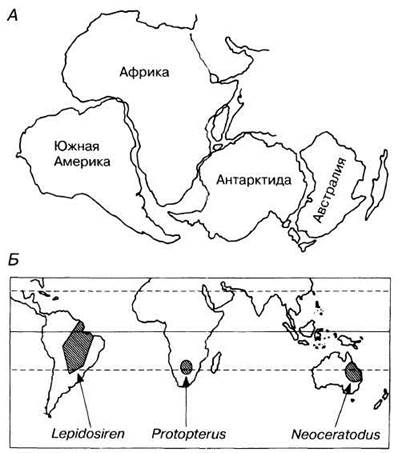
Fig. 26.5. A. Relative positions of South America, Africa, and Australia during the Cytology/cytology/16.html">Early stages of continental drift, indicating the proximity of regions where lungfishes may have originated. B. Modern distribution ranges of lungfishes.
As for camels and llamas (family Camelidae), they are believed to descend from a common ancestor that, fossil records indicate, originated in North America. During the Pleistocene, this ancestor spread south across the Isthmus of Panama into South America and north into Asia before rising sea levels separated it from North America (Fig. 26.6). Throughout this time, progressive changes are thought to have occurred within the Camelidae Lineage, leading to The formation of two genera—Camelus and Lama—at the peripheral regions of their Pleistocene migration. Forms intermediate between modern camels and llamas have been discovered as fossils throughout North America. Paleontological data show that other representatives of this family in other parts of the world became extinct at the end of the last ice age.
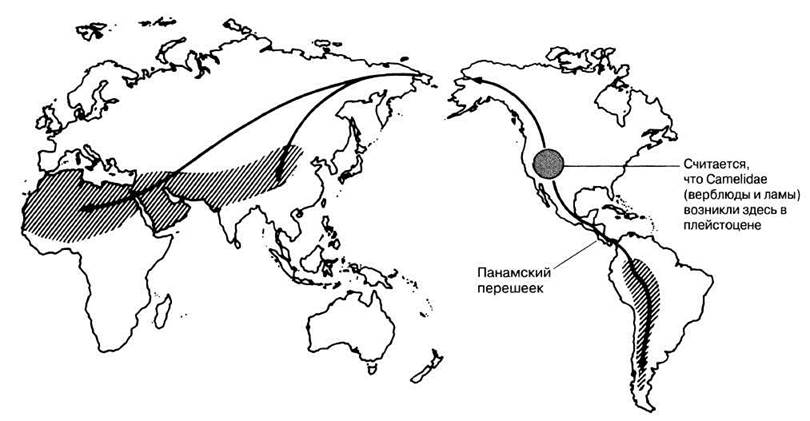
Fig. 26.6. Map showing the modern distribution of the family Camelidae: camels in Asia and North Africa, and llamas in South America. Fossil finds indicate that during the Pleistocene, Camelidae were distributed throughout North and South America, much of Asia, and North Africa. Solid lines with arrows indicate probable migration routes. (After Matthewes, 1939, Climate of Evolution, vol. 1, 2nd ed., N.Y. Acad. of Sci.)
Another example of discontinuous distribution resulting from geographical isolation is found among the monotremes and marsupials of the Australian region. Australia broke away from the other landmasses at the end of the Jurassic period, immediately following The Emergence of primitive mammals. Mammals are divided into three subclasses: monotremes (Monotremata), marsupials (Marsupialia), and placentals (Eutheria). Only the first two groups evolved in the Australian region. Here they coexisted and underwent adaptive radiation, giving rise to the characteristic Australian fauna represented by the monotremes Tachyglossus and Zaglossus (echidnas and long-beaked echidnas), Ornithorhynchus (platypus), and 45 genera of marsupials. In other parts of the world, more advanced placental mammals evolved. As they spread across the continents, they apparently outcompeted more primitive monotremes and marsupials for ecological niches, stopping only where geographical barriers blocked their further dispersal, as was the case toward Australia.
All of the above can be summarized as follows:
1) species originated in a specific area;
2) they dispersed beyond this area;
3) most species were able to disperse only if landmasses were situated sufficiently close to one another;
4) the absence of more highly organized forms from a given region usually indicates that the region separated from the homeland of those forms before they evolved.
None of the facts presented above explains The Mechanism of speciation, but they all indicate that different groups arose at different times and in different regions. The fossil record provides insight into the pathways along which these organisms gradually changed, yet it again offers no clues regarding the potential mechanism driving such change.
The probable mechanism of speciation through natural Selection can be inferred from the distribution of plants and animals on oceanic islands. Both Wallace and Darwin were struck by the immense diversity of species inhabiting such islands as the Hawaiian or Galapagos archipelagos. Geological evidence shows that these islands were formed by volcanic activity that lifted them from the ocean floor, meaning they never had a direct geographical connection to any continental landmass. Plants found on these islands were most likely carried there by wind as spores and seeds, or by Water as floating seeds or vegetative debris. Aquatic and semi-aquatic animals were presumably brought by ocean currents, while terrestrial organisms arrived on logs or floating mats of vegetation. Bats, birds, and flying insects found it considerably easier to colonize these islands.
The Galapagos Islands lie in the Pacific Ocean on the equator, nearly 1200 km west of Ecuador, forming an archipelago described in more detail in Section 27.8.3. In 1835, when Darwin first visited these islands, he was struck by the similarity between their resident species and those inhabiting the nearest continent—a parallel similarity between island and mainland forms that he also observed on the Cape Verde Islands off the coast of West Africa. However, on oceanic islands, plants and animals were in most cases markedly larger. This can be explained by the absence of large, more highly organized dominant species with which the smaller relatives of island species had to compete on the mainland. For example, the giant tortoise (Geohelone elephantopus), which feeds on the abundant island vegetation, likely attained its colossal size—nearly 2 m in length and 260 kg in weight—due to the absence of competition from the various mammals inhabiting the continent. Darwin also noted that the numerous iguanas inhabiting the Galapagos Islands were likewise significantly larger than their continental relatives. While lizards are typically terrestrial, of the two iguana species discovered in the Galapagos, one lives in the sea. The marine Galapagos iguana (Amblyrhynchus cristatus) feeds on marine Algae and is adapted for locomotion in water through its laterally flattened tail and well-developed webbing between the digits on all four limbs (Fig. 26.7). It is suggested that competition between land iguanas for food, living space, and mates created selection pressure favoring individuals whose variations favored aquatic life. This mechanism of environmental action on a variable genotype is termed natural selection, as described above. It was likely through this process that the marine iguana species gradually evolved. However, perhaps the most profound influence on Darwin's thoughts regarding the mechanism of speciation was The Diversity of adaptive traits observed among 13 species of finches inhabiting the islands. In Ecuador, i.e., on the mainland, there was only a single type of finch, possessing a beak adapted for crushing seeds. The finches of the Galapagos Islands exhibit six Major Types of beaks, each adapted to a specific feeding strategy. The various finch groups, their feeding habits, and the number of species in each group are illustrated in Fig. 26.8.

Fig. 26.7. Giant marine iguana of the Galapagos Islands (underwater).


Fig. 26.8. A. Adaptive radiation of Darwin's finches (after Lack). B. Male cactus finch (Geospiza scandens).
Darwin suggested that the islands were originally colonized by a flock of finches from the mainland. Once established, the inevitable competition resulting from population growth, combined with the availability of vacant ecological niches, drove the diversification of forms with advantageous adaptive variations into various niches. The specific differences among them boil down to minor variations in body size, plumage coloration, and beak shape. Several species are found across all the major islands. Ground finches and warbler finches, considered the most primitive, inhabit the majority of the islands. Insectivorous tree finches and the vegetarian tree finch are absent from the peripheral islets, whereas woodpecker finches are restricted to the central island group. The current distribution of these species is of great interest; according to Lack, it can be explained by adaptive radiation and geographical isolation. For instance, the central islands host a rich diversity of species belonging to different groups (ground, tree, warbler, and woodpecker finches) rather than a single group. Even where multiple species of the same group coexist (such as on the peripheral islands), they all differ in their ecological requirements. This aligns with Gause's competitive exclusion principle (see Section 10.7.5), which states that two or more closely related species can occupy the same area only if their ecological requirements are distinct.
Last update: 06/08/2026
Editorial and Educational Adaptation: This material has been compiled based on the primary/original source text. The project team performed an editorial review, corrected technical inaccuracies, structured sections, and adapted the content for an educational format.
What was processed:
- elimination of formatting defects (OCR errors, structural breaks, corrupted characters);
- editorial organization of content;
- standardization of terminology in accordance with academic sources;
- verification of factual statements against the original source text.
All mentions of the author, publication year, and origin of the primary text have been preserved in accordance with the source.