BIOLOGY Volume 2 - A Guide to General Biology - 2004
12. MICROBIOLOGY AND BIOTECHNOLOGY
12.16. Enzyme Technology
12.16.4. Fruit Juice Production
During juice production, fruits are first crushed. Like other plant parts, fruits consist of Cells surrounded by Cell walls. These walls contain Cellulose and other complex Polysaccharides known as hemicelluloses. Cell walls are exceptionally rigid and difficult to break down. To increase product yield and quality, cellulases and hemicellulases are added during the maceration stage; these Enzymes break down the cellulose and hemicellulose in the walls, making them more "soluble" and ensuring a more complete breakdown of the Tissues. The enzymes are selected to operate at low pH levels, since fruit juice is acidic, with an optimum pH ranging from 4 to 5.
Plant cells are held together by other complex polysaccharides called Pectins. These are sticky substances that help jams set. During fruit storage or Processing, they can convert into Water-soluble pectins, meaning they remain present in fruit juices (in solution) even after the "bits"—undamaged cells and Cell wall debris—have been removed. At low temperatures, pectins begin to precipitate out of solution, forming a colloidal suspension (a suspension of tiny particles that do not settle). This gives the beverage a cloudy appearance. To some consumers, particularly in the US and the UK, this is an unappealing trait, although it should rather be regarded as an indicator of high fruit content. If enzymes called pectinases are added to the juice, they partially break down the pectins into smaller polysaccharides and sugars that remain in solution even at low temperatures. Thus, pectinases clarify the beverage (Fig. 12.26), making it "chill-proof." The source of these pectinases is Bacteria.
The same principles apply to The production of beer and wine, although beer haze is generally caused by the presence of Proteins and Tannins rather than polysaccharides. To break down proteins and reduce chill haze in beer, proteinases such as Pepsin and Papain are added.
Class="center">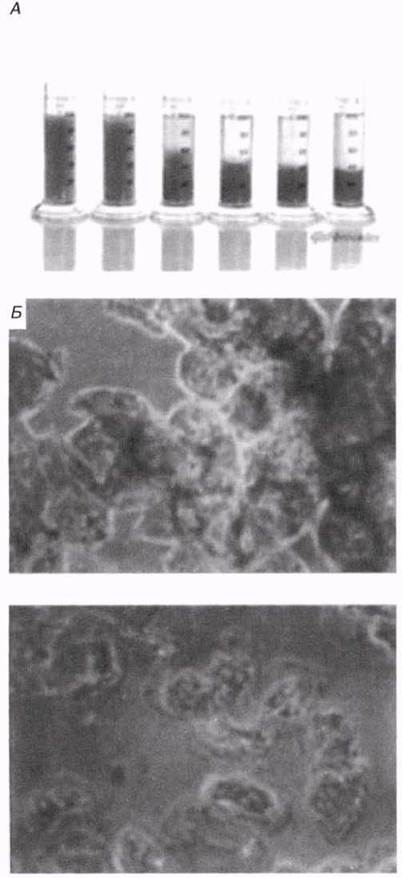
Fig. 12.26. A. A series of vessels demonstrating The Effect of increasing pectinase dosage in apple juice. The two cloudy vessels on the left contain no enzyme. The remaining vessels contain (from left to right) 0.5, 1.0, 1.5, and 2.0 g of pectinase per 100 dm3. B. Apple pulp before (top) and after (bottom) the action of pectinase. Pectinase (rapidase) removes the pectin coating the cells, making them more fragile and less viscous.
Last update: 06/08/2026
Editorial and Educational Adaptation: This material has been compiled based on the primary/original source text. The project team performed an editorial review, corrected technical inaccuracies, structured sections, and adapted the content for an educational format.
What was processed:
- elimination of formatting defects (OCR errors, structural breaks, corrupted characters);
- editorial organization of content;
- standardization of terminology in accordance with academic sources;
- verification of factual statements against the original source text.
All mentions of the author, publication year, and origin of the primary text have been preserved in accordance with the source.