BIOLOGY Volume 2 - A Guide to General Biology - 2004
12. MICROBIOLOGY AND BIOTECHNOLOGY
12.14. Biomass fuel - a new energy source
Biomass in the form of coal, oil, wood, peat, and dry manure has long served as traditional fuel. As the reserves of some of these resources steadily deplete, they become increasingly expensive. Consequently, new Methods are being developed to utilize living organisms and biological processes as alternative fuel sources. Artificial Photosynthesis, which is still far from realization, will eventually enable The production of hydrogen from Water to be used as fuel. Another promising approach focuses on converting the energy stored in biomass into other usable fuel forms. Target Materials currently under investigation include waste products such as manure, sewage sludge, household waste, food scraps, wastepaper, crop residues, sugarcane tops, and molasses. Various agricultural crops (such as corn, sugarcane, and sugar beet) and aquatic plants (such as kelp and water hyacinth) can also be utilized. Currently, two primary processes are predominantly employed: biogas (methane) production by Bacteria and Ethanol Production by Yeast. Both of these processes are anaerobic.
12.14.1. Biogas
Class="center">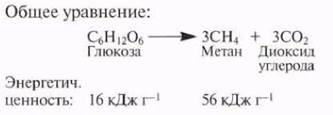
Biogas consists of 54–74% methane. The remainder is composed primarily of carbon dioxide, along with trace amounts of nitrogen, hydrogen, and other gases. (Natural gas contains approximately 80% methane.) The Fermentation process involves a diverse community of microorganisms, including a group of bacteria known as methanogens, such as Methanobacterium, which generate methane from carbon dioxide and hydrogen. These bacteria belong to archaebacteria, an ancient group of organisms closely related to true bacteria. A wide range of waste materials or plant-based products (see above) serves as the substrate for fermentation. In the USA, water hyacinth has been utilized—a plant with high regenerative capacity that often clogs canals and waterways. This process is ideally suited for small-scale production where the generated fuel is consumed on-site, as seen in India and China (Fig. 12.23).
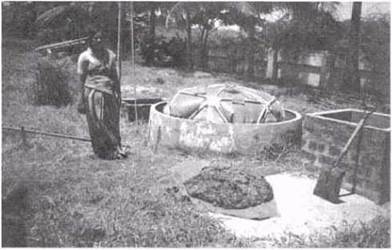
Fig. 12.23. A biogas production unit in India. Animal manure is placed in a vat, where it decomposes and releases methane gas.
The manure produced by a single cow in a year can yield an amount of methane equivalent to approximately 227 liters of gasoline. For instance, the gas generated from just 0.5 kg of manure is sufficient to cook meals for an entire family for a day. China has constructed approximately 18 million of such family-scale digesters. The gas is typically used for cooking, lighting, fueling tractors or automobiles, and powering electrical generators.
On a larger scale, gas can be produced as a byproduct from the waste or wastewater of Processing plants, such as sugar refineries. This gas can be utilized to power electrical generators at wastewater Treatment plants and waste recycling facilities. In England, municipal refuse could serve as a primary source of methane, with up to 20 liters of gas obtainable from every kilogram of waste. Currently, gas is harvested from landfill sites by sinking pipes into compacted refuse and pumping the gas out.
Considering the growing scarcity of landfill sites and the environmental nuisances they cause, greater efforts should be directed toward developing fermentation processes for materials such as paper and cardboard, even if the resulting fuel may not be cheaper than conventional fuels. The economic outlook is generally more favorable in developing countries that lack domestic fossil fuel reserves and are experiencing deforestation. Wastewater and dry manure can also be processed in fermenters. The fuel value of fermented manure is six times higher than that of simply dried manure.
Last update: 06/08/2026
Editorial and Educational Adaptation: This material has been compiled based on the primary/original source text. The project team performed an editorial review, corrected technical inaccuracies, structured sections, and adapted the content for an educational format.
What was processed:
- elimination of formatting defects (OCR errors, structural breaks, corrupted characters);
- editorial organization of content;
- standardization of terminology in accordance with academic sources;
- verification of factual statements against the original source text.
All mentions of the author, publication year, and origin of the primary text have been preserved in accordance with the source.