BIOLOGY Volume 2 - A Guide to General Biology - 2004
12. MICROBIOLOGY AND BIOTECHNOLOGY
12.13. Agriculture
12.13.3. Nitrogen fixation
Legume crops (Papilionaceae), including peas, beans, clover, and alfalfa, have been used in crop rotation systems for centuries because their roots enrich the soil with nitrogen. In the 19th century, it was discovered that characteristic swellings on the roots of these plants (ROOT nodules) contain Bacteria capable of fixing atmospheric nitrogen and converting it into nitrate. This process is described in more detail in Section 10.4.1. The bacteria belong to various strains of Rhizobium (Fig. 12.22). Specific strains infect different legume species. Typically, plants are infected naturally since legumes usually grow in soils where Rhizobium is already present. However, if seeds are to be grown in areas where these bacteria may be absent—such as when seeds are intended for export—a method of seed "inoculation" has been developed. Cultures of the required Rhizobium strain are grown in fermenters and then mixed with a suitable carrier, usually sterile peat. This peat can be added to the soil during sowing, for example, placed in the seed furrow. In regions where a crop is grown regularly, seed inoculation is unnecessary because Rhizobium persists in the soil for many years, utilizing simple Organic compounds as well as ammonium or nitrates as nitrogen sources. The bacteria fix nitrogen exclusively when associated with plant roots.
Examples of seed export include the Introduction of clover to Australia, soybeans to North America, and alfalfa to Europe. Utilizing these crops in rotation reduces The Need for industrially manufactured nitrogen fertilizers, making this practice even more economically and environmentally attractive (see Section 10.8.2).
Class="center">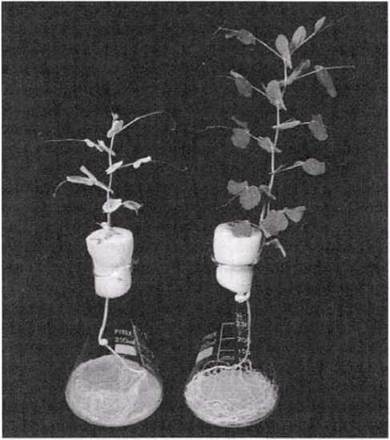
Fig. 12.22. The Effect of Rhizobium inoculation on pea seedlings. The roots of the pea seedlings on the left are kept under sterile conditions in a flask containing mineral salts medium lacking any nitrogen source, resulting in stunted growth and yellowing. The roots of the seedlings on the right have been inoculated with Rhizobium bacteria, which convert atmospheric nitrogen into usable compounds. Consequently, the plant appears healthy and shows no signs of nitrogen deficiency.
Last update: 06/08/2026
Editorial and Educational Adaptation: This material has been compiled based on the primary/original source text. The project team performed an editorial review, corrected technical inaccuracies, structured sections, and adapted the content for an educational format.
What was processed:
- elimination of formatting defects (OCR errors, structural breaks, corrupted characters);
- editorial organization of content;
- standardization of terminology in accordance with academic sources;
- verification of factual statements against the original source text.
All mentions of the author, publication year, and origin of the primary text have been preserved in accordance with the source.