BIOLOGY Volume 2 - A Guide to General Biology - 2004
19. HOMEOSTASIS
19.4. Ectothermic Animals
Most animals are ectotherms, meaning their activity levels depend on ambient Temperature. Ectothermic animals typically have a low metabolic rate and lack physiological mechanisms for heat retention.
Class="center">19.4.1. Thermoregulation in Aquatic Ectotherms
Aquatic ectotherms experience a relatively narrow temperature range dictated by the size of the Water body they inhabit. For instance, while pond water temperatures fluctuate significantly throughout the year, ocean temperatures vary only near the surface and usually by just a few degrees. Despite the wide temperature swings in smaller water bodies, many insects complete certain stages of their life cycle (larvae, nymphs, pupae) in them because temperatures are more stable and do not drop as severely in winter as they do on land. Such insects include mayflies, dragonflies, caddisflies, and mosquitoes.
Thanks to a comparatively simple physiology, aquatic invertebrates can withstand wider temperature fluctuations than aquatic vertebrates. Fish have a higher metabolic rate than aquatic invertebrates, yet most of their endogenous heat is quickly dissipated throughout the body and lost to the environment through the Skin and gills. As a result, a fish's body temperature generally matches that of the surrounding water. While a fish's body temperature cannot drop below the water temperature, it can occasionally be higher, as seen in tunas. In these cases, heat is retained within the body via a countercurrent heat exchange system, allowing the temperature of the 'red' swimming Muscle to rise up to 12 °C above that of sea water.
19.4.2. Thermoregulation in Terrestrial Ectotherms
Terrestrial ectotherms face much harsher temperature fluctuations than aquatic animals, but they also have the advantage of being able to live at higher ambient temperatures, which enables greater activity. The relatively low thermal conductivity of air minimizes heat loss in terrestrial organisms, while water evaporation from the body surface or Lungs can be used for cooling. Many ectothermic species are capable of maintaining body temperatures slightly above or below the ambient air temperature, thereby avoiding extreme thermal shocks.
Terrestrial ectotherms gain and lose heat through behavioral and physiological mechanisms. Their primary heat sources are direct solar radiation or contact with sun-warmed air and soil. The amount of heat absorbed depends on: 1) the animal's coloration; 2) its surface area; and 3) its orientation relative to the radiation source (primarily the Sun).
COLORATION. At low temperatures, a certain Australian grasshopper species exhibits a dark coloration, which facilitates the absorption of solar radiation and promotes rapid body warming. When its temperature rises above the optimum, the exoskeleton automatically lightens, reducing heat absorption. This color change is believed to be a direct pigment Cell response to body temperature. Such organisms are known as radiational heliotherms (from the Greek helios meaning sun).
ORIENTATION. Altering the body's orientation relative to thermal rays (primarily sunlight) changes the surface area exposed to heat. This strategy is utilized by many terrestrial ectotherms, including insects, arachnids, amphibians, and reptiles, in what is known as behavioral thermoregulation. For example, desert locusts are relatively inactive at 17 °C, but by positioning themselves perpendicular to the sun's rays, they warm up rapidly. When ambient temperatures approach 40 °C, the insect shifts its posture to align parallel to the sun's rays, thereby minimizing the heated surface area of its body. Further temperature increases that could prove fatal are prevented by the locust elevating itself above the heated ground or climbing onto vegetation. Air temperature drops sharply just a short distance above the soil surface, and this behavior helps the locust secure a more favorable microclimate.
Reptiles
When on land, crocodiles regulate their body temperature by adjusting their posture relative to sunlight. They also gape—holding their mouths wide open—to increase evaporative heat loss. If the shore becomes too hot, they retreat into the water, which is cooler than the land. Conversely, at night, crocodiles submerge in the water to shield themselves from the now cooler air.
Lizards have been the subject of particularly extensive thermoregulation studies, revealing a vast array of responses to temperature changes. As terrestrial reptiles, lizards exhibit many behavioral patterns common to other groups of terrestrial ectotherms. However, certain species possess physiological mechanisms that allow them to warm up and maintain body temperatures above the ambient level (Fig. 19.9). Other reptiles can restrict their body temperature within narrow limits by altering their activity levels and moving into shade or sunlight as needed. In both cases, lizards foreshadow many of the homeothermic mechanisms characteristic of birds and mammals.
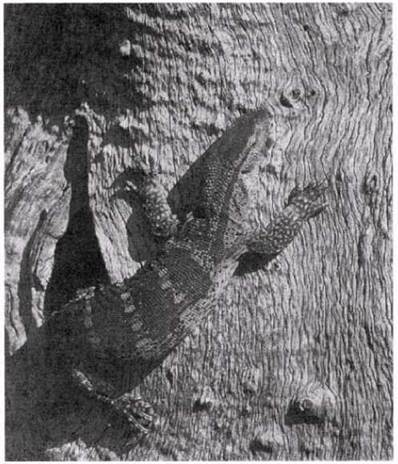
Fig. 19.9. A monitor lizard basking on a tree trunk near its tree-hole retreat to raise its body temperature.
In deserts, ground surface temperatures can soar to 70-80 °C by day and plunge to 4 °C by dawn. To cope with these extremes, most lizards seek refuge in burrows or under rocks. This behavior, combined with specific physiological mechanisms, is observed in horned lizards (genus Phrynosoma) inhabiting the deserts of the southwestern United States and Mexico. Alongside burrowing, these lizards can adjust their body posture and coloration, and during scorching heat, even reduce their body surface area by flattening their Ribs. Responses to high temperatures include thermal panting (which enhances heat dissipation via water evaporation from the Oral Cavity, Pharynx, and lungs), eye bulging (evaporation from the eye surface), the 'heat dance' (Fig. 19.10), and the expulsion of rapidly evaporating urine from the cloaca.
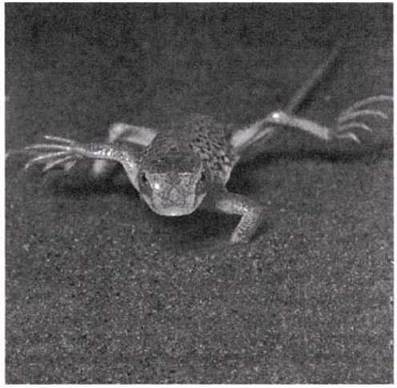
Fig. 19.10. A Namib desert lizard (Aporosaura anchielae). In the afternoon, when the desert sand is scorching hot, it alternately lifts contralateral pairs of feet to let them cool in the air—a behavior known as the heat dance.
Marine iguanas (genus Amblyrhynchus) generally maintain a body temperature of about 37 °C by basking on the rocky shores of the Galápagos Islands. However, because they feed on Algae, they are forced to spend extended periods in water that is roughly 25 °C. These reptiles prevent rapid cooling while submerged by reducing Blood flow between superficial and deep body Tissues through a slowed Heart rate (bradycardia).
Amphibians
The moist skin of typical amphibians is ideally suited for evaporative heat loss. However, unlike mammals, they cannot regulate this water loss through physiological mechanisms, leaving them vulnerable to rapid dehydration in dry conditions. Unsurprisingly, most amphibians inhabit damp environments and avoid sunny spots during hot weather.
Last update: 06/08/2026
Editorial and Educational Adaptation: This material has been compiled based on the primary/original source text. The project team performed an editorial review, corrected technical inaccuracies, structured sections, and adapted the content for an educational format.
What was processed:
- elimination of formatting defects (OCR errors, structural breaks, corrupted characters);
- editorial organization of content;
- standardization of terminology in accordance with academic sources;
- verification of factual statements against the original source text.
All mentions of the author, publication year, and origin of the primary text have been preserved in accordance with the source.