BIOLOGY Volume 1 - A Guide to General Biology - 2004
4. ENZYMES
4.3. Factors Affecting the Rate of Enzyme-Catalyzed Reactions
4.3.3. Temperature
As the Temperature rises, molecular motion accelerates, increasing the chances of substrate and enzyme molecules colliding with one another. Consequently, the probability of a reaction taking place also increases. The temperature at which maximum activity is achieved is known as the optimum temperature. If the temperature rises above this level, The rate of the enzyme-catalyzed reaction declines despite the increased frequency of collisions. This happens because the secondary and tertiary structures of the enzyme are disrupted—in other words, the enzyme undergoes Denaturation (Fig. 4.8). The enzyme molecule unfolds, and its Active Site progressively loses its specific shape. Hydrogen Bonds and hydrophobic interactions are particularly sensitive to high temperatures.
Class="center">
Fig. 4.8. Effect of temperature on the rate of an enzyme-catalyzed reaction.
The temperature optimum for most mammalian Enzymes lies between 37—40 °С. However, some enzymes have a much higher temperature optimum; for instance, in Bacteria living in hot springs, it may exceed 70 °С. Such enzymes are utilized as additives in laundry detergents designed for hot-Water washing. When the temperature approaches or falls below the freezing point, enzymes become inactivated, but denaturation does not occur. As the temperature rises again, their catalytic activity is restored.
Nowadays, quick-freezing is widely used as a method for the long-term preservation of food products. It prevents the GROWTH AND REPRODUCTION of microorganisms and also inactivates their digestive enzymes, rendering them incapable of causing food spoilage. The enzymes naturally present in the food itself are likewise inactivated. Frozen foods must be stored at low temperatures and should not be allowed to thaw until immediately before cooking.
4.1. Examine Fig. 4.9. What can you deduce about the shapes of the three curves describing the course of an enzyme-catalyzed reaction at different temperatures?
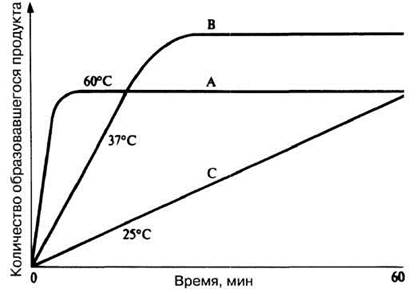
Fig. 4.9. Course of an enzyme-catalyzed reaction at different temperatures.
Temperature coefficient Q10
The Effect of temperature on the rate of an enzyme-catalyzed reaction can be expressed in terms of the temperature coefficient Q10:

Within the range of 0—40 °С, the Q10 of an enzyme-catalyzed reaction is equal to 2. In other words, for every 10 °С rise in temperature, the reaction rate doubles.
Last update: 06/08/2026
Editorial and Educational Adaptation: This material has been compiled based on the primary/original source text. The project team performed an editorial review, corrected technical inaccuracies, structured sections, and adapted the content for an educational format.
What was processed:
- elimination of formatting defects (OCR errors, structural breaks, corrupted characters);
- editorial organization of content;
- standardization of terminology in accordance with academic sources;
- verification of factual statements against the original source text.
All mentions of the author, publication year, and origin of the primary text have been preserved in accordance with the source.