BIOLOGY Volume 1 - A Guide to General Biology - 2004
4. ENZYMES
4.3. Factors Affecting the Rate of Enzyme-Catalyzed Reactions
4.3.4. pH
At a constant Temperature, any enzyme typically operates most efficiently within a narrow pH range. The optimum pH is considered to be the value at which the reaction proceeds at its maximum rate (Fig. 4.10 and Table 4.1). At higher and lower pH values, enzyme activity decreases. As the pH drops, acidity increases along with the concentration of H+ ions. Consequently, the number of positive charges in the medium rises. A shift in pH alters the charge of ionized acidic and basic groups, which leads to the disruption of ionic bonds involved in maintaining the specific conformation of enzyme molecules (sec. 3.5.3). As a result, the shape of the enzyme molecules changes, most notably the shape of their Active Site. Extreme pH shifts will cause the enzyme to denature.
Class="center">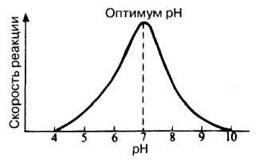
Fig. 4.10. Effect of pH on The rate of an enzyme-catalyzed reaction.
Table 4.1. Optimum pH for various Enzymes
Enzyme |
Optimum pH |
2.00 |
|
Sucrase |
4.50 |
Enterokinase |
5.50 |
Salivary amylase |
4.80 |
Catalase |
7.60 |
7.00-8.00 |
|
Pancreatic lipase |
9.00 |
Arginase |
9.70 |
1 Found in The Stomach along with Hydrochloric acid. |
|
4.2. a) State the optimum pH for The activity of enzyme B in Fig. 4.11.
b) Give Examples of any known enzymes whose activity could be represented by
1) curve A and 2) curve B.
c) Why does the activity of enzyme C decrease between pH 8 and 9?
d) Why is the Introduction/15.html">Regulation of enzyme Activity via changes in pH important in vivo?
e) 1 ml of catalase solution was added to hydrogen peroxide solutions at various pH levels, and the time required to collect 10 ml of O2 was recorded. The following results were obtained:
Solution pH |
Gas collection time, min |
4.00 |
20.00 |
5.00 |
12.50 |
6.00 |
10.00 |
7.00 |
13.60 |
8.00 |
17.40 |
Plot these results on a graph and explain them.
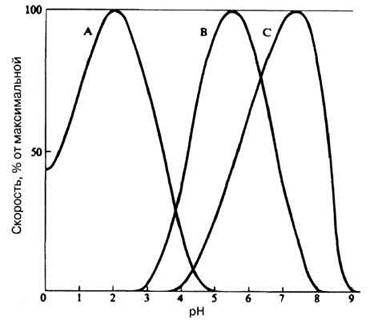
Fig. 4.11. Effect of pH on the activity of three enzymes — A, B, and C.
Last update: 06/08/2026
Editorial and Educational Adaptation: This material has been compiled based on the primary/original source text. The project team performed an editorial review, corrected technical inaccuracies, structured sections, and adapted the content for an educational format.
What was processed:
- elimination of formatting defects (OCR errors, structural breaks, corrupted characters);
- editorial organization of content;
- standardization of terminology in accordance with academic sources;
- verification of factual statements against the original source text.
All mentions of the author, publication year, and origin of the primary text have been preserved in accordance with the source.