BIOLOGY Volume 1 - A Guide to General Biology - 2004
2. THE DIVERSITY OF LIFE ON EARTH
2.7. The Plant Kingdom
2.7.6. Plant Adaptations to Terrestrial Life
Now that we have examined the distinguishing Features of the four major plant groups—namely bryophytes, pteridophytes, gymnosperms, and angiosperms (flowering plants)—we can better appreciate the evolutionary progress made by plants in adapting to life on land.
Challenges
Perhaps the most formidable obstacle to overcome in the transition from an aquatic to a terrestrial habitat was desiccation. Any plant lacking adequate protection, such as a waxy cuticle, will quickly dry out and inevitably perish. Even if this difficulty is surmounted, other unresolved problems remain. Foremost among these is how to successfully accomplish sexual reproduction. In the earliest plants, reproduction relied on male Gametes capable of reaching female gametes only by swimming through Water.
It is generally believed that the first plants to colonize the land evolved from green Algae, certain of whose most evolutionarily advanced representatives developed reproductive Organs—specifically archegonia (female) and antheridia (male)—within which gametes were enclosed and thus protected. This circumstance, along with A number of other specific adaptations to prevent drying out, enabled certain green algae to conquer the land.
One of The most significant evolutionary trends in plants is their progressively increasing independence from water.
The primary challenges associated with the transition from an aquatic to a terrestrial existence are listed below.
1. Desiccation. Air is a drying environment, yet water is essential for life for a variety of reasons (sec. 3.1.2). Consequently, mechanisms for acquiring and storing water become necessary.
2. Reproduction. Delicate gametes must be protected, and motile male gametes (sperm) can only reach female gametes in the Presence of water.
3. Support. Unlike water, air provides no structural buoyancy to support plants.
4. Nutrition. Plants require light and carbon dioxide (СО2) for Photosynthesis, meaning at least part of the plant must rise above the ground. However, mineral salts and water are found in or on the soil, so to utilize these resources effectively, another part of the plant must remain underground and grow in the dark.
5. Gas exchange. For photosynthesis and Respiration, the exchange of carbon dioxide and oxygen must take place with the atmosphere rather than with an aqueous surrounding medium.
6. Environmental factors. Water—especially in large bodies such as lakes or oceans—provides a highly stable environment. In contrast, terrestrial habitats are characterized by much greater fluctuations in critical factors such as Temperature, light intensity, ion concentration, and pH.
Liverworts and Mosses
Mosses are well adapted for spore dispersal in terrestrial environments: this process relies on the drying of the capsule and the wind-dispersal of small, lightweight spores. Nevertheless, these plants remain dependent on water for the following reasons.
1. Water is essential for their reproduction, as sperm must swim to the archegonia. These plants have evolved adaptations that release sperm only in moist environments, since the antheridia dehisce exclusively under such conditions. They have partially adapted to land life because their gametes are produced within protective structures—antheridia and archegonia.
2. They lack specialized supportive Tissues, which severely restricts their upward growth.
3. Bryophytes lack roots capable of penetrating deep into the substrate and can only survive where moisture and mineral salts are readily available at or near the soil surface. However, they possess rhizoids for anchoring to the ground, which represents one of their Adaptations to life on a solid substrate.
2.4. Liverworts and mosses are often referred to as the amphibians of the plant world. Briefly explain why.
Ferns
2.5. Ferns are better adapted to terrestrial life than liverworts and mosses. How is this manifested?
2.6. In terms of what key traits are mosses, ferns, and liverworts poorly adapted to life on land?
Seed plants - conifers and flowering plants
One of the major challenges faced by land plants is the vulnerability of their gametophyte generation. In ferns, for example, the gametophyte is a delicate prothallus that produces male gametes (spermatozoids) requiring water to reach the egg Cell. In seed plants, however, the gametophyte is protected and highly reduced.
Seed plants possess three key advantages: first, heterospory; second, the evolution of non-motile male gametes; and third, The formation of seeds.
HETEROSPORY AND NON-MOTILE MALE GAMETES. A pivotal role in plant evolution was played by The Emergence of certain ferns and their close relatives that produced Two Types of spores. This phenomenon is termed heterospory, and such plants are called heterosporous. All seed plants are heterosporous. They produce large spores, called megaspores, in one type of sporangium (megasporangia), and small spores, called microspores, in another type of sporangium (microsporangia). Upon germination, these spores develop into gametophytes (Fig. 2.34). Megaspores develop into female gametophytes, and microspores into male gametophytes. In seed plants, the gametophytes produced by megaspores and microspores are very small and are never released from the spores. Consequently, the gametophytes remain protected against desiccation, representing a major evolutionary breakthrough. Nevertheless, sperm from the male gametophyte still need to reach the female gametophyte, a process greatly facilitated by the dispersal of microspores. Being extremely small, they can be produced in vast quantities and carried by the wind far from the parent sporophyte. By chance, they may land in close proximity to a megaspore, which in seed plants is not shed from the parent sporophyte (Fig. 2.45). This is precisely how pollination occurs in plants whose pollen grains represent microspores. Male gametes are formed within these pollen grains.
Class="center">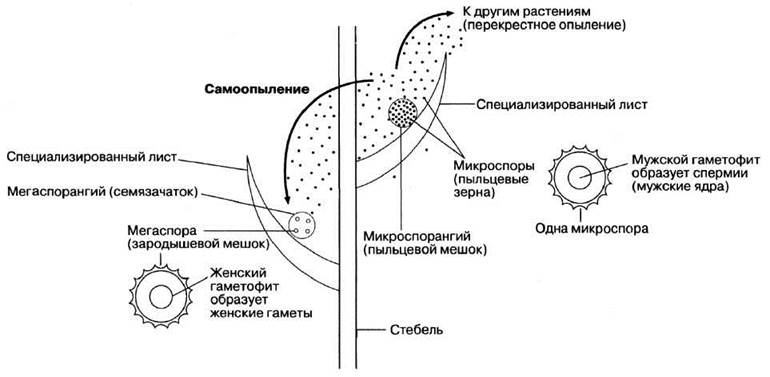
Fig. 2.45. Schematic representation of the main elements of heterospory and pollination.
Seed plants developed yet another evolutionary advantage. Male gametes no longer need to swim toward female gametes because seed plants evolved pollen tubes. These develop from pollen grains and grow in the direction of the female gametes. Through this tube, the male gametes reach the female gamete and fertilize it. Swimming sperm are no longer produced; only male nuclei participate in Fertilization.
Consequently, plants evolved a fertilization mechanism independent of water. This was one of the primary reasons why seed plants vastly outperformed other plants in colonizing the land. Initially, pollination occurred solely via wind—a rather random process accompanied by heavy pollen losses. However, as early as the Carboniferous period approximately 300 million years ago, flying insects appeared, bringing with them the possibility of more efficient pollination. Flowering plants make extensive use of insect pollination, whereas conifers still predominantly rely on wind pollination.
SEEDS. In early heterosporous plants, megaspores were released from the parent sporophyte much like microspores. In seed plants, however, megaspores are not detached from the parent plant, remaining instead within the sporangia, or ovules (Fig. 2.45). The ovule contains the female gamete. Following fertilization of the female gamete, the ovule is referred to as a seed. Thus, a seed is a fertilized ovule. The presence of the ovule and seed confers distinct advantages upon seed plants.
1. The female gametophyte is protected by the ovule. It depends entirely on the parent sporophyte and, unlike a free-living gametophyte, is insensitive to dehydration.
2. Following fertilization, a reserve of nutrients is built up within the seed, supplied to the gametophyte by the parent sporophytic plant to which it remains attached. This reserve is utilized by the developing zygote (the next sporophyte generation) after seed germination.
3. Seeds are adapted to withstand adverse conditions and remain dormant until environmental conditions become favorable for germination.
4. Seeds may develop various adaptations that facilitate their dispersal.
A seed is a complex Structure that encompasses Cells from three generations: the parent sporophyte, the female gametophyte, and the embryo of the next sporophyte generation. The parent sporophyte provides the seed with everything necessary for life, and only after the seed is fully mature—i.e., having accumulated nutrient reserves for the sporophyte embryo—does it detach from the parent sporophyte.
2.7. The chances of survival and development for wind-borne pollen grains (microspores) are much lower than those for Dryopteris spores. Why?
2.8. Explain why megaspores are large while microspores are small.
Last update: 06/08/2026
Editorial and Educational Adaptation: This material has been compiled based on the primary/original source text. The project team performed an editorial review, corrected technical inaccuracies, structured sections, and adapted the content for an educational format.
What was processed:
- elimination of formatting defects (OCR errors, structural breaks, corrupted characters);
- editorial organization of content;
- standardization of terminology in accordance with academic sources;
- verification of factual statements against the original source text.
All mentions of the author, publication year, and origin of the primary text have been preserved in accordance with the source.