BIOLOGY Volume 1 - A Guide to General Biology - 2004
10. ORGANISMS AND THE ENVIRONMENT
10.8. Human Impact on Ecosystems
10.8.2. Water Pollution
Until recently, Water pollution was a relatively localized issue affecting industrialized nations. Today, however, eutrophication—the enrichment of inland water bodies with nitrogen and phosphorus—has become widespread. The primary sources of these elements are agricultural fertilizer runoff and sewage discharges. This phenomenon has now reached global proportions, impacting both freshwater and marine ecosystems.
Raw sewage from coastal communities is sometimes discharged directly into the sea without any Treatment, posing an immediate threat to the health of swimmers and marine life. Runoff from urban and industrial areas, as well as from landfills, is frequently contaminated with heavy metals and Hydrocarbons. The bioaccumulation of heavy metals through marine food chains can result in doses that are lethal to humans, as occurred with industrial mercury discharges into the coastal waters near Minamata, Japan. High mercury levels in fish caused the deaths of numerous people and other fish-eating animals. Sublethal doses of heavy metals, pesticides, and petroleum products can compromise an Organism's resistance to disease.
Over the past decade, to combat pollution and the degradation of the North Sea ecosystem, measures have been adopted to reduce and ultimately ban the dumping and incineration of toxic wastes in the coastal Zones of the surrounding nations.
Another major concern is severe soil erosion. Sediment carried away by surface runoff leads to the siltation of inland and coastal waters, which occasionally boosts local fish stocks. However, negative consequences are also evident. For instance, deforestation accelerated soil erosion in Australia, increasing turbidity in its coastal waters and resulting in the die-off of coral polyps in the Great Barrier Reef.
Thermal and oil pollution of water are also of great significance.
Eutrophication
Eutrophication is the nutrient enrichment of an ecosystem. Over extended periods, typically thousands of years, lakes naturally transition from an oligotrophic state (nutrient-poor) to a eutrophic state (nutrient-rich), or even a dystrophic state characterized by high concentrations of organic rather than Mineral Substances (Table 10.6). However, the 20th century witnessed an accelerated, anthropogenic eutrophication of numerous lakes, inland seas (such as the Baltic, Mediterranean, and Black seas), and rivers worldwide.
Class="center">Table 10.6. General characteristics of oligotrophic and eutrophic lakes
Oligotrophic |
Eutrophic |
|
Depth |
Deep |
Shallow |
Summer hypolimnetic oxygen content |
Present |
Absent |
Algae and cyanobacteria |
High species diversity with low population density and productivity; green algae often dominant |
Low species diversity with high population density and productivity; cyanobacteria often dominant |
Algal blooms |
Rare |
Frequent |
Nutrient flux through autotrophs |
Low |
High |
Animal productivity |
Low |
High |
Fish |
Salmonids (trout, char) and coregonids often dominant |
Coarse fish (perch, carp, roach, etc.) often dominant |
(From: C. F. Mason (1981) Biology of freshwater pollution, Longman.) |
||
NOTES |
||
According to the classical model of natural eutrophication, a newly formed deep lake (such as one left behind by a retreating glacier) is nutrient-poor because insufficient time has passed for nutrients to leach from the surrounding rocks or enter via surface runoff from the catchment area. As a result, Primary and secondary productivity are low, the water is clear, and it is oxygen-saturated to the bottom. Over time, weathering and surface runoff enrich the water with nutrients, primary and secondary productivity increase, organic and inorganic sediments accumulate on the bottom, and the lake becomes shallower. Water transparency decreases, and the hypolimnion (see Fig. 10.29) may become depleted of oxygen during certain seasons. A lake that receives large quantities of organic matter from terrestrial plants is termed dystrophic. The water in such lakes is clear but has a brownish tint; the shores are typically formed of peat (quaking bogs). Dystrophic lakes develop in raised bogs. |
||
The primary drivers of this trend have been the intensified use of nitrogen fertilizers and the discharge of large volumes of phosphate-containing domestic sewage into water bodies. The latter reflects not only global population growth and the modern trend toward urbanization, but also improvements in sewage systems.
Eutrophication creates severe economic and environmental challenges. Clean water is essential for numerous Industrial processes, human consumption and livestock, commercial and recreational fisheries, tourism, and navigation (Table 10.7).
Table 10.7. Main ecosystem consequences of eutrophication and the associated human problems
Consequences |
1. Species diversity decreases and dominant biota shifts |
2. Plant, algal, and animal biomass increases |
3. Water turbidity increases |
4. Sedimentation rate increases, shortening the lifespan of the lake |
5. Anoxic conditions may develop |
Problems |
1. Drinking water treatment may become difficult; water can acquire unpleasant tastes and odors |
2. Water may become a health hazard |
3. Water becomes excessively hard |
4. Excessive macrophyte growth can reduce river flow velocity and hinder navigation |
5. Important commercial species, such as salmonids and coregonids, may disappear |
(From: C. F. Mason (1981) Biology of freshwater pollution, Longman.) |
Nitrates and, in particular, phosphates are the nutrients that most frequently limit primary productivity in aquatic ecosystems. Consequently, The addition of these salts stimulates rapid plankton proliferation. Consumers respond more slowly to the increase in food resources, leading to a higher proportion of autotrophs that die a 'natural death' and directly feed organic matter into detrital food webs. The mineralization of accumulating debris by decomposers demands oxygen. As a result, dissolved oxygen concentrations can drop below the levels required for the survival of many native species in the original ecosystem. In advanced stages, fish and other large animals perish; their decomposition further drives up oxygen demand, creating a runaway feedback loop. This problem can extend well beyond the directly eutrophied zone. Even a few oxygen-depleted stretches in a river system can be enough to block the migration of diadromous fish, such as salmon and eels.
Deoxygenation of running waters caused by organic waste is a slow process, and maximum oxygen deficit typically occurs at some distance downstream from the nutrient input point (Fig. 10.28). For instance, in the Thames in the autumn of 1967, under low-water conditions, the oxygen-sag zone extended 40 km below London Bridge, whereas in the spring, when water levels were high, it spanned only 12 km. Over the past 30 years, extensive cleanup efforts have been carried out on the river. Such severe oxygen depletion is no longer observed in the Thames, and fish can be caught along its entire length.
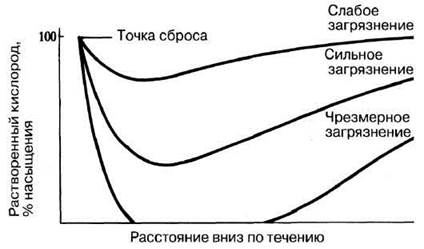
Fig. 10.28. Typical oxygen-sag curves: The Effect of organic waste discharge into a river on dissolved oxygen concentration. (From C. F. Mason (1981) Biology of freshwater pollution, Longman.)
10.19. List the factors that determine the degree of water deoxygenation.
In lakes, oxygen depletion caused by eutrophication can be exacerbated by seasonal stratification, which is The formation of non-mixing water layers with different temperatures. In temperate climates, thermal stratification typically occurs in early summer (Fig. 10.29), primarily due to the following two factors.
1. The sun heats the water surface. Warm water has a lower density, so instead of sinking, it forms a warm, stationary upper layer (the epilimnion). Below this layer, heat can only be transferred by thermal conduction, which is a slow process in a liquid medium.
2. Rivers and streams flowing into the lake are shallower, and their water warms throughout its entire depth. This water mixes only with the epilimnion, further elevating its Temperature compared to the deeper layer (the hypolimnion).

Fig. 10.29. Thermal stratification of a lake in the temperate zone (Linsley Ponds, Connecticut, USA). In summer, the warm, oxygen-rich circulating layer of water (epilimnion) is separated from the cool, oxygen-poor bottom layer (hypolimnion) by a broad zone of rapid temperature change known as the thermocline. In this zone, the oxygenation gradient of the water is similar to that shown for the water body as a whole. (Adapted from: E. R. Odum (1971) Fundamentals of ecology, Saunders.)
For a lake ecosystem, all of this has important consequences, notably making it difficult to supply the hypolimnion with oxygen.
Lake water receives oxygen through three main pathways:
1) via Photosynthesis, which requires light—i.e., occurring most intensively near the surface;
2) via diffusion from the atmosphere;
3) via the inflowing water of tributary rivers and streams.
As can be seen, these sources enrich the epilimnion with oxygen first and foremost. The oxygenation of deeper layers depends on downward diffusion and water mixing during strong wave action. The latter is more characteristic of the winter season. Thus, once summer stratification is established, Life in the depths of the lake relies primarily on the oxygen reserve built up in the hypolimnion by spring.
In a healthy lake ecosystem, the bulk of primary biomass is consumed by herbivores; detritivores and decomposers account for a relatively small proportion of the food intake. Eutrophication boosts phytoplankton productivity in the epilimnion, and a large mass of dead organic matter settles to the bottom because consumers simply cannot keep pace with the increased food supply. This stimulates the proliferation of decomposers in the hypolimnion, depleting an already meager oxygen reserve. If the hypolimnion were rich in oxygen, no problems would arise. However, by late summer, anoxic (oxygen-free) conditions may develop there, causing catastrophic fish kills and the death of other aquatic animals.
Monitoring Eutrophication
Changes associated with eutrophication can be tracked using biological and chemical Methods. Such regular observations—i.e., monitoring—make it possible to take timely, appropriate measures to prevent the catastrophic degradation of the ecosystem. The onset of eutrophication can be detected by shifts in phytoplankton composition, such as more frequent "blooms" caused by cyanobacteria. Eutrophic waters are typically characterized by low phytoplankton species diversity coupled with a high Abundance of a few co-dominant species.
A useful chemical parameter is the so-called biological oxygen demand (BOD) (Experiment 11.9), which serves as a measure of oxygen depletion by the biota. This value is thought to reflect the intensity of microbial decomposition of detritus present in the water (as noted earlier, eutrophic water bodies are characterized by an increase in particulate organic matter). Theoretically, the result also includes oxygen consumption by phytoplankton. In practice, this is usually negligible, although in some cases algae may account for up to 50% of the BOD. Thus, this analysis provides only an approximate assessment of water quality, and it is best used in combination with other methods.
10.20. What are the Advantages and disadvantages of biological monitoring of eutrophication compared to chemical monitoring?
Thermal Pollution
Thermal pollution poses problems in rivers and coastal marine waters. Typically, this pollution stems from The Use of natural waters as coolants in industrial processes, such as in power plants. Water returned to water bodies by industrial facilities is warmer than the intake water and consequently contains less dissolved oxygen. At the same time, the warming of the environment increases the metabolic rate of its inhabitants and, hence, their oxygen demand. If the temperature of the discharged water differs only slightly from that of the receiving water body, there may be no noticeable Changes in the biotic component of the ecosystem. However, if the temperature rises significantly, severe alterations in the biota can occur. For example, for migratory fish such as salmon, oxygen-depleted stretches of rivers become impassable barriers, severing The connection between these species and their spawning grounds.
Nevertheless, such use of water bodies (rivers or estuaries) already polluted with organic matter can sometimes have a positive effect. Passing through industrial cooling system pipes, the water becomes oxygenated through turbulence, so upon returning to the eutrophic ecosystem, it can enrich it with oxygen. This stimulates microbial activity and helps improve habitat quality.
Oil Pollution
Oil pollution primarily threatens marine and coastal ecosystems. Its main causes are:
1) oil tanker accidents resulting from collisions, fires, or wrecks;
2) oil leaks from onshore storage facilities;
3) tank-washing operations carried out at sea.
Each year, such incidents result in approximately 10 million tonnes of crude oil entering the world's oceans.
Oil does not mix with water, but when washed ashore, it destroys algae, Mollusks, crustaceans, and other littoral animals. Marine mammals suffer from oil pollution because their fur becomes coated with oil. However, the most visible victims are fish-eating birds: oil saturates and mats their feathers, making flight impossible and impairing body insulation, which threatens death from hypothermia; simultaneously, buoyancy is reduced, causing the birds to drown; finally, attempts to preen lead to the ingestion of hydrocarbons and poisoning. Phytoplankton does not appear to suffer particularly severe damage from oil pollution, although a dark film on the sea surface reduces light penetration through the water Column, temporarily dampening photosynthetic activity.
Over the long term, the ecological damage from oil spills is minimal. Recovery is faster if the oil is allowed to disperse naturally. Bacterial degradation of hydrocarbons, facilitated by the breakup of the continuous slick by wind and waves, is completed within 3 to 4 years in warm and temperate climates. In cold climates, such as along the coast of Alaska where the tanker Exxon Valdez wrecked in 1989, negative effects persist longer due to reduced bacterial activity. The use of surfactant dispersants speeds up the process, but these chemicals themselves often exacerbate environmental damage because they are toxic and highly resistant to biodegradation.
Research results have shown that subtle yet continuous leaks of petroleum products—such as from coastal Processing plants and terminals—pose a greater hazard to marine and littoral ecosystems than widely publicized major accidents.
The methods for combating oil water pollution are as follows:
1) protecting the coastline from oil slicks on the water using floating barriers (booms);
2) burning off heavy oil fractions;
3) collecting the oil and pumping it into specialized treatment vessels;
4) treating the oil slick with Bacteria (e.g., Pseudomonas) that degrade hydrocarbons (see Chapter 25);
5) applying newly developed dispersing agents that are less toxic and more biodegradable than traditional ones;
6) routing supertankers away from hazardous waters and ecologically vulnerable coastlines;
7) constructing tankers with double-walled cargo tanks;
8) introducing new ballast systems.
Last update: 06/08/2026
Editorial and Educational Adaptation: This material has been compiled based on the primary/original source text. The project team performed an editorial review, corrected technical inaccuracies, structured sections, and adapted the content for an educational format.
What was processed:
- elimination of formatting defects (OCR errors, structural breaks, corrupted characters);
- editorial organization of content;
- standardization of terminology in accordance with academic sources;
- verification of factual statements against the original source text.
All mentions of the author, publication year, and origin of the primary text have been preserved in accordance with the source.