BIOLOGY Volume 1 - A Guide to General Biology - 2004
10. ORGANISMS AND THE ENVIRONMENT
10.8. Human Impact on Ecosystems
Even 10,000 years ago, ecosystems evolved in response to abiotic changes independently of human activity (anthropogenic influences). As technology advanced, humans exerted an increasingly profound influence on the environment. This trend has become particularly pronounced over the last 200 years, as widespread industrialization has led to environmental pollution that is potentially hazardous even to ourselves.
In a broad sense, pollution can be defined as the Introduction into a habitat of a substance or energy in quantities that adversely affect the survival of the biota. Pollutants act upon organisms either directly or indirectly—by altering abiotic factors—and are readily transferred between different ecosystem components.
10.8.1. Air Pollution
Until relatively recently, air pollution was considered a local problem confined to major cities and industrial centers. It is now understood that atmospheric pollutants travel vast distances, damaging the environment far from their source of emission. Consequently, combating them has become a global challenge requiring international cooperation. Major air pollutants include anthropogenic gases such as chlorofluorocarbons (CFCs), sulfur dioxide (SO2), Hydrocarbons (HCs), and nitrogen oxides (NOx). Another form of pollution can be considered the human-induced increase in the atmosphere of carbon dioxide, one of its vital natural components.
Pollutants can seriously affect other natural constituents of the atmosphere, notably by depleting the concentration of ozone (O3) in the upper layer. Ironically, ozone itself acts as a ground-level air pollutant in certain places. It directly damages many agricultural crops, poses a risk to human health, and combines with HCs and NOx to form photochemical smog. In the broader sense, atmospheric pollutants also include dust, noise, excess heat, radioactivity, and electromagnetic fields.
Carbon Dioxide and the Greenhouse Effect
The movement of carbon through its biogeochemical cycle is summarized in Fig. 10.12. The bulk of this element on Earth is sequestered in carbonate minerals, fossil fuels, biomass, and soil organic matter (SOM). Recently, however, there has been an accelerated release of carbon into the atmosphere in the form of carbon dioxide, primarily driven by the combustion of fossil fuels, while the removal of carbon dioxide from the atmosphere is slowed down by large-scale deforestation (Section 10.8.3).
10.18. Why does deforestation lead to an accumulation of carbon dioxide in the atmosphere?
Normally, Carbon dioxide is present in the lower atmosphere (troposphere) at a low concentration—approximately 0.03% by volume. An increase in its concentration intensifies the global greenhouse effect. This occurs because carbon dioxide (along with certain other gases) is transparent to incoming short-wave solar radiation, but strongly absorbs the long-wave radiation reflected from the Earth's surface. In other words, much like the Glass in a greenhouse, it traps heat near the planet's surface, warming it. Naturally, this energy is eventually radiated back into space, but the continued accumulation of carbon dioxide and other "greenhouse" gases in the atmosphere has the theoretical potential to raise global temperatures by 32 °C.
It is important to recognize that without the greenhouse effect, which remained relatively stable over millions of years, modern ecosystems could not exist. However, in recent times, the atmospheric concentrations of carbon dioxide and other similar greenhouse gases—primarily carbon monoxide, methane, and CFCs—have been rising at an unprecedented rate (Fig. 10.24). This threatens a globally enhanced greenhouse effect, i.e., widespread warming. In turn, this warming will accelerate Water evaporation and increase atmospheric water vapor content. Since water vapor also strongly absorbs long-wave radiation, the greenhouse effect will escalate through a positive feedback loop. Global warming will cause severe alterations and spatial redistribution of weather patterns, with profound consequences for human civilization and wildlife alike.
In 1988, the Intergovernmental Panel on Climate Change (IPCC) was established to coordinate the exchange of scientific information and research into the potential causes and consequences of rising levels of carbon dioxide and other greenhouse gases, as well as to identify effective mitigation strategies. In 1992, the UN Conference on Environment and Development (the "Earth Summit") attempted to establish a binding international agreement on reducing CO2 emissions for all nations. While conclusive evidence of anthropogenic global warming is still debated, some scientists believe it is already underway. In any case, international efforts to curb the escalating greenhouse effect are to be welcomed.
Class="center">
Fig. 10.24. A. Growth rate curve of carbon dioxide volumetric concentration since 1958, based on data from the Mauna Loa Observatory in Hawaii. The smooth curve represents the same data averaged over 10-year periods. The current atmospheric concentration of carbon dioxide is close to 0.035% (355 ppm). B. Changes in industrial carbon emissions (from fossil fuel combustion) and global carbon reservoirs since the mid-19th century. Calculations indicate that the terrestrial biosphere was a net carbon source until 1940 (negative values on the graph), but began acting as a carbon sink around 1960. (From Climate Change (1994) IPCC Scientific Assessment, WMO/UNEP, CUP.)
Depletion of the Ozone Layer
The atmosphere serves as both a thermal blanket and a radiation shield for the Earth. In its upper layer—the stratosphere (at an altitude of 15–50 km)—oxygen and ozone absorb the bulk of incoming solar ultraviolet radiation. In high doses, UV radiation is lethal to all living things as it damages genetic material. While a specific wavelength range of ultraviolet light is beneficial to humans by triggering vitamin D synthesis (Section 8.7.9), excessive exposure to sunlight is known to increase the risk of Skin Cancer. Furthermore, by absorbing solar radiation, stratospheric ozone heats the stratosphere, creating a pronounced Temperature inversion layer where air temperature increases with altitude. This layer restricts convection currents, and any disruption to it will severely impact global weather systems and, consequently, established climate patterns.
Ozone is formed in the stratosphere when solar radiation acts upon oxygen. CFCs and certain other volatile substances, such as carbon tetrachloride and chloroform—commonly used as Solvents, propellant gases in aerosol cans, and refrigerants in cooling systems—are chemically quite stable and accumulate in the atmosphere, thereby enhancing the greenhouse effect. The main problem, however, is that upon diffusing into the upper atmosphere, they are broken down by solar radiation, releasing chlorine and fluorine. These elements react with ozone, converting it into oxygen faster than the reverse process can occur; in other words, these gases destroy the ozone shield.
In 1987, the seasonal yet total disappearance of the ozone layer over Antarctica was recorded for the first time, and throughout the 1990s, a regular thinning of the ozone layer was observed over the Arctic. The causes of this phenomenon are not fully understood. It is possible that overcooling of the upper atmosphere occurred due to an intensified greenhouse effect, which traps heat near the Earth's surface. This facilitates The formation of polar stratospheric clouds over the poles, under conditions where ozone concentrations drop rapidly. Consequently, and regrettably, the ongoing widespread reduction in CFC emissions may not necessarily lead to the recovery of the ozone layer in the near future, contrary to what scientists once hoped. More aggressive measures to combat the enhanced greenhouse effect may prove necessary.
Acid Rain
Acid rain is neither a simple nor a uniform phenomenon. Acid-forming gases, specifically sulfur dioxide (SO2) and nitrogen oxides (NOx), are released during the combustion of fossil fuels. Incomplete combustion of these fuels also results in hydrocarbon emissions into the atmosphere. These gases may act directly or be scavenged from the atmosphere by water, acidifying snow and rain (Fig. 10.25). In the world's most heavily industrialized regions, such as the eastern United States, Western Europe, northeastern China, and Japan, precipitation with a pH significantly below 4.0 occurs regularly.

Fig. 10.25. The complex nature of acid rain. A schematic representation of how air pollutants interact to produce varying effects depending on local environmental conditions. (From C. Rose (1985) Acid rain falls on British woodland, New Scientist, 108, 1482, 52–57)
Acid rain (pH < 5) frequently triggers severe ecological shifts and damages infrastructure. Often, this damage occurs in countries neighboring the primary sources of pollutant gases. For instance, acid rain in Norway and Sweden is driven by industrial emissions from the UK and central European industrial centers, carried toward Scandinavia by prevailing winds. In central Sweden and southern Norway, these acidic depositions reduce catches of salmon and trout (Fig. 10.26) and damage forests. Tree dieback linked to acid pollution is now widespread across Europe (Fig. 10.27), while beech and yew trees suffer from its effects in Britain.
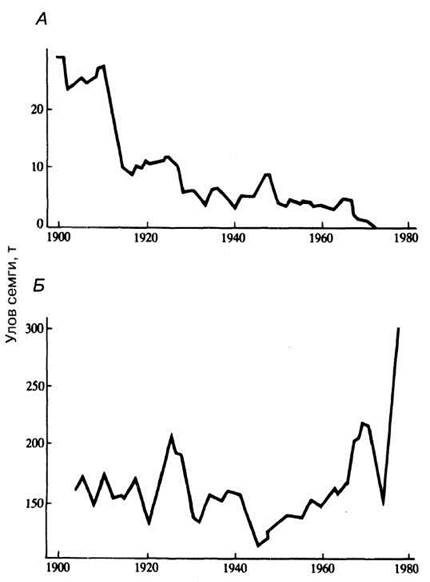
Fig. 10.26. Fluctuations in salmon catches in Norwegian rivers: A — in the southern part of the country, most affected by acid rain; B — in 68 other Norwegian rivers. (From F. Pearce (1986) Unravelling a century of acid pollution, New Scientist 11, 1527, p. 33.)

Fig. 10.27. Forest dieback caused by acid rain in Germany.
Acid rain leaches magnesium and calcium from the soil and damaged leaves. Ultimately, as the pH drops, aluminum, manganese, and heavy metals such as iron and cadmium are released into the soil solution. Their concentrations can reach toxic levels, damaging roots and destroying mycorrhizae. This diminishes the trees' ability to absorb water and essential nutrients from the soil. Mineral-deficiency diseases spread and are further exacerbated during drought conditions.
Remediation measures such as the liming of lakes (in Sweden) and forest soils (in West Germany) can only be considered temporary fixes. The situation can only be fundamentally corrected by reducing atmospheric pollutant emissions. Current efforts focus primarily on curbing sulfur dioxide, as its industrial sources—chiefly coal-fired power plants—are easily identifiable. Furthermore, effective, albeit costly, technologies exist for flue-gas desulfurization. Nevertheless, in the long term, curbing the emissions of hydrocarbons and nitrogen oxides is equally crucial.
Last update: 06/08/2026
Editorial and Educational Adaptation: This material has been compiled based on the primary/original source text. The project team performed an editorial review, corrected technical inaccuracies, structured sections, and adapted the content for an educational format.
What was processed:
- elimination of formatting defects (OCR errors, structural breaks, corrupted characters);
- editorial organization of content;
- standardization of terminology in accordance with academic sources;
- verification of factual statements against the original source text.
All mentions of the author, publication year, and origin of the primary text have been preserved in accordance with the source.