Protein Structure and Function. Application of Bioinformatics Methods - John Rigden 2014
Prediction of Membrane Protein Structure
Structural Classes
Beta-barrels
Beta-barrel transmembrane Proteins are found in the outer membranes of Gram-negative Bacteria, The Cell walls of Gram-positive bacteria, and the outer membranes of Mitochondria and METABOLISM/14.html">Chloroplasts. They consist of rows of antiparallel ß-strands embedded in the membrane. Each strand is linked to the preceding and succeeding strands in the sequence by Hydrogen Bonds. The rows of strands are connected to one another by extramembrane loops. The ß-strands contain alternating polar and hydrophobic Amino Acids, oriented such that the hydrophobic residues face the outer surface of the pore and interact with the surrounding Lipids, while the hydrophilic residues line the interior of the pore. All ß-barrel transmembrane proteins share a simple up-and-down topological Organization, which likely reflects a common evolutionary origin and a similar folding mechanism. Porins are among the transmembrane proteins that adopt a ß-barrel Structure. These ß-barrels consist of 16 or 18 ß-strands and form Water-filled channels. Through such channels, nutrients and Metabolic waste products undergo Passive Diffusion Across the outer membrane (Fig. 4.2). Potentially toxic substances of larger size are excluded from the cell due to channel size constraints. Porins and structurally related proteins account for 2–3% of Gene Expression IN Gram-negative bacteria (Wimley 2003).
Class="center">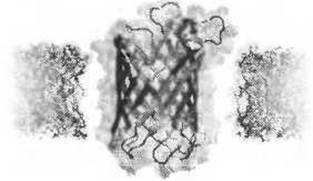
Fig. 4.2. (For the color version of this figure, see the insert.) A typical ß-barrel—the monomeric porin OmpG from Escherichia coli, side view. Porins are transmembrane proteins featuring a central cavity through which small molecules diffuse. PDB ID 2f1c
Last update: 06/08/2026
Editorial and Educational Adaptation: This material has been compiled based on the primary/original source text. The project team performed an editorial review, corrected technical inaccuracies, structured sections, and adapted the content for an educational format.
What was processed:
- elimination of formatting defects (OCR errors, structural breaks, corrupted characters);
- editorial organization of content;
- standardization of terminology in accordance with academic sources;
- verification of factual statements against the original source text.
All mentions of the author, publication year, and origin of the primary text have been preserved in accordance with the source.