BIOCHEMISTRY - L. Stryer - 1984
VOLUME 2
PART II GENERATION AND STORAGE OF METABOLIC ENERGY
CHAPTER 16. GLYCOGEN AND DISACCHARIDE METABOLISM
16.22. Lactose Synthesis Is Controlled by a Modifying Subunit
The regulation of lactose synthesis is of particular interest. Lactose synthase is composed of a catalytic subunit and a modifying subunit. The isolated catalytic subunit, termed galactosyltransferase, catalyzes The transfer of galactose from UDP-galactose to N-acetylglucosamine, forming N-acetyllactosamine.
Class="center">
The Specificity of the catalytic subunit is altered upon binding to α-lactalbumin, the modifying subunit. The resulting complex, designated as lactose synthase, transfers galactose not to N-acetylglucosamine, but to glucose, leading to The formation of lactose.
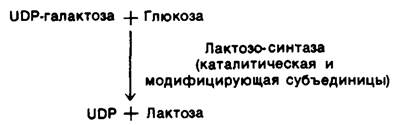
Galactosyltransferase is present in most Tissues, where it participates in the Synthesis of the carbohydrate component of Glycoproteins. In contrast, lactose synthase is found exclusively in the mammary gland. During Pregnancy, galactosyltransferase is synthesized and accumulates in the mammary gland, whereas the modifying subunit is produced in small amounts. At parturition, drastic shifts in the levels of certain Hormones trigger the synthesis of large quantities of the modifying subunit. The resulting lactose synthase complex then synthesizes large amounts of lactose. The regulation of lactose synthesis illustrates how hormones can exert their physiological effects by profoundly altering Enzyme Specificity.
16.23. Adult Lactose Intolerance Caused by Lactase Deficiency
Nearly all infants and children are able to digest lactose. In contrast, the majority of human adults in certain populations exhibit lactase deficiency, which leads to lactose intolerance. In individuals with lactase deficiency, lactose accumulates in the lumen of the Small Intestine after milk ingestion because they lack a mechanism to mediate the absorption of this disaccharide. The high osmotic effect of unabsorbed lactose causes an influx of Water into the small intestine. Consequently, the Clinical symptoms of lactose intolerance include bloating, nausea, cramps, pain, and watery diarrhea. Lactase deficiency appears to be inherited as an autosomal recessive trait and typically manifests in adolescence or young adulthood. The prevalence of lactase deficiency varies widely across human populations, ranging, for example, from 3% in Danes to 97% in Tahitians. Populations that do not consume milk as adults generally exhibit a high incidence of lactase deficiency. The same holds true for other mammals. The ability of adult humans to digest lactose apparently evolved approximately ten thousand years ago in connection with the domestication of cattle.
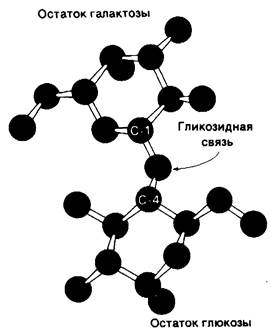
Fig. 16.13. Model of lactose
16.24. Entry of Fructose and Galactose into the Glycolytic Pathway
Fructose accounts for a substantial fraction of dietary CARBOHYDRATES. Its typical daily intake is 100 g, consumed both as free sugar and as a component of sucrose. The bulk of ingested fructose is metabolized in the Liver via the fructose 1-phosphate pathway. The first step in this pathway is the phosphorylation of fructose to fructose 1-phosphate by fructokinase. Fructose 1-phosphate is subsequently cleaved into glyceraldehyde and dihydroxyacetone phosphate. This aldol Cleavage is catalyzed by a specific fructose 1-phosphate aldolase.
Glyceraldehyde is then phosphorylated by triokinase to glyceraldehyde 3-phosphate, thereby entering The Glycolytic Pathway. Alternatively, fructose can be phosphorylated to fructose 6-phosphate by hexokinase. However, the affinity of hexokinase for glucose is twenty times greater than for fructose; consequently, in the liver, which has a high glucose concentration, only negligible phosphorylation of fructose to fructose 6-phosphate occurs. In contrast, in adipose tissue, where the concentration of fructose significantly exceeds that of glucose, the Formation of fructose 6-phosphate is not subject to substantial competitive inhibition. Therefore, in adipose tissue, the major portion of fructose is metabolized via fructose 6-phosphate.

Galactose is produced by the Hydrolysis of lactose, the primary carbohydrate of milk. Galactose is subsequently converted into glucose 1-phosphate in four steps. The initial reaction in the galactose-glucose interconversion pathway is the phosphorylation of galactose to galactose 1-phosphate, catalyzed by galactokinase.
Galactose + ATP → Galactose-1-phosphate + ADP + H+.
Next, in an exchange reaction catalyzed by galactose 1-phosphate uridylyltransferase, UDP-galactose is formed.
The UDP-bound galactose is subsequently epimerized to glucose. The configuration of the hydroxyl group at C-4 is inverted by UDP-galactose 4-epimerase, which contains tightly bound NAD+. Fluorescence labeling experiments have demonstrated that this NAD+ undergoes transient reduction to NADH during catalysis. NAD+ presumably accepts a hydrogen atom attached to C-4 of the sugar, generating a 4-ketosugar as an intermediate. The hydrogen
of NADH is then transferred to the opposite face of C-4 to yield the other epimer. The overall reaction for the individual steps catalyzed by galactokinase, transferase, and epimerase is as follows:
Galactose + ATP → Glucose-1-phosphate + ADP + H+.
The reversible reaction catalyzed by epimerase is crucial not only for the utilization of galactose as an energy source. The conversion of UDP-glucose into UDP-galactose is essential for the synthesis of galactosyl residues in complex Polysaccharides and glycoproteins whenever dietary galactose is insufficient to meet the demand for these components.
16.25. In the Absence of Transferase, Galactose Is Highly Toxic
The absence of galactose-1-phosphate uridylyltransferase causes galactosemia, a severe autosomal recessive disorder. In affected individuals, Galactose METABOLISM is blocked at the galactose-1-phosphate stage. Infants fail to thrive properly, and milk ingestion leads to vomiting or diarrhea. Characteristic symptoms of this pathology include hepatomegaly and jaundice. In many cases, galactosemic children suffer from mental retardation. Blood galactose levels are significantly elevated, and galactose is also detected in the urine. Furthermore, the concentration of galactose-1-phosphate in erythrocytes increases. The definitive diagnostic criterion is the absence of galactose-1-phosphate uridylyltransferase in erythrocytes.
Galactosemia can be treated by eliminating galactose from the diet. Implementing a galactose-free diet leads to the rapid disappearance of virtually all clinical symptoms, with the exception of mental retardation, which may be irreversible. Prolonged galactose consumption can, in some cases, result in death. The tissue damage observed in galactosemia is caused by the accumulation of toxic metabolites rather than the lack of any essential compound. Patients are able to synthesize UDP-galactose from UDP-glucose because their epimerase activity remains within the normal range. One of the toxic compounds is galactitol, which is formed via the reduction of galactose. High concentrations of galactitol lead to cataract formation. Galactose-1-phosphate may serve as a precursor to other toxic agents and, in large quantities, exerts direct toxic effects as well.

Last update: 06/08/2026
Editorial and Educational Adaptation: This material has been compiled based on the primary/original source text. The project team performed an editorial review, corrected technical inaccuracies, structured sections, and adapted the content for an educational format.
What was processed:
- elimination of formatting defects (OCR errors, structural breaks, corrupted characters);
- editorial organization of content;
- standardization of terminology in accordance with academic sources;
- verification of factual statements against the original source text.
All mentions of the author, publication year, and origin of the primary text have been preserved in accordance with the source.