BIOCHEMISTRY - L. Stryer - 1984
VOLUME 2
PART II GENERATION AND STORAGE OF METABOLIC ENERGY
CHAPTER 12. GLYCOLYSIS
12.16. Enol Phosphates Have a High Group-Transfer Potential
Because 1,3-BPG is an acyl phosphate, it has a high group-transfer potential. Later stages of Glycolysis generate various high-energy phosphate compounds. Phosphoenolpyruvate, an enol phosphate, is formed by the dehydration of 2-phosphoglycerate. The ∆G0' of Hydrolysis of a standard alcohol phosphate ester is —3 kcal/mol, whereas for phosphoenolpyruvate this value is —14.8 kcal/mol. Why does phosphoenolpyruvate have such a high phosphate-transfer potential? The answer is that the reaction does not stop at the phosphoryl-group transfer to yield an enol. The enol undergoes a conversion into a ketone, specifically Pyruvate.
Class="center">

The ∆G0' of the enol → ketone conversion is very large, approximately —10 kcal/mol. Comparing this value with the ∆G0' of hydrolysis of phosphoenolpyruvate to enolpyruvate, which is roughly —3 kcal/mol, we see that the high phosphate-transfer potential inherent in phosphoenolpyruvate arises from the large driving force of the subsequent enol → ketone conversion.
12.17. Metabolism of 2,3-Bisphosphoglycerate, a Regulator of Oxygen Transport
Recall that 2,3-bisphosphoglycerate (2,3-BPG) serves as a regulator of Oxygen transport in erythrocytes. It decreases the affinity of Hemoglobin for oxygen by stabilizing the deoxygenated form of hemoglobin (Chapter 4). Erythrocytes are characterized by a high concentration of 2,3-BPG (typically 4 mM), which distinguishes them from other Cells containing only trace amounts of this compound. 2,3-BPG plays a general role as a cofactor in The conversion of 3-phosphoglycerate to 2-phosphoglycerate catalyzed by phosphoglycerate mutase.
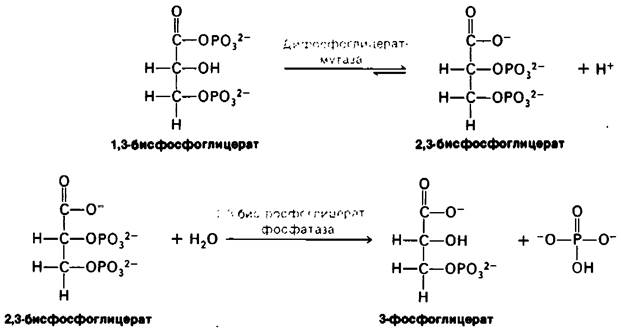
The Synthesis and Breakdown of 2,3-BPG bypass The Glycolytic Pathway (Fig. 12.16). Under the action of bisphosphoglycerate mutase (diphosphoglycerate mutase), 1,3-BPG is converted into 2,3-BPG.
Fig. 12.16. Pathway of synthesis and breakdown of 2,3-bisphosphoglycerate

2,3-BPG is hydrolyzed by 2,3-bisphosphoglycerate phosphatase to yield 3-phosphoglycerate. A phosphatase is an enzyme that catalyzes the hydrolysis of a phosphate ester.
The Mechanism of this mutase reaction is of particular interest. 3-Phosphoglycerate is an obligatory participant, although it does not appear in the overall reaction stoichiometry. The mutase simultaneously binds 1,3-bisphosphoglycerate and 3-phosphoglycerate. Within this ternary complex, a phosphoryl group is transferred from C-1 of 1,3-bisphosphoglycerate to C-2 of 3-phosphoglycerate (Fig. 12.17).
Fig. 12.17. Schematic representation of the involvement of 3-phosphoglycerate in the conversion of 1,3-bisphosphoglycerate to 2,3-bisphosphoglycerate
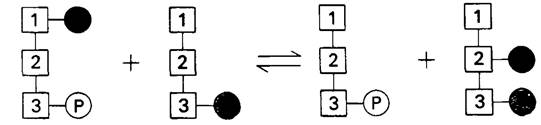
In this mutase reaction, 2,3-BPG acts as a potent competitive inhibitor with respect to 1,3-BPG. Thus, The rate of 2,3-BPG synthesis partly depends on its own concentration. Another regulatory factor is the concentration of 1,3-BPG, as the enzyme is not always saturated with this compound. In contrast, the level of 3-phosphoglycerate in erythrocytes is close to that required to saturate the mutase. Consequently, the rate of 2,3-BPG synthesis is regulated by the concentrations of unbound 1,3-BPG and 2,3-BPG.
12.18. Impairment of Glycolysis in Erythrocytes Leads to Altered Oxygen Transport
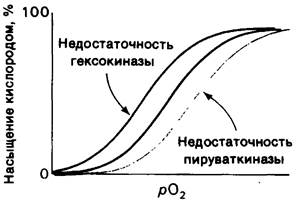
Glycolysis in erythrocytes and oxygen transport are linked through the involvement of 2,3-bisphosphoglycerate in both processes. This means that defects in glycolysis can affect oxygen transport. Indeed, in some patients with hereditary glycolytic deficiencies, the oxygen dissociation curves are altered (Fig. 12.18). In hexokinase deficiency, the concentrations of glycolytic intermediates are low due to the Impairment of the first step of the process, namely the phosphorylation of glucose. Erythrocytes from such patients are characterized by a lowered concentration of 2,3-BPG and, consequently, their hemoglobin exhibits an abnormally high oxygen affinity. Exactly opposite changes occur in pyruvate kinase deficiency. The concentrations of glycolytic intermediates are abnormally high, which is explained by the blockade of the final step of the pathway. Accordingly, the 2,3-BPG content is twice the normal level, resulting in a low oxygen affinity of hemoglobin. The abnormalities in oxygen dissociation curves in hexokinase and pyruvate kinase deficiencies remained inexplicable until it was established that 2,3-BPG acts as a regulator of oxygen transport.
Table 12.3. Normal concentrations of glycolytic intermediates in erythrocytes

Fig. 12.18. Oxygen dissociation curves for normal erythrocytes (black line), erythrocytes from a patient with hexokinase deficiency (red line), and erythrocytes from a patient with pyruvate kinase deficiency (blue line)
Last update: 06/08/2026
Editorial and Educational Adaptation: This material has been compiled based on the primary/original source text. The project team performed an editorial review, corrected technical inaccuracies, structured sections, and adapted the content for an educational format.
What was processed:
- elimination of formatting defects (OCR errors, structural breaks, corrupted characters);
- editorial organization of content;
- standardization of terminology in accordance with academic sources;
- verification of factual statements against the original source text.
All mentions of the author, publication year, and origin of the primary text have been preserved in accordance with the source.