BIOCHEMISTRY - L. Stryer - 1984
VOLUME 2
PART II GENERATION AND STORAGE OF METABOLIC ENERGY
CHAPTER 12. GLYCOLYSIS
12.13. Aldolase forms a Schiff base with dihydroxyacetone phosphate
Let us now turn to aldolase, which catalyzes the Condensation of dihydroxyacetone phosphate and glyceraldehyde 3-phosphate to form fructose 1,6-bisphosphate. First, dihydroxyacetone phosphate forms a protonated Schiff base with a specific Lysine residue in the Active Site of animal tissue aldolases.
Class="center">
This protonated Schiff base plays a crucial role in catalysis because it facilitates The formation of the enolate anion of dihydroxyacetone phosphate.

The subsequent addition of glyceraldehyde 3-phosphate to the resulting enolate anion intermediate yields the protonated Schiff base of fructose 1,6-bisphosphate.
This Schiff base is deprotonated and hydrolyzed to yield fructose 1,6-bisphosphate and regenerate the enzyme.

The pathway of fructose 1,6-bisphosphate Cleavage is simply the reverse of its formation pathway.
12.14. Formation of a thioester in the oxidation of glyceraldehyde 3-phosphate
The action of glyceraldehyde 3-phosphate dehydrogenase involves the formation of various enzyme-substrate intermediates. The enzyme catalyzes the Oxidative Phosphorylation of its aldehyde substrate.
Glyceraldehyde 3-phosphate + Pi + NAD+ → 1,3-BPG + NADH + H+.
In The conversion of the aldehyde to an acyl phosphate, the aldehyde group is first oxidized.
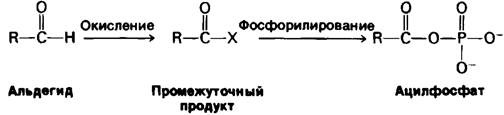
This requires the removal of a hydride ion (H-), which is a hydrogen Nucleus with two electrons. The detachment of a hydride ion from an aldehyde must overcome a formidable barrier due to the dipolar Nature of the carbonyl group. The carbonyl carbon atom already carries a partial positive charge.
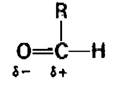
Fig. 12.14. Micrograph of aldolase crystals

The removal of the hydride ion is facilitated by reducing the positive charge on the carbon atom. This is achieved by The addition of a nucleophilic agent, designated as X- in the following equation:

The hydride ion is easily detached from the resulting product because the carbon atom no longer carries a high positive charge. Furthermore, some of the Free energy of oxidation is conserved in the acyl intermediate. The addition of orthophosphate to this intermediate yields an acyl phosphate, which has a high group-transfer potential. This sequence of reactions is called substrate-level phosphorylation.

Now let us examine how glyceraldehyde 3-phosphate dehydrogenase catalyzes these reactions (Fig. 12.15). The nucleophile X is the sulfhydryl group of a Cysteine residue in the active site of the enzyme. The aldehyde substrate reacts with the ionized form of this sulfhydryl group to form a hemithioacetal. The next step is The transfer of a hydride ion. The acceptor for the hydride ion is an NAD+ molecule that is tightly bound to the enzyme. The reaction products are the reduced coenzyme NADH and a thioester. This thioester is a high-energy intermediate, corresponding to the acyl intermediate mentioned earlier. NADH dissociates from the enzyme, and NAD+ binds to the active site again. Next, orthophosphate attacks the thioester to form 1,3-bisphosphoglycerate, a high-energy phosphate. The formation of 1,3-bisphosphoglycerate from glyceraldehyde 3-phosphate is of crucial importance because the thermodynamically unfavorable reaction, the formation of an acyl phosphate
from a carboxylate, is driven by the thermodynamically favorable reaction, The oxidation of the aldehyde.

Figure 12.15. Catalytic Mechanism of glyceraldehyde 3-phosphate dehydrogenase

These two reactions are coupled by a thioester intermediate, which preserves much of the free energy released during the oxidation reaction. Here we see The Use of a covalently bound enzyme intermediate as a mechanism for energy coupling.
12.15. Arsenate, a phosphate analog, acts as an uncoupler
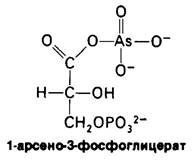
Arsenate (AsO43-) is very similar to Pi in Structure AND REACTIVITY. In the reaction catalyzed by glyceraldehyde 3-phosphate dehydrogenase, arsenate can replace phosphate in attacking the high-energy thioester intermediate. The resulting 1-arseno-3-phosphoglycerate, unlike 1,3-bisphosphoglycerate, is unstable. 1-Arseno-3-phosphoglycerate and other acyl arsenates hydrolyze very rapidly and spontaneously. Therefore, the net reaction in the presence of arsenate is as follows:
Glyceraldehyde 3-phosphate + NAD+ + H2O → 3-phosphoglycerate + NADH + 2H+.
Note that Glycolysis proceeds in the presence of arsenate, but it is not accompanied by the ATP formation that normally occurs during the conversion of 1,3-bisphosphoglycerate to 3-phosphoglycerate. Thus, arsenate uncouples oxidation and phosphorylation by forming a highly labile acyl arsenate. The likely reason why phosphorus was preferred over arsenic in the evolution of biological molecules is the greater kinetic stability of high-energy phosphorus compounds.
Last update: 06/08/2026
Editorial and Educational Adaptation: This material has been compiled based on the primary/original source text. The project team performed an editorial review, corrected technical inaccuracies, structured sections, and adapted the content for an educational format.
What was processed:
- elimination of formatting defects (OCR errors, structural breaks, corrupted characters);
- editorial organization of content;
- standardization of terminology in accordance with academic sources;
- verification of factual statements against the original source text.
All mentions of the author, publication year, and origin of the primary text have been preserved in accordance with the source.