Pharmacognosy with Basics of Plant Biochemistry - Kovalyov V. M. 2004
Special Part
Peptides and Proteins
Medicinal plants and raw materials containing lectins
MISTLETOE SHOOTS — CORMІ VISCI
European mistletoe — Viscum album L., fam. Loranthaceae
European mistletoe; the name originates from the Latin viscum meaning birdlime.
Plant. A perennial, dioecious, semi-parasitic, evergreen, spherical shrub.
Branches are glabrous, greenish-yellow, cylindrical, woody, dichotomously branched, swollen at the nodes, and highly brittle. Leaves are coriaceous, entire, elliptically oblong, sessile, yellow-green, with 3–5 prominent arcuate Veins and an upwardly curved apex, arranged oppositely at the ends of the shoots. Flowers are unisexual, yellow, sessile, clustered in groups of 3–6 into HEAD-like inflorescences at the forkings of the branches. Fruits are berry-like, white, containing one or two oval seeds and a viscous pericarp. Blooms in March–April.
It parasitizes deciduous trees (poplar, maple, willow, linden, elm, pear, apple), attaching to them via haustoria through which it absorbs Water and mineral nutrients from the host tree.
Distribution. It has a Eurasian range that coincides with the distribution of broadleaf forests. Found in the forest-steppe regions of Ukraine, Polissya, and occasionally in the northern part of the Steppe and Crimea.
Class="center">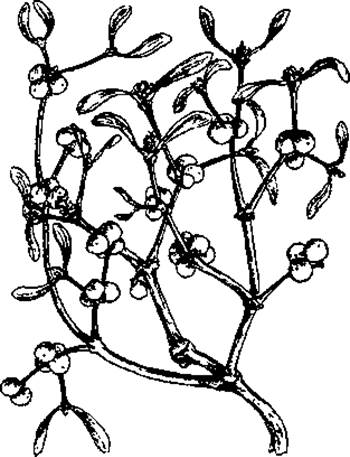
Harvesting. Young branches with leaves are cut in late autumn and winter using pruners or hooks. They are dried in warm, well-ventilated areas by spreading them in a thin (3–5 cm) layer on fabric or paper. Artificial drying is carried out at a Temperature of 40–50 °C.
Chemical composition of the raw material. Contains 0.03–0.10% of the glycoprotein viscotoxin, galactose-specific Lectins (ML-1, ML-2), α- and β-viscol, viscerin, oleanolic and ursolic acids, Choline and its derivatives (acetylcholine, propionylcholine), amines (viscalin, viscalbin, tyramine, etc.), alcohols (pinitol, querbicitol, etc.), Flavonoids (quercetin, rhamnetin, isorhamnetin, rhamnazin-3-glucoside, Chalcones), fatty oil, ascorbic acid, carotene, resins, and mineral salts (over 20 Trace Elements).
Biological activity and application. Mistletoe shoots are used as a hypotensive, sedative, astringent, hemostatic, anthelmintic, diuretic, and hypoazotemic agent. In folk medicine, the infusion is administered for stage I–II Hypertension, intestinal atonia, pulmonary, nasal, and prolonged uterine bleeding, particularly in patients with arterial hypertension during the menopausal period. Mistletoe extract is a component of the medicinal product Cardiofit and the energy tonic Doppelherz. Purified mistletoe extracts, such as Iscador and Helixor-M, have been proposed as cytolytic agents for inoperable forms of Cancer. Prolonged use of mistletoe preparations may cause poisoning.
In homeopathy, fresh leaves and berries are used for hypertension and hypotension, spasmodic cough, Bronchial Asthma, and menopausal disorders.
Last update: 06/08/2026
Editorial and Educational Adaptation: This material has been compiled based on the primary/original source text. The project team performed an editorial review, corrected technical inaccuracies, structured sections, and adapted the content for an educational format.
What was processed:
- elimination of formatting defects (OCR errors, structural breaks, corrupted characters);
- editorial organization of content;
- standardization of terminology in accordance with academic sources;
- verification of factual statements against the original source text.
All mentions of the author, publication year, and origin of the primary text have been preserved in accordance with the source.