Biochemistry - The Chemical Reactions of Living Cells, Volume 3 - D. Metzler 1980
Light in Biology
Photochemistry
Chemical Equilibrium in the Excited State
Since the transition to excited states (singlet and triplet) increases the energy of molecules, the latter acquire chemical properties absent in unexcited molecules [67, 67a]. Changes in the pKa values of functional groups upon excitation can lead to either proton dissociation or association. Dissociation into ions or radicals is occasionally accompanied by bond Cleavage. Photoaddition and photoelimination reactions may occur, as well as molecular isomerization, which plays a crucial role in the functioning of visual receptors. Excited molecules can also act as strong oxidizing agents capable of accepting hydrogen atoms or electrons from other molecules. An example of this is the photooxidation of EDTA by riboflavin (which undergoes photoreduction, as shown in Fig. 8-15). A biologically more significant process is Photosynthesis, during which excited chlorophyll molecules drive the photoreduction of other molecules, temporarily becoming oxidized in the process. Unfortunately, the value of studying photochemical reactions is severely compromised by the potential occurrence of numerous parallel reactions, often leading to The formation of a vast array of distinct photochemical products (one need only look at the thin-layer chromatogram of riboflavin degradation products, Fig. 2-34).
Upon irradiation of pyridoxamine, which exists as a dipolar cyclic ion [Scheme 18-27] and exhibits an absorption band at  , the maximum fluorescence is observed at
  . Conversely, when basic pyridoxamine—present as a cyclic anion with an absorption band at
  —is irradiated, the fluorescence maximum is observed at 27,000 cm-1; that is, the shift from the absorption maximum is again ~5500 cm-1. However, placing the same compound in an acidic medium where
  results in a luminescence maximum once more observed at 25,000 cm-1 (i.e., coinciding with that of the neutral dipolar ionic form) and consequently shifted from the absorption maximum by 9000 cm-1 [68, 69]. This phenomenon, observed in most phenols, has been attributed to the rapid dissociation of the proton from the phenolic group in the photoexcited state. Thus, the excited pyridoxamine cation rapidly converts into a dipolar ion in an acidic medium. In other words, the phenolic group becomes more acidic in the excited state than in the ground state.
Direct information regarding the pKa values of a group in the excited state can be obtained by studying the pH dependence of fluorescence intensity. A more indirect approach (proposed by Förster) is also used to estimate the pKa of phenols in the excited state. Let E1 be the 0–0 transition energy for the undissociated form (best determined as the midpoint between the observed transition energies in the absorption and fluorescence spectra), and E2 be the 0–0 transition energy for the dissociated form (anionic in the case of phenols); furthermore, let ∆H and ∆H* denote the enthalpy of dissociation in the ground and excited states, respectively. It immediately follows that
Class="center">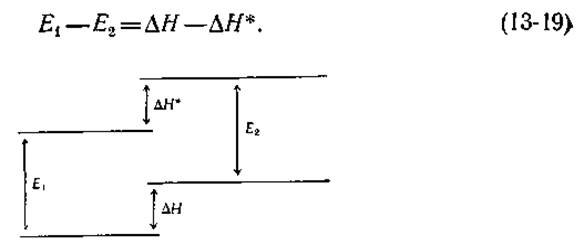
Assuming that the Entropy change is identical for reactions in the ground and excited states, we obtain the following relationships:

or

Equation (13-21) indicates that a 1000 cm-1 shift of the absorption spectrum of the basic form toward lower wave numbers relative to THE SPECTRUM OF the acidic form corresponds to a 2.1-unit decrease in the pKa for the dissociation of the acidic form. Although THE POSITION OF the 0–0 band is best determined from both absorption and fluorescence spectra, researchers often record only the Absorption Spectra and estimate the 0–0 band position from the maximum of the absorption band. For example, for pyridoxamine, the shift of the absorption maximum from 34,000 cm-1 in the protonated form to 30,700 cm-1 in the dissociated form suggests that its ground-state pKa of 3.4 decreases upon excitation by 6.9 units, down to a value of —3.50.
While phenols and amines are more acidic in the singlet excited state than in the ground state, certain compounds (such as aromatic ketones) become more basic upon photoexcitation.
The presence of an anomalously large fluorescence spectrum shift found a very interesting application in the work of Johnson et al. [70]. The absorption of Pyridoxal phosphate bound to Glycogen phosphorylase at λ = 330 nm (30,300 cm-1) may be attributed either to the formation of an adduct between one of the enzyme's functional groups and the Schiff base formed by PLP and a Lysine side chain (Structure A), or to the formation of a non-ionic cyclic Schiff base form within a hydrophobic environment (Structure B). For Structure A, the fluorescence spectrum position should be identical to that of pyridoxamine. On the other hand, in a Schiff Base of the type shown in Structure B, a photoinduced proton transfer (phototautomerization) should occur, yielding compound C, which exhibits an absorption band with λmax = 430 nm (23,300 cm-1) and fluoresces at even longer wavelengths [52, 70]. Since the fluorescence λmax is 530 nm, it was concluded that the chromophore adopts Structure B.
1) According to calculations by Bridges et al. [69], the pK* value is —4.25, whereas the pH dependence of fluorescence yields a pK* ≈ —4.1.

The rate of proton dissociation for molecules in the excited state is now measured directly using nanosecond fluorimetry [71].
Last update: 06/08/2026
Editorial and Educational Adaptation: This material has been compiled based on the primary/original source text. The project team performed an editorial review, corrected technical inaccuracies, structured sections, and adapted the content for an educational format.
What was processed:
- elimination of formatting defects (OCR errors, structural breaks, corrupted characters);
- editorial organization of content;
- standardization of terminology in accordance with academic sources;
- verification of factual statements against the original source text.
All mentions of the author, publication year, and origin of the primary text have been preserved in accordance with the source.