Biochemistry - The Chemical Reactions of Living Cells, Volume 2 - D. Metzler 1980
Types of enzyme-catalyzed reactions
Classification of enzymatic reactions
Most Enzymes apparently contain only amino acid side chains in their active sites. Enzyme-catalyzed reactions can be broadly divided into three main types (Table 7-1): 1) substitution reactions, in which one base or nucleophile is replaced by another; 2) addition reactions, in which a reagent adds across a double bond; and 3) elimination reactions, which involve the Cleavage of specific groups from a substrate to form double bonds (note that these reactions are simply the reverse of addition reactions).
Class="center">Types of Biochemical Reactions

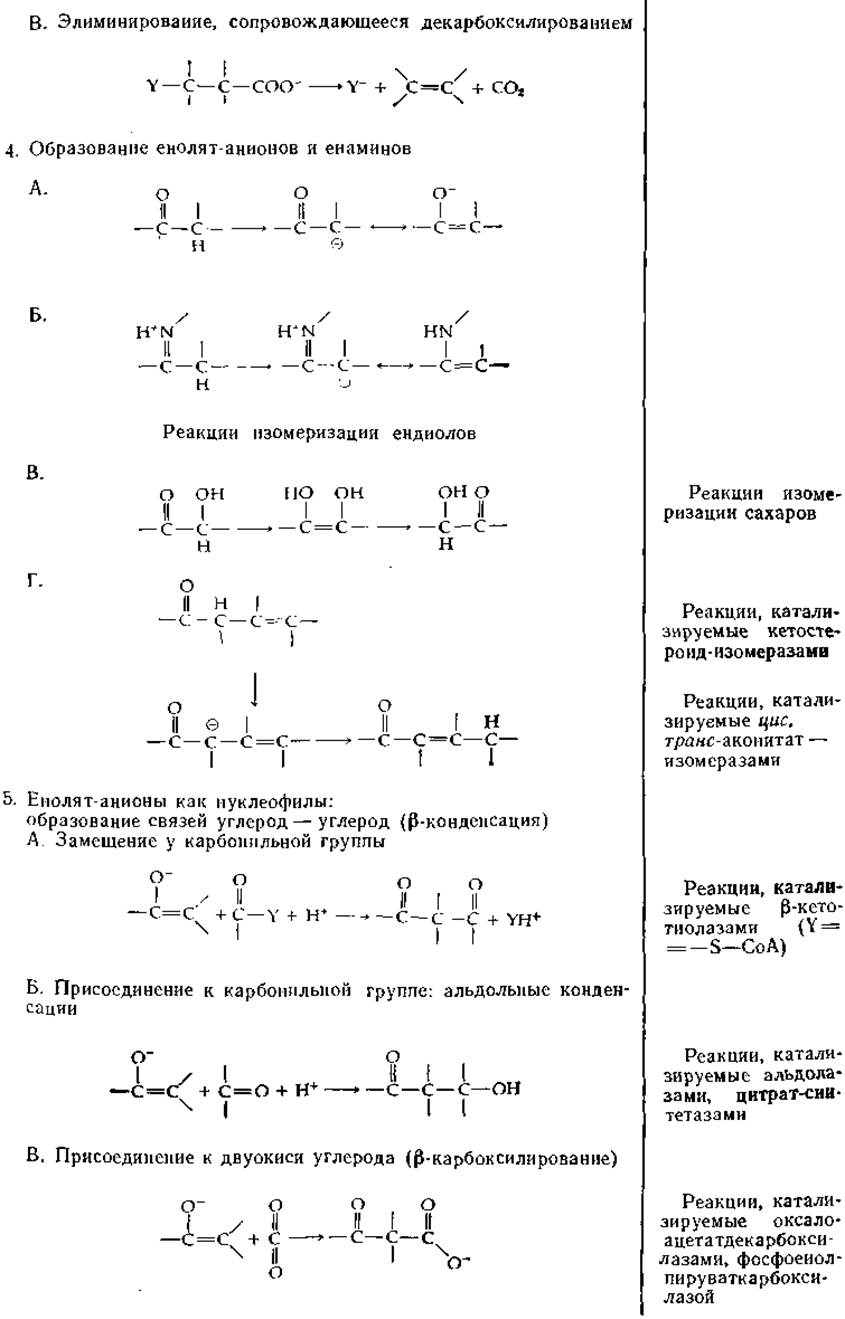
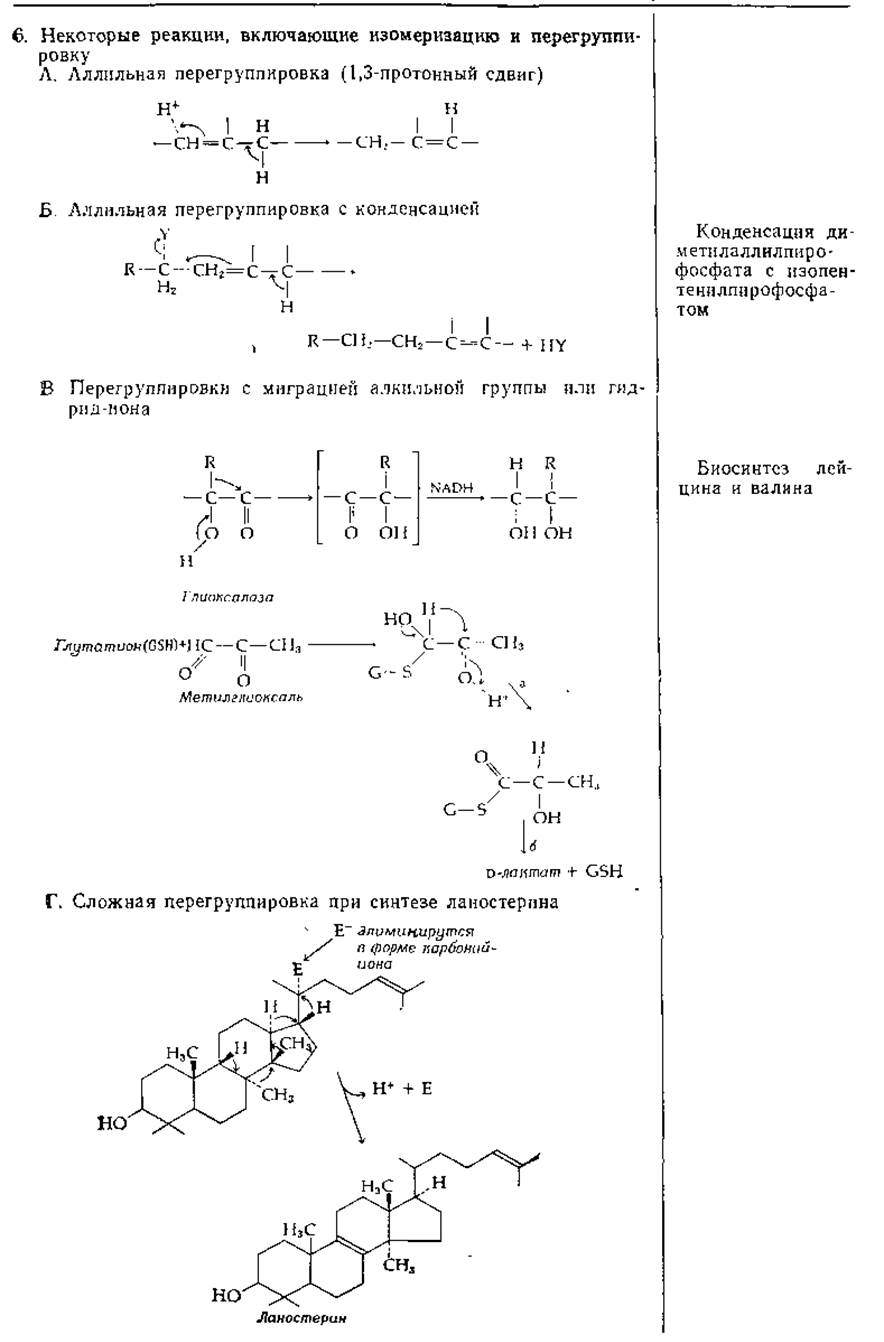
Two other groups of reactions involve The formation of enolate anions or related intermediates. These include 4) isomerization reactions and 5) a large and important group of reactions in which carbon–carbon bonds are formed or cleaved. Finally, There is a group of 6) isomerization and rearrangement reactions that do not fit neatly into any of the categories listed above.
Biochemical Reactions of the first type (substitution reactions) encompass all hydrolytic reactions by which Biopolymers are cleaved into monomers, as well as most reactions leading to the Condensation of these monomers to form polymers. Many addition reactions serve to introduce oxygen, nitrogen, and sulfur atoms into biochemical compounds, whereas elimination reactions frequently drive biosynthetic pathways. In many cases, complex enzymatic processes consist of a combination of multiple steps involving substitution, addition, or elimination. Reactions Involving the formation or cleavage of C—C bonds are essential for the Biosynthesis AND DEGRADATION of various carbon skeletons found in Biomolecules, while isomerization reactions link Other types of reactions together in the formation of metabolic pathways.
The remainder of this chapter is devoted to discussing the reaction types of individual enzymes and the corresponding experimental evidence. Although I hope that all the material presented in this chapter will be of interest, readers may choose the order in which to study specific sections at their own discretion. For instance, after reviewing Table 7-1, the reader may turn directly to Chapter 8 for a Brief Overview of coenzyme Functions, and then proceed to the chapters covering METABOLISM. These chapters contain cross-References that direct the reader back to Chapters 7 and 8 for discussions of individual enzymes.
However, readers who are relatively unfamiliar with enzymology may wish to first read at least the sections on Chymotrypsin (Section D,1), carboxypeptidase (Section D,4), Ribonuclease (Section D,2), multiple substitution reactions (Section E), Imines (Section G,3), C—C bond addition reactions (Section G,5), and $\beta$-elimination and condensation reactions (Section K).
Last update: 06/08/2026
Editorial and Educational Adaptation: This material has been compiled based on the primary/original source text. The project team performed an editorial review, corrected technical inaccuracies, structured sections, and adapted the content for an educational format.
What was processed:
- elimination of formatting defects (OCR errors, structural breaks, corrupted characters);
- editorial organization of content;
- standardization of terminology in accordance with academic sources;
- verification of factual statements against the original source text.
All mentions of the author, publication year, and origin of the primary text have been preserved in accordance with the source.