Biochemistry: The Chemical Reactions of Living Cells, Volume 2 - D. Metzler 1980
Coenzymes: specific natural specialized reagents
Coenzyme forms of vitamin B12
Enzymatic functions of B12 coenzymes
There are two types of reactions that require alkylcorrinoide Coenzymes. The first type depends on 5'-deoxyadenosylcobalamin and can be formally represented as follows:
Class="center">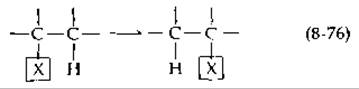
A certain group X, which may be attached by a C—C, C—O, or C—N bond, is transferred to an adjacent carbon atom bearing a hydrogen atom. At the same time, this hydrogen atom migrates to the carbon to which group X was originally bound. In only one case (for the enzyme Ribonucleotide reductase, Table 8-6) does the hydrogen transfer proceed intermolecularly. The second group of reactions involves The transfer of methyl groups mediated by methylcobalamin and several related reactions [163].
Convincing evidence has now been obtained that in the first-type reactions, hydrogen is transferred via the B12 coenzyme. In none of the cases, with the exception of ribonucleotide reductase, does any exchange with the medium occur. Since X can be an electronegative group, such as an OH group, these reactions can generally be formally viewed as a hydride ion transfer. However, it is more likely that they proceed via homolytic Cleavage with The intermediate formation of radicals.
Abeles and coworkers demonstrated that during catalysis by diol dehydratase (Table 8-6) of The conversion of 1,2-[1-3H]-propanediol to propionaldehyde, tritium appears in both the coenzyme and the final product. When the 3H-labeled coenzyme is incubated with unlabeled propanediol, the product also contains 3H. Chemical degradation of the labeled coenzyme showed that all radioactivity is localized at the C-5' atom. Furthermore, if a synthetically prepared 5'-deoxyadenosyl coenzyme containing 3H at the 5'-position is used, it likewise transfers 3H to the product. Most importantly, when a mixture of propanediol and Ethylene glycol is used, the intramolecular transfer is negligible, meaning that 3H is transferred to acetaldehyde, the dehydration product of ethylene glycol.
Another important experiment [171] showed that 18O from 2-18O-propanediol is transferred to position 1 without exchange with the solvent. In addition, 18O from 5-1-18O-propanediol is retained in the product, whereas in the case of the R-isomer, it is not retained.
Thus, it is evident that the enzyme stereospecifically dehydrates the terminal intermediate. Based on these and other experiments, a partial mechanism was proposed, as shown in equation (8-77).
In step a, the asterisks-labeled hydrogen is transferred to the coenzyme with Cleavage of the cobalt-5'-deoxyadenosyl bond. The 5'-deoxyadenosine now contains the hydrogen atom of the substrate, and this hydrogen becomes equivalent to the other two hydrogen atoms of the coenzyme. The Nature of the substrate derivative formed during this hydrogen transfer has not been definitively established; however, there is reason to believe that the abstracted hydrogen is replaced by cobalt. This substrate-cobalamin compound must then undergo an isomerization reaction, which in the case of diol dehydratase leads to the intramolecular transfer of the OH group [step b in equation (8-77)]. In step c, the hydrogen atom is transferred back from 5'-deoxyadenosine to a new position in the product, and in step d, the resulting gem-diol is dehydrated to yield the aldehyde product.

According to equation (8-77), 5'-deoxyadenosine is released from its bond with cobalt during the enzymatic process. Why does deoxyadenosine not dissociate completely from the coenzyme, which would lead to its inactivation? Substrate-induced inactivation is not typically characteristic of B12 coenzyme-dependent reactions, but it has been detected in certain Enzymes when pseudosubstrates are used. For example, glycolaldehyde causes the Conversion of the diol dehydratase coenzyme into 5'-deoxyadenosine; a similar picture is observed in the case of ethanolamine deaminase in the presence of ethylene glycol. If the 5'-deoxyadenosine in the normal diol dehydratase coenzyme is replaced by 5'-deoxyinosine (Chapter 2, Section D, 1), the latter is quantitatively released upon the action of the substrate. This apparently indicates that in the normal holoenzyme, the protein can retain the adenine group of 5'-deoxyadenosine via hydrogen bonding with the amino group. Since the OH group of inosine tautomerizes to C = O, inosine cannot be held as tightly.
Evidence supporting the notion that the MECHANISM OF ACTION of ethanolamine-ammonia-lyase is analogous to that presented in equation (8-77) is the transfer of 3H from 5'-3H-deoxyadenosylcobalamin to both the L-2-aminopropanol substrate and the reaction product with kinetically measurable rates [172, 173]. The fact that 2H is transferred from position 1 of deuterated 2-aminopropanol to the methyl group of 5,5-di-2H-adenosylcobalamin, yielding 5'-deoxyadenosine containing a C2H3 group, serves as further evidence supporting this mechanism [173a].
Despite the existing evidence, the hypothesis that 5'-deoxyadenosine is an intermediate in vitamin B12-dependent isomerization reactions is met with some skepticism. It is hard to believe that a methyl group could exchange its hydrogen atoms so rapidly. Protonation of the ribose ring oxygen, according to equation (8-75), could facilitate the dissociation of a hydrogen atom. However, when the ring oxygen is replaced by a CH2 group in a synthetic analogue, coenzyme activity is not lost [163]. Another possibility is that the methyl group acquires unusual reactivity upon the reduction of cobalt to Co(II) (see the following section).
Last update: 06/08/2026
Editorial and Educational Adaptation: This material has been compiled based on the primary/original source text. The project team performed an editorial review, corrected technical inaccuracies, structured sections, and adapted the content for an educational format.
What was processed:
- elimination of formatting defects (OCR errors, structural breaks, corrupted characters);
- editorial organization of content;
- standardization of terminology in accordance with academic sources;
- verification of factual statements against the original source text.
All mentions of the author, publication year, and origin of the primary text have been preserved in accordance with the source.