Biochemistry - Chemical Reactions in Living Cells, Volume 1 - D. Metzler 1980
The Molecules We Are Made Of
How We Study Molecular Structure
Product Analysis
Virtually in any biochemical research, it is crucial to be able to detect and accurately quantify minute amounts of specific compounds. This is most commonly achieved using special Reagents known as indicators, which change color in a characteristic way upon interacting with target compounds. For example, to detect trace amounts of Amino Acids or Peptides on a chromatogram (down to fractions of a micromole), the chromatogram is sprayed with ninhydrin (Box 8-E). If the compound in question is in solution, its concentration can be determined from the color intensity. Phenols and concentrated sulfuric acid react with sugars—either in solution or on chromatographic paper—to produce a red color, a reaction that forms The basis of colorimetric carbohydrate analysis. Reducing sugars are typically detected on chromatograms by spraying with a silver nitrate solution.
NUCLEOTIDES, like many other light-absorbing compounds, are quantified using their absorption spectra (Figs. 13-11 and 13-12) [146]. An even more sensitive approach is fluorescence assay. For instance, this method can detect as little as 3 picomoles (1 ng) of riboflavin on a thin-layer chromatogram (Fig. 2-34) [147]. One of the newer reagents, fluorescamine, reacts with any primary amine to yield highly fluorescent products, enabling the detection of extremely small quantities of amino acids—less than 50 picomoles (Fig. 2-36) [148].
Class="center">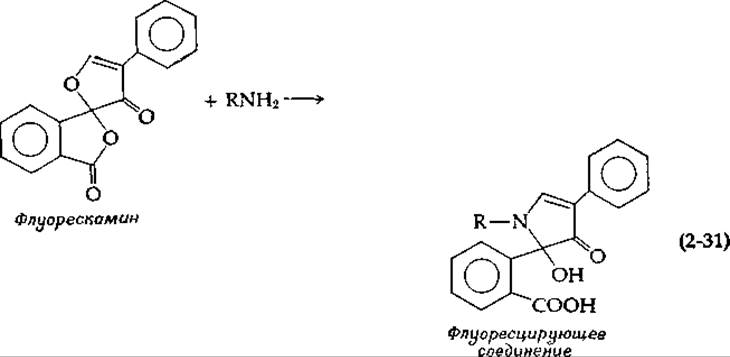
Methods for detecting volatile compounds using gas Chromatography are exceptionally sensitive. By employing flame ionization detectors, it is possible to quantify virtually any compound present in amounts as small as a few picomoles. Needless to say, The Development of even more sensitive analytical techniques is of paramount importance. The application of the most sensitive among them, such as mass spectrometry, now makes it possible in certain cases to detect substances present in quantities of just a few femtomoles! Analyzing neurotransmitter release from single Brain Neurons can be pivotal for understanding neural function, just as analyzing the contents of individual Cells can shed light on many fundamental questions in the biochemistry of higher organisms.
A particularly valuable variation of standard thin-layer or paper chromatography is diagonal chromatography. The sample is first chromatographed in one direction, followed by a specific chemical reaction carried out directly on the thin-layer plate or paper, after which a second-dimension Separation is performed at a right angle. Unmodified compounds lie along a diagonal across the plate, whereas the products of the chemical modification are displaced off-diagonal. This technique has been used to study the photochemical [149] and other [150] reactions of flavins. A similar diagonal Electrophoresis approach has been employed to identify pairs of —SH groups involved in protein Disulfide Bonds [150]. Peptide fragments containing S—S bridges were separated by paper electrophoresis, exposed to performic acid vapors to cleave the bridges [equation (2-20)], and then subjected to electrophoresis in the perpendicular direction followed by ninhydrin staining. Spots located off the diagonal corresponded to fragments originally linked by S—S bridges. The positions of these spots allowed researchers to identify specific pairs of peptides, which were subsequently correlated with fragments characterized during standard sequencing Procedures performed on the performic acid-oxidized protein.
Last update: 06/08/2026
Editorial and Educational Adaptation: This material has been compiled based on the primary/original source text. The project team performed an editorial review, corrected technical inaccuracies, structured sections, and adapted the content for an educational format.
What was processed:
- elimination of formatting defects (OCR errors, structural breaks, corrupted characters);
- editorial organization of content;
- standardization of terminology in accordance with academic sources;
- verification of factual statements against the original source text.
All mentions of the author, publication year, and origin of the primary text have been preserved in accordance with the source.