Biochemistry of Amino Acids - A. Meister 1961
Naturally Occurring Amino Acids
α-Keto Analogues of Amino Acids
α-Keto analogues of Amino Acids are of considerable biochemical interest as intermediates in amino acid Biosynthesis AND DEGRADATION pathways. Some of them also serve as intermediates in The Citric Acid Cycle, playing a crucial role as connecting links in the METABOLISM of fats, CARBOHYDRATES, and Three amino acids (glutamic acid, aspartic acid, and Alanine).
α-Keto acids are formed from their corresponding α-amino acids via enzymatic Oxidative Deamination (p. 182) and Transamination (p. 210). For Methods of Preparing α-keto acids, see the review by Meister [546]. Many α-keto acids have been obtained through chemical synthesis, whereas others have become accessible only through the application of enzymatic methods—specifically, oxidative deamination [547]. Table 9 lists numerous α-keto acids of biochemical interest.
α-Keto analogues of amino acids possessing more than one asymmetric carbon atom can exist in optically active forms. For instance, S-hydroxylysine, Threonine, and isoleucine should each correspond to two optically active α-keto acids. To date, this has been confirmed by the preparative isolation of individual isomers only for the α-keto acid analogue of isoleucine.
Two α-keto-β-methylvaleric acids were prepared from the respective isoleucine isomers via enzymatic deamination and isolated as sodium salts [558]. When the second center of optical Asymmetry is the β-carbon atom, enolization of the α-keto acid leads to racemization. In the case of α-keto-β-methylvaleric acid isomers, this conversion occurs readily in alkaline solution:
Class="center">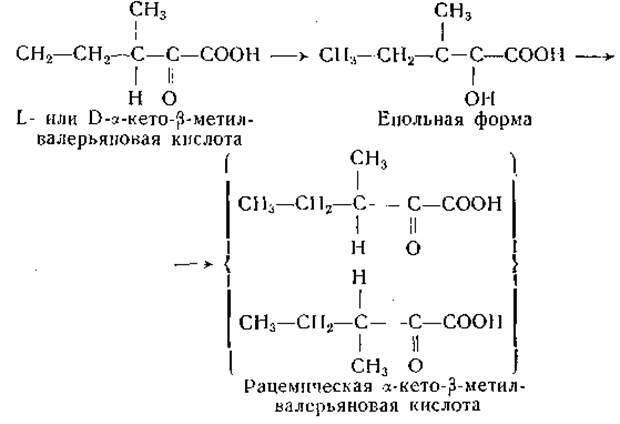
Evidence that such racemization (or enolization) does not occur rapidly under all conditions is provided by observations showing that the L-isomer of α-keto-β-methylvaleric acid (corresponding to L-isoleucine and allo-D-isoleucine) more effectively Supports the growth of young rats [559] and certain Bacteria [560] than does the optical antipode of this keto acid. Oxalosuccinic acid can theoretically exist in two optically active forms, but due to its susceptibility to enolization, the Separation of these isomers would likely be difficult. Meanwhile, the possibility remains that only one of the oxalosuccinic acid isomers is metabolically active. α-Keto acids capable of enolization can theoretically exist in cis- and trans-enol forms, which has been experimentally demonstrated in certain cases [561, 562].
While a great deal of research has been devoted to the isolation and identification of amino acids, relatively little attention has been paid to their keto acid analogues. Pyruvic, oxaloacetic, and a-ketoglutaric acids have been found in the Tissues of many animals and plants; furthermore, evidence indicates the presence of glyoxylic [563], a-ketoisovaleric [564], a-keto-y-methylglutaric [565], a-ketopimelic [566], a-ketoadipic [566], ß-hydroxypyruvic [566], and a-keto-y-hydroxybutyric acids in biological specimens [566].
The identification of a-keto acids in biological material is fraught with difficulty due to the instability of many of these compounds. Good results are obtained by separating a-keto acid hydrazones using chromatographic methods. However, the 2,4-dinitrophenylhydrazone of an a-keto acid often produces two spots on chromatograms, which apparently correspond to the syn- and anti-forms of the hydrazone:

When these spots are eluted and re-chromatographed, each substance frequently yields two spots again (corresponding to the original ones). Hydrogenation of either eluate leads to The formation of the exact same amino acid.
Hydrogenation of a-keto acid hydrazones typically yields the corresponding amino acids [556, 563, 567], which can be identified chromatographically. This method is of great value for identifying a-keto acids present in biological material. It must be borne in mind, however, that the 2,4-dinitrophenylhydrazones of certain a-keto acids yield more than one amino acid upon hydrogenation (see Table 9). Melting points are also useful for identifying a-keto acid 2,4-dinitrophenylhydrazones; nevertheless, in some cases (e.g., the 2,4-dinitrophenylhydrazone of phenylpyruvic acid), the melting point depends on the solvent used for crystallization [554].
Quantitative determination of a-keto acids can be carried out via decarboxylation using cerium sulfate [568, 569] or hydrogen peroxide [570]. Other methods useful for keto acid identification include preparing bisulfite derivatives, studying infrared and ultraviolet absorption spectra, and non-enzymatic transamination yielding the corresponding a-amino acids. Some a-keto acids, such as a-keto-y-methylthiobutyric acid, give the same characteristic color reactions as their amino acid analogues. A number of a-keto acid assay methods are based on Reactions of the carbonyl group.
Enzymatic and microbiological methods can be employed for the detection and quantitative determination of certain a-keto acids. Many a-keto acids are reduced by the action of Lactate dehydrogenase, with at least six of them (ß-mercaptopyruvic acid, a-ketobutyric acid, a-keto-ß-hydroxybutyric acid, ß-hydroxypyruvic acid, pyruvic acid, and glyoxylic acid) being reduced at approximately the same rate. Yeast a-keto acid decarboxylase also exhibits a broad substrate Specificity (see Table 9).
Last update: 06/08/2026
Editorial and Educational Adaptation: This material has been compiled based on the primary/original source text. The project team performed an editorial review, corrected technical inaccuracies, structured sections, and adapted the content for an educational format.
What was processed:
- elimination of formatting defects (OCR errors, structural breaks, corrupted characters);
- editorial organization of content;
- standardization of terminology in accordance with academic sources;
- verification of factual statements against the original source text.
All mentions of the author, publication year, and origin of the primary text have been preserved in accordance with the source.