Biochemistry of Amino Acids - A. Meister 1961
Naturally Occurring Amino Acids
Peptides and Related Compounds
Antibiotics
Peptide bonds and Amino Acids have been discovered in the molecules of numerous Antibiotics, which has spurred the intensive development of peptide chemistry in recent years [420].
As mentioned above, certain antibiotics contain D-amino acid residues; in addition, several novel amino acids have been identified within their composition. Penicillins contain D-penicillamine, which can be viewed as a derivative of D-valine or D-Cysteine [374, 421].
Class="center">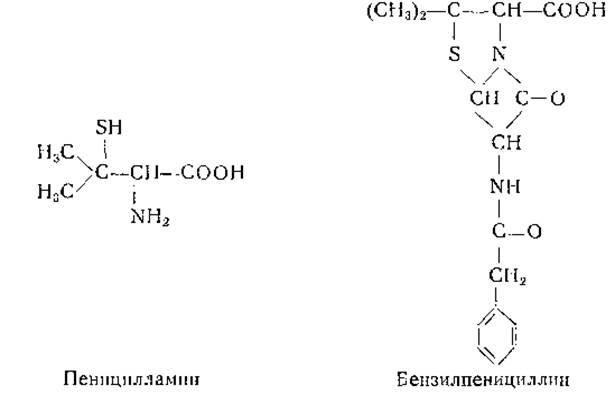
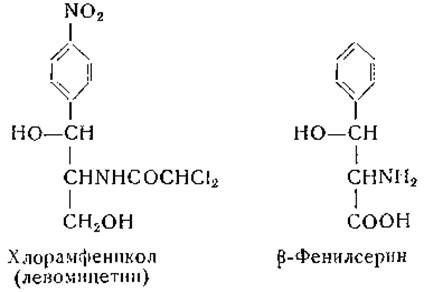
Chloramphenicol (levomycetin), a structural analogue of phenylalanine, is stereochemically a derivative of D-threo-β-phenylserine [422]:
Bacillus subtilis produces two Peptides with antibiotic activity: subtilin and bacitracin. Subtilin is composed of Glycine, Alanine, valine, leucine, isoleucine, Proline, phenylalanine, Tyrosine, Lysine, aspartic and glutamic acids, mesolanthionine, and “methyl-lanthionine” (p. 53) [423]. Bacitracin preparations consist of several components; upon acid Hydrolysis, one of them breaks down to yield cystine, Ornithine, lysine, phenylalanine, aspartic acid, isoleucine, leucine, and glutamic acid [424].
The tyrocidine and gramicidin groups of antibiotics are cyclic peptides containing D-amino acid residues. For purified tyrocidin A, the following empirical formula has been established: (D-phenylalanine) 2, L-phenylalanine, L-valine, L-tyrosine, L-leucine, L-proline, L-ornithine, L-glutamine, L-asparagine [365, 375, 376, 378, 425]. Much attention has been focused on the polymyxin group, which also includes aerosporin and circulin. These antibiotics contain L-α,γ-diaminobutyric acid; D-Serine and D-leucine have also been detected in their hydrolysis products [426]. The hydrolysis products of antibiotics belonging to the actinomycin group were found to contain N-methylvaline, Sarcosine, allo-D-isoleucine (p. 68), and D-valine [382, 383]. Among the hydrolysis products of the antibiotic cephalosporin N, D-δ-amino-δ-carboxyvalerylglycine [369, 370]—a derivative of the δ-amide of D-α-aminoadipic acid [45, 357]—was discovered. The isolated compound

δ-Amino-δ-carboxyvalerylglycine
can be regarded as a higher homologue of γ-D-glutamylglycine. Using chromatographic analysis, γ-glutamylalanine was detected in pea seedlings [427].
Last update: 06/08/2026
Editorial and Educational Adaptation: This material has been compiled based on the primary/original source text. The project team performed an editorial review, corrected technical inaccuracies, structured sections, and adapted the content for an educational format.
What was processed:
- elimination of formatting defects (OCR errors, structural breaks, corrupted characters);
- editorial organization of content;
- standardization of terminology in accordance with academic sources;
- verification of factual statements against the original source text.
All mentions of the author, publication year, and origin of the primary text have been preserved in accordance with the source.