Biochemistry of Amino Acids - A. Majster 1961
Naturally Occurring Amino Acids
Introductory Remarks
Amino Acids are chemical compounds containing both amine and carboxyl groups. The molecules of most Naturally Occurring Amino Acids share a common Structure
Class="center">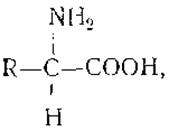
in which the amino group is located in the α-position relative to the carboxyl group. Exceptions to this rule include amino acids with more than one carboxyl or amine group, those containing amino groups associated with Other types of acidic groups, and amino acids whose Amino groups are not bound to the α-carbon atom. The majority of amino acids possess at least one asymmetric carbon atom, allowing them to exist in at least two optically active forms. Most naturally occurring Amino acids have the L-configuration, though A number of D-amino acids are also found in nature.
The Nomenclature of Amino acids has two notable features. First, biochemistry employs a number of trivial names for amino acids. Such terminology is simple and highly convenient; in this field, as in any other specialized scientific discipline, it is essential to be familiar with the accepted professional jargon. Second, it is desirable—and usually necessary—to indicate the optical configuration of The amino acid (when known) by using the capital letters D and L. If the configuration is unknown, the amino acid may be designated as d or l depending on the direction of its optical rotation in an aqueous solution.
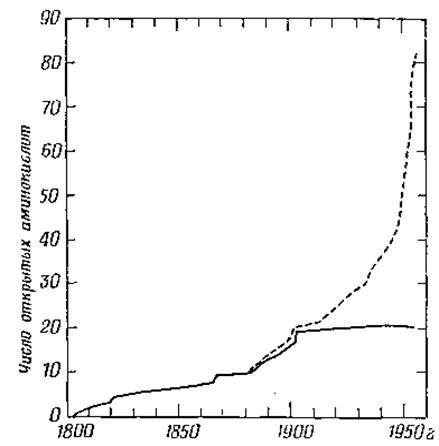
Fig. 1. Discovery of naturally occurring amino acids — Amino Acids Commonly Found in Proteins; - - - - - all amino acids.
Some confusion has existed regarding the designation of the optical configuration and the direction of rotation of amino acids; this topic is discussed in more detail below (p. 81).
This chapter is devoted to the naturally occurring amino acids. Among them, the first to be discovered were asparagine, found in 1806, and cystine, in 1810. Since that time, more than 80 amino acids have been discovered. The curve shown in Fig. 1 (dashed line) indicates that the greatest number of new Natural Amino Acids has been discovered over the past 10 years. At the same time, since 1935, when Threonine was discovered, no new amino acids entering into the composition of proteins have been found, as can be seen from the solid curve also shown in Fig. 1. The amino acids commonly found in protein hydrolysates are considered in the next section. Those amino acids that rarely occur in proteins, and those found in other types of compounds or in the free state, are discussed in the final sections of this chapter.
Last update: 06/08/2026
Editorial and Educational Adaptation: This material has been compiled based on the primary/original source text. The project team performed an editorial review, corrected technical inaccuracies, structured sections, and adapted the content for an educational format.
What was processed:
- elimination of formatting defects (OCR errors, structural breaks, corrupted characters);
- editorial organization of content;
- standardization of terminology in accordance with academic sources;
- verification of factual statements against the original source text.
All mentions of the author, publication year, and origin of the primary text have been preserved in accordance with the source.