Biochemistry of Amino Acids - A. Meister 1961
Intermediary Metabolism of Amino Acids
Threonine
Biosynthesis
Data on Threonine synthesis were obtained by studying metabolic processes in various microorganisms. The Study of a Neurospora crassa mutant requiring both Methionine and threonine for growth showed that homoserine can replace both of these Amino Acids [235]. This was the first indication that threonine could be synthesized from homoserine. It was found that homoserine and threonine accumulate in cultures of a Neurospora mutant that requires only methionine for growth [236]. When grown on media containing labeled acetate, Yeasts and Escherichia coli synthesize threonine and aspartic acid in which the isotope atoms are distributed identically [48, 64]. The results of isotope studies are also consistent with the hypothesis that homoserine is a precursor of threonine [117, 233]. Further advances in elucidating the threonine Biosynthesis pathways were achieved through the research of Cohen and co-workers [240–242] and Black [243–248]. It was found that Suspensions of an E. coli mutant requiring threonine for growth are able to convert aspartic acid into homoserine, whereas Cell suspensions of normal E. coli strains utilize homoserine for threonine synthesis [240, 241]. In The process of converting aspartic acid into threonine, Black discovered two new intermediates, namely ß-aspartyl phosphate and aspartic ß-semialdehyde. The intermediate reactions of this conversion were studied using purified enzyme preparations obtained from yeasts [243–248]. The conversion of L-aspartic acid to L-ß-aspartyl phosphate occurs in the presence of ATP, magnesium ions, and the enzyme ß-aspartokinase [246]:
Class="center">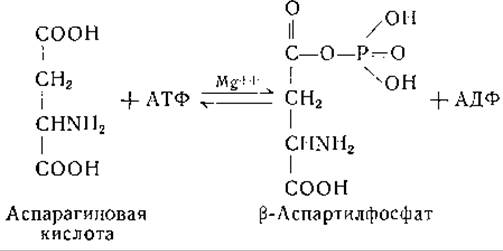
A specific enzyme acting in the presence of triphosphopyridine nucleotide (aspartic ß-semialdehyde dehydrogenase) reduces ß-aspartyl phosphate to the corresponding aldehyde acid [247]:

L-aspartic ß-semialdehyde is reduced by homoserine dehydrogenase (in the presence of diphosphopyridine nucleotide) to L-homoserine; this enzyme also exhibits some activity with triphosphopyridine nucleotide [248]:
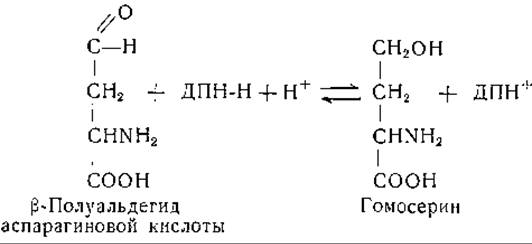
Cohen and co-workers [249] found that in The first phase of the conversion, ß-aspartyl coenzyme A serves as an intermediate; data obtained from studying E. coli mutants are consistent with the reaction sequence described above [250]. In E. coli, the conversion of homoserine to threonine requires the presence of ATP and Pyridoxal phosphate, and although both Cofactors are necessary for threonine formation, the presence of ATP alone is sufficient for the disappearance of homoserine. From this, it can be concluded that the process of converting homoserine to threonine proceeds via The formation of an intermediate compound1. In various Bacteria, threonine can partially replace the aspartic acid required for growth [251, 252]; this is explained by the aforementioned conversion of aspartic acid to threonine. The Role of threonine racemase in E. coli [253] (p. 245) is not yet clear.
Data have been obtained showing that the a-keto acid corresponding to threonine plays the role of a precursor for valine and isoleucine (p. 353). In Neurospora, isoleucine can also be synthesized from acetaldehyde and a-ketobutyric acid formed from threonine (p. 336). In this regard, it is of interest that an N. crassa mutant has been discovered which, when grown in the presence of threonine, accumulates a-keto-ß-methylvaleric acid, a-ketoisovaleric acid, pyruvic acid, and acetaldehyde in the medium [254].
Last update: 06/08/2026
Editorial and Educational Adaptation: This material has been compiled based on the primary/original source text. The project team performed an editorial review, corrected technical inaccuracies, structured sections, and adapted the content for an educational format.
What was processed:
- elimination of formatting defects (OCR errors, structural breaks, corrupted characters);
- editorial organization of content;
- standardization of terminology in accordance with academic sources;
- verification of factual statements against the original source text.
All mentions of the author, publication year, and origin of the primary text have been preserved in accordance with the source.