Principles of Biochemistry Volume 3 - A. Lehninger 1985
Molecular mechanisms of genetic information transfer
Protein synthesis and its regulation
Protein synthesis is inhibited by various antibiotics
A multitude of Antibiotics inhibit Protein Synthesis in a highly specific manner. This fact is of particular biological interest because antibiotics can be viewed as "chemical weapons" produced by certain species of microorganisms and highly toxic to other organisms. Antibiotics have become invaluable tools in The Study of protein synthesis, as virtually every step of this process is specifically inhibited by one antibiotic or another.
One of the most important inhibitory antibiotics is puromycin, synthesized by the mold Streptomyces alboniger. Structurally, puromycin bears a striking resemblance to the 3'-end of aminoacyl-tRNA (Fig. 29-21). Its MECHANISM OF ACTION involves terminating Polypeptide chain elongation by mimicking the incoming aminoacyl-tRNA, entering the ribosome, and forming peptidylpuromycin. Because no further Amino Acids can be added to peptidylpuromycin, it dissociates from the ribosome, thereby aborting polypeptide synthesis.
Class="center">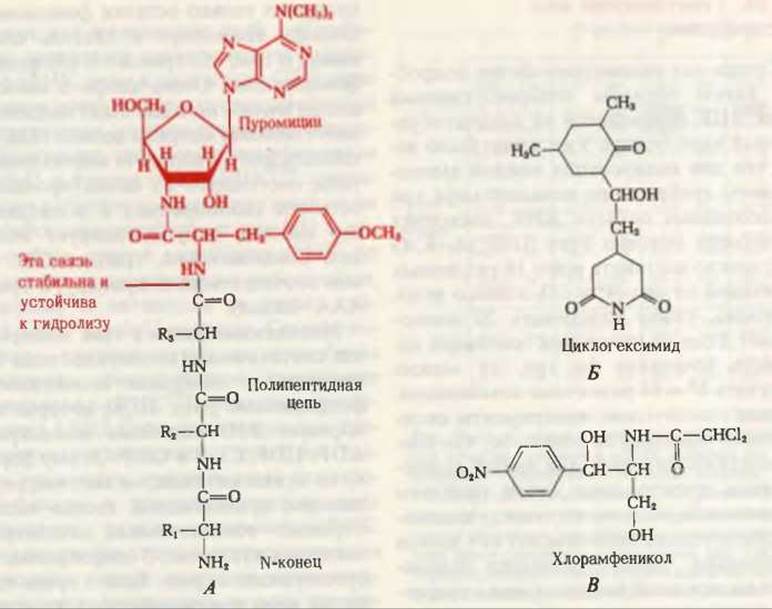
Fig. 29-21. Antibiotics as inhibitors of protein synthesis. A. Puromycin (its formula is highlighted in red), resembling the terminal aminoacyl adenylate moiety of aminoacyl-tRNA, reacts with the C-terminus of the growing peptidyl-tRNA to form a peptidylpuromycin complex. However, because the bond between puromycin and the peptide is resistant to enzymatic Cleavage, further elongation becomes impossible, and peptidylpuromycin dissociates from the ribosome. B. Cycloheximide inhibits protein synthesis by eukaryotic 80S Ribosomes but does not affect protein synthesis in prokaryotes or Cell/35.html">Mitochondria. C. Chloramphenicol inhibits protein synthesis by prokaryotic and mitochondrial ribosomes, but does not interfere with the function of eukaryotic 80S ribosomes.
Tetracyclines—another class of antibiotics—inhibit protein synthesis by blocking the A site of the ribosome, thereby preventing it from binding aminoacyl-tRNA. Chloramphenicol inhibits protein synthesis carried out by prokaryotic (and mitochondrial) ribosomes, but has no effect on extramitochondrial protein synthesis in eukaryotes. Cycloheximide, conversely, inhibits protein synthesis by eukaryotic 80S ribosomes without disrupting the function of prokaryotic or mitochondrial 70S ribosomes. Here we once again encounter the remarkable similarity between prokaryotes and mitochondria. Streptomycin induces mistranslation of METABOLISM/28.html">The Genetic Code, whereas tunicamycin prevents the attachment of oligosaccharide side chains to certain Glycoproteins.
Other Protein Synthesis Inhibitors include diphtheria toxin, which inactivates an elongation factor, and ricin, an extremely toxic protein from the castor bean plant (Ricinus communis) that inactivates the 60S subunit of eukaryotic ribosomes.
Last update: 06/08/2026
Editorial and Educational Adaptation: This material has been compiled based on the primary/original source text. The project team performed an editorial review, corrected technical inaccuracies, structured sections, and adapted the content for an educational format.
What was processed:
- elimination of formatting defects (OCR errors, structural breaks, corrupted characters);
- editorial organization of content;
- standardization of terminology in accordance with academic sources;
- verification of factual statements against the original source text.
All mentions of the author, publication year, and origin of the primary text have been preserved in accordance with the source.