Biochemistry, Vol. 1 - A. Lehninger 1985
Biomolecules
Water
Chemical reactions characteristic of amino acids
The ability of Amino Acids, like all other Organic compounds, to participate in Chemical Reactions is determined by the presence of functional groups within their Structure (see Chapter 3). Since all amino acids contain both an amino group and a carboxyl group, each can undergo the Chemical reactions characteristic of these groups. For instance, amino groups can be acetylated and carboxyl groups esterified. We will not examine all the organic chemical reactions in which Amino acids can participate, but will highlight two key reactions widely used for the detection, identification, and quantitative analysis of amino acids.
The first of these is the ninhydrin reaction (Fig. 5-16), used to detect and accurately quantify small amounts of amino acids. When Amino acids are heated with an excess of ninhydrin, a purple-colored product is formed if The amino acid contains a free α-amino group, and a yellow product if, as in the case of Proline, the α-amino group is substituted. Under properly optimized conditions, the color intensity can be employed for the Colorimetric determination of amino acid concentrations, as this method possesses exceptionally high sensitivity.
Class="center">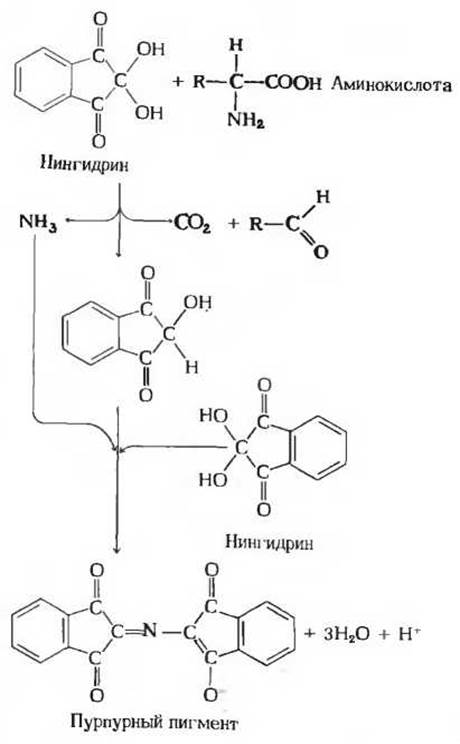
Fig. 5-16. The ninhydrin reaction, used for the detection and Quantitative determination of α-amino acid content. The atoms of the amino acid are highlighted in red to track their fate during the course of the reaction.
Ultimately, the purple pigment incorporates two ninhydrin molecules and the nitrogen atom from the amino acid.
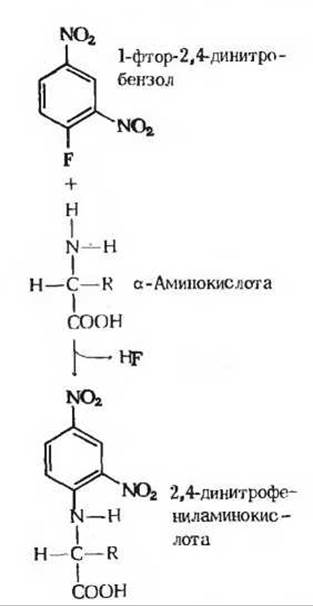
Fig. 5-17. Formation of 2,4-dinitrophenyl derivatives of amino acids.
The second important reaction of amino acids is their interaction with 1-fluoro-2,4-dinitrobenzene (FDNB). In a mildly alkaline solution, FDNB reacts with α-amino acids to yield 2,4-dinitrophenyl derivatives (Fig. 5-17), which can be utilized to identify individual amino acids. Later, we will see how crucial this reaction is for determining the Amino Acid Sequence of Peptides.
Last update: 06/08/2026
Editorial and Educational Adaptation: This material has been compiled based on the primary/original source text. The project team performed an editorial review, corrected technical inaccuracies, structured sections, and adapted the content for an educational format.
What was processed:
- elimination of formatting defects (OCR errors, structural breaks, corrupted characters);
- editorial organization of content;
- standardization of terminology in accordance with academic sources;
- verification of factual statements against the original source text.
All mentions of the author, publication year, and origin of the primary text have been preserved in accordance with the source.