Principles of Biochemistry Volume 1 - A. Lehninger 1985
Biomolecules
Cells
Lysosomes - containers with hydrolytic enzymes
Lysosomes are membrane-bound spherical vesicles found in the Cell Cytoplasm (Fig. 2-14). Their size varies, but they typically do not exceed the size of Mitochondria. Lysosomes contain a variety of Enzymes capable of digesting—that is, breaking down via Hydrolysis—cellular Proteins, Polysaccharides, and Lipids that are no longer needed. Because these enzymes could also destroy the rest of The Cell's contents, they are safely enclosed within the lysosomes. Proteins and other components destined for degradation are selectively transported into the lysosomes, where they undergo hydrolytic Cleavage into their simplest building blocks, which are then recycled back into the cytoplasm. Individuals with the inherited Tay-Sachs disease lack certain lipid-hydrolyzing enzymes in their lysosomes, causing some of these compounds to accumulate in the Brain and other Tissues, leading to mental retardation.
Class="center">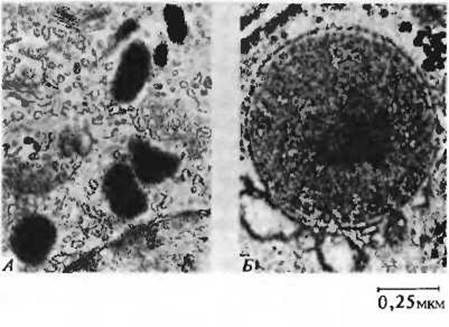
Fig. 2-14. Lysosomes and Peroxisomes are enzyme "sacs". A. A portion of an adrenal cortex cell. The dark, irregularly shaped oval bodies are lysosomes. They are smaller than mitochondria. Lysosomes contain over 40 hydrolytic enzymes; additionally, folds of "excess" membrane containing cellular proteins and other components are sometimes found within them. B. Peroxisome. The crystalline core consists of urate oxidase, one of several peroxide-producing enzymes found in peroxisomes.
Last update: 06/08/2026
Editorial and Educational Adaptation: This material has been compiled based on the primary/original source text. The project team performed an editorial review, corrected technical inaccuracies, structured sections, and adapted the content for an educational format.
What was processed:
- elimination of formatting defects (OCR errors, structural breaks, corrupted characters);
- editorial organization of content;
- standardization of terminology in accordance with academic sources;
- verification of factual statements against the original source text.
All mentions of the author, publication year, and origin of the primary text have been preserved in accordance with the source.