Principles of Biochemistry Volume 1 - A. Lehninger 1985
Biomolecules
Vitamins and Trace Elements: Their Role in Enzyme Function
Thiamine (vitamin B1) functions in the form of thiamine pyrophosphate
Vitamin B1, or thiamine, is an essential dietary component for most vertebrates and certain microorganisms. A deficiency of this vitamin in the human diet causes beriberi, a disease characterized by rapid weight loss and various neurological disorders. In Asia during the 19th and early 20th centuries, beriberi claimed the lives of hundreds of thousands of people whose diet consisted primarily of polished or milled white rice. The bran removed during the milling process contains nearly all the thiamine present in rice. Thiamine was first isolated in pure form in 1926. Its chemical Structure was elucidated in the early 1930s by the American scientist Robert R. Williams, and the Chemical synthesis of thiamine was achieved shortly thereafter.
Class="center">Table 10-1. Vitamins AND THEIR Role in Enzymatic Reactions
|
Vitamin |
Coenzyme (or active) form |
Type of catalyzed reaction or function |
|
Water-soluble |
||
|
Thiamine |
Thiamine pyrophosphate |
Decarboxylation of a-keto acids |
|
Riboflavin |
Flavin mononucleotide, flavin adenine dinucleotide |
Oxidation-reduction reactions |
|
Nicotinic acid |
Nicotinamide adenine dinucleotide, nicotinamide adenine dinucleotide phosphate |
Oxidation-reduction reactions |
|
Pantothenic acid |
Coenzyme A |
Transfer of acyl groups |
|
Pyridoxine |
Transfer of amino groups |
|
|
Biotin |
Biocytin |
Transfer of СО2 |
|
Tetrahydrofolic acid |
Transfer of single-carbon groups |
|
|
Vitamin B12 |
Deoxyadenosylcobalamin |
Transfer of a carbon-bonded hydrogen atom to an adjacent carbon atom |
|
Ascorbic acid |
Unknown |
Cofactor for hydroxylation reactions |
|
Fat-soluble |
||
|
Vitamin A |
Retinal |
Visual process |
|
Vitamin D |
1,25-dihydroxycholecalciferol |
Regulation of Ca2+ METABOLISM |
|
Vitamin E |
Unknown |
|
|
Vitamin K |
Unknown |
Cofactor for carboxylation reactions |
The thiamine molecule contains a bicyclic system composed of pyrimidine and thiazole rings (Fig. 10-2). In animal Tissues, thiamine is present primarily in the form of its cofactor, thiamine pyrophosphate (Fig. 10-2). Thiamine pyrophosphate serves as a cofactor in A number of Enzymatic reactions involving The transfer of aldehyde groups from a donor molecule to an acceptor molecule. In these reactions, thiamine pyrophosphate acts as an intermediate carrier of the aldehyde group, which is covalently bound to the thiazole ring. An example is the reaction catalyzed by Pyruvate decarboxylase (Fig. 10-3),
which represents a crucial stage in the Yeast-mediated Alcoholic Fermentation of glucose. During the pyruvate decarboxylase reaction, the carboxyl group of pyruvate is cleaved off as СО2; simultaneously, the remaining portion of the molecule, sometimes referred to as active acetaldehyde, is transferred to the C-2 position of the thiazole ring of enzyme-bound thiamine pyrophosphate, yielding a hydroxyethyl derivative. This intermediate exists only transiently because the hydroxyethyl group is rapidly cleaved from the coenzyme as free acetaldehyde. Thiamine pyrophosphate also Functions as a cofactor in more complex Reactions of the main carbohydrate oxidation pathway in Cells—specifically, those catalyzed by the pyruvate dehydrogenase and a-ketoglutarate dehydrogenase enzyme complexes.
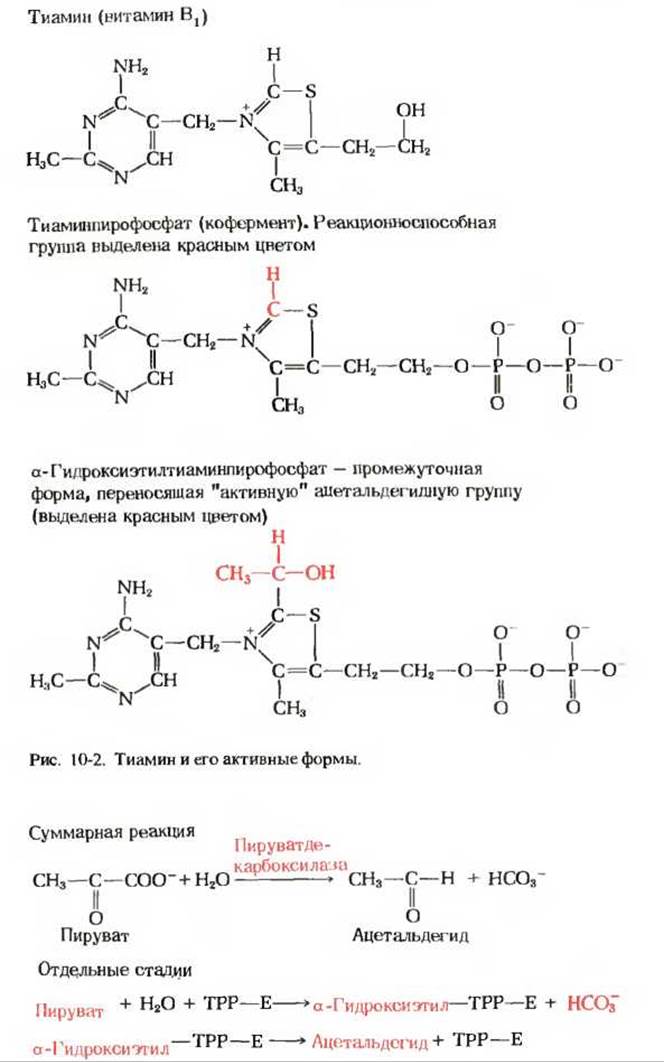
Fig. 10-3. Enzymatic decarboxylation of pyruvate by pyruvate decarboxylase (designated by the letter E). This process proceeds with the participation of thiamine pyrophosphate (TPP), which serves as a tightly bound prosthetic group of the enzyme. The top part of the figure shows the overall reaction equation. The bottom part breaks the reaction down into individual steps illustrating The Role of thiamine pyrophosphate as an intermediate acetaldehyde carrier.
Last update: 06/08/2026
Editorial and Educational Adaptation: This material has been compiled based on the primary/original source text. The project team performed an editorial review, corrected technical inaccuracies, structured sections, and adapted the content for an educational format.
What was processed:
- elimination of formatting defects (OCR errors, structural breaks, corrupted characters);
- editorial organization of content;
- standardization of terminology in accordance with academic sources;
- verification of factual statements against the original source text.
All mentions of the author, publication year, and origin of the primary text have been preserved in accordance with the source.